Spain

The bishop of Barbastro - Monzón reopens the debate on Torreciudad

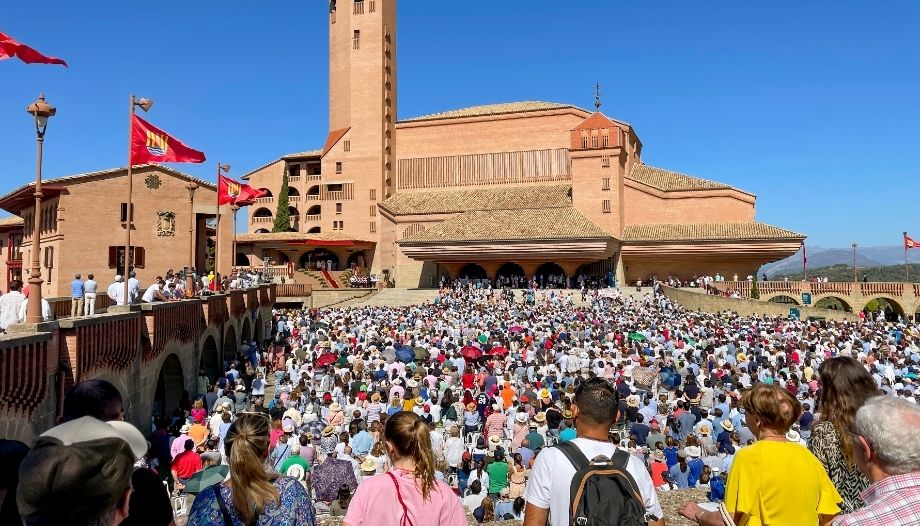
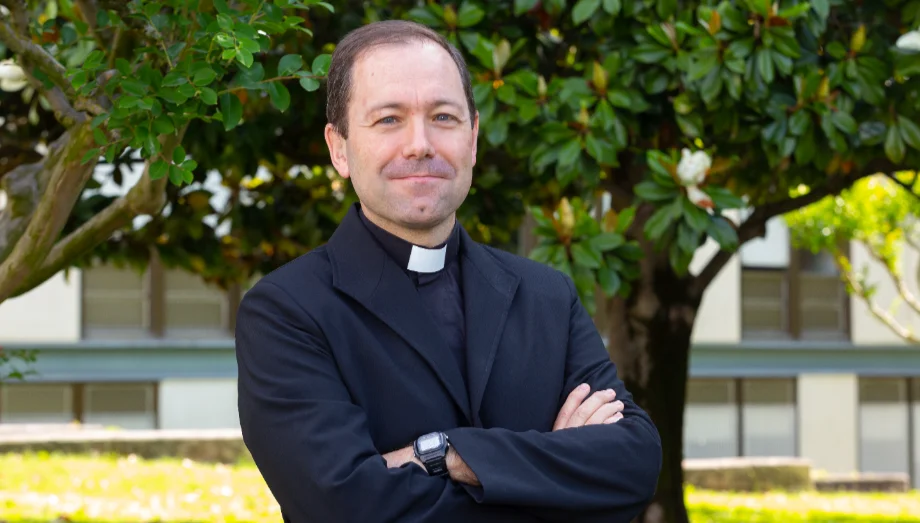
Within the framework of the local festivities of the Nativity of the Virgin, the bishop of Barbastro-Monzón, Ángel Pérez, dedicated his homily entirely to the situation of Torreciudad.

María José Atienza / Javier García Herrería-September 8, 2025-Reading time: 4 minutes

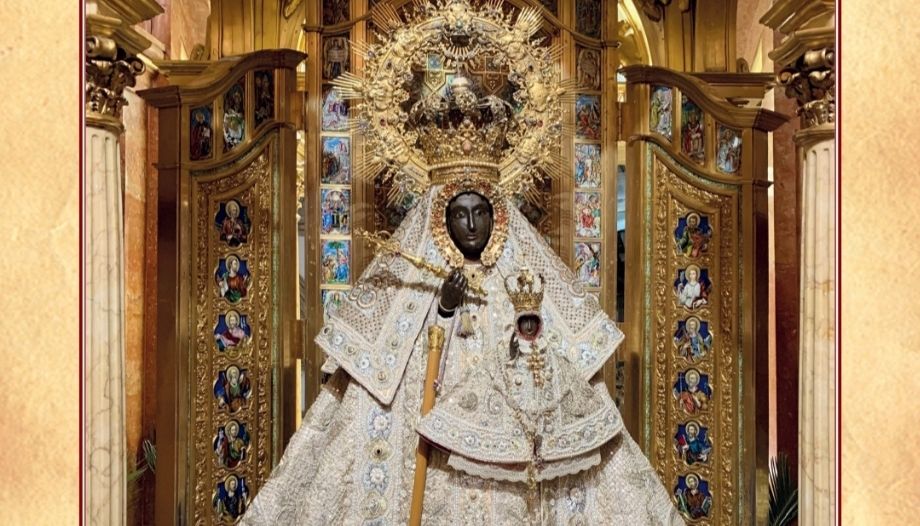
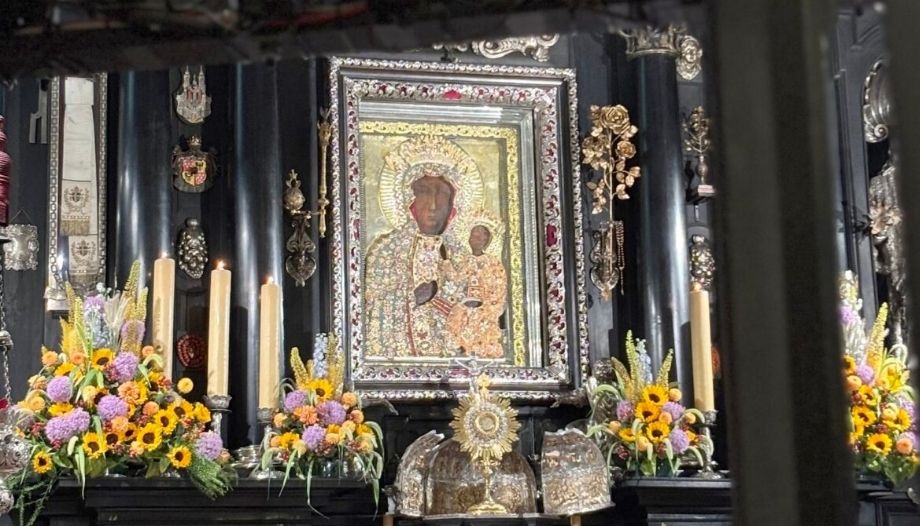
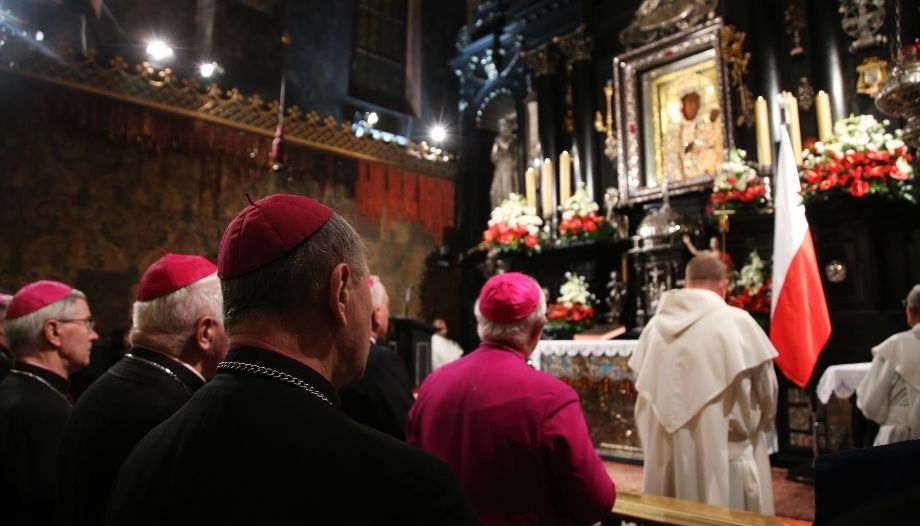
The new church of Torreciudad, which has celebrated its half-century in the past few weeks, is located in the center of the town of Torreciudad, from July 2023 in a complicated process due to the demand of the bishop of the diocese of Barbastrina, who asks for the return of the Virgin to the old hermitage, located a few meters from the new temple.

From that moment on, the Prelature and the bishopric have maintained discrepancies with respect to the validity of the contract that granted Opus Dei the cession (but not the ownership) in perpetuity of the image of Our Lady of the Angels. The Work defends the validity of this contract and, therefore, the public veneration of the image in the new church, as well as the management of the church and its dependencies and the right to present a list of three priests for the appointment of the rector. 

A process with ups and downs

The process of negotiations between the Diocese of Barbastro Monzón and Opus Dei has had various stages. 

In October 2024, Pope Francis appointed Bishop Alejandro Arellano Cedillo, as Pontifical Commissioner Plenipotentiary for Torreciudad with the objective that this canonist would be the one who, once all the parties had been heard, would decide the future of Torreciudad. At that time, both the Prelature of Opus Dei and Bishop Pérez Pueyo were in favor of abiding by the resolution dictated by the person appointed by the Pope for this purpose.

Since then, the Commissioner has been able to meet with representatives of the diocese and the Prelature as well as with Pope Francis and, later, Pope Leo XIV without the tenor of any of these conversations being made public.  

The last time the process had news was just over two months ago, by early July 2025The bishopric published a note in which it varied to a certain extent its initial demand, proposing that Torreciudad "be recognized and canonically erected as an International Shrine, under the direct dependence of the Holy See," and taking the image of our Lady to the wayside shrine. He also asked that the baptismal font in which St. Josemaría received this sacrament be returned to the cathedral. The font was replaced at the initiative of the Cathedral Chapter in the 1940s, due to its poor condition. The remains were left in the bed of the Vero River and in 1959, these few remains were offered to Opus Dei and transferred to Rome. 

Pope Francis' performance

Now, the diocesan bishop of Barbastro Monzón has once again put the spotlight on this delicate issue, whose final decision is in the hands of the Holy See. According to the bishop of Barbastro, Pope Francis supported his demands -in writing and by word of mouth- on at least four occasions, although until now the bishop had not spoken about any of them publicly:

The first time during the visit ad Limina of the Spanish bishops in December 2021. Already then the Argentine Pontiff expressed his desire that the Virgin of Torreciudad should be in the hermitage and not in the central nave of the new temple.

He also mentioned a personal letter handwritten in 2023, in which Francis wrote to him: "Angel, don't give up", referring to the fact that he would not give up in his determination to take the carving back to its original hermitage.

Thirdly, Perez Pueyo assured that, during a brief protocol greeting on September 18, 2024, during an audience in St. Peter's Square, Francis asked him: "Angel, did they bring Our Lady down yet".

Finally, a month later, in a handwritten letter dated October 13, 2024,the prelate states that Francis wrote to him again warning him "to beware of the 'mafia intrigues that are ongoing' around this matter."

The letters have not been published, but Bishop Pérez Pueyo says he is willing to make them public, if necessary.

Willing to "give his life as Eleazar".

Taking as a reference the biblical figure of Eleazar, who gave his life for refusing to eat meat forbidden by the Jewish Law, the bishop of the Aragonese diocese has emphasized that "if I were forced, as a pastor I would repeat the same words of the old man Eleazar, in the face of the pressures to accept what I cannot accept: That I cannot do so 'without attracting stain and dishonor to my old age' that could serve as a bad example to my parishioners", referring to a possible decision of the Holy See that would not contemplate the main demands of the bishop. 

The agreement regarding Torreciudad has not been made known at the time of going to press, while the Prelature of Opus Dei has always pointed to the need to await the decision of the Plenipotentiary Commissioner.

Key dates

July 17, 2023: The bishop of Barbastro-Monzón unilaterally appoints the parish priest of Bolturina-Ubiergo, José Mairal, as rector of the Torreciudad Sanctuary and maintains that the canonical situation of Torreciudad is irregular, so that the contract of cession of the Virgan and the hermitage are not valid. 

March 1, 2024. Opus Dei publishes the documentation on the agreements and contracts between the bishopric of Barbastro-Monzon and the prelature, which explains in detail the agreement of cession of the image and the hermitage, the construction of the new temple.

October 9, 2024. Pope Francis appoints Bishop Alejandro Arellano as Pontifical Commissioner to resolve the issues in dispute over Torreciudad.

July 1, 2025. The diocese of Barbastro-Monzon asks for the return of the Virgin of Torreciudad to the hermitage and claims the baptismal font of the cathedral of Barbastro, which is located in the headquarters of the prelature. It also asks that Torreciudad be erected as an International Shrine and that Opus Dei designate the rector of the shrine. 

Since there had been much speculation over the last two years as to whether the prelature should pay a heavy economic fee to the diocese for the use of the image, the diocese requests that Torreciudad be financially independent. 

September 8, 2025. The bishop of Barbastro Monzón denounces in a homily the pressures and difficulties he is having for the image of Torreciudad to return to the original hermitage.

The authorMaría José Atienza / Javier García Herrería

Evangelization

Carlo and the call to evangelize in the digital age

Even the most devout Catholic may miss daily Mass, but almost everyone is connected to social networks every day. Whether out of habit or addiction, scrolling through networks is one of the most common human behaviors of our time. And we have the opportunity - and the responsibility - to place Jesus in those moments.

OSV / Omnes-September 8, 2025-Reading time: 3 minutes

- Courtney Roach (OSV).

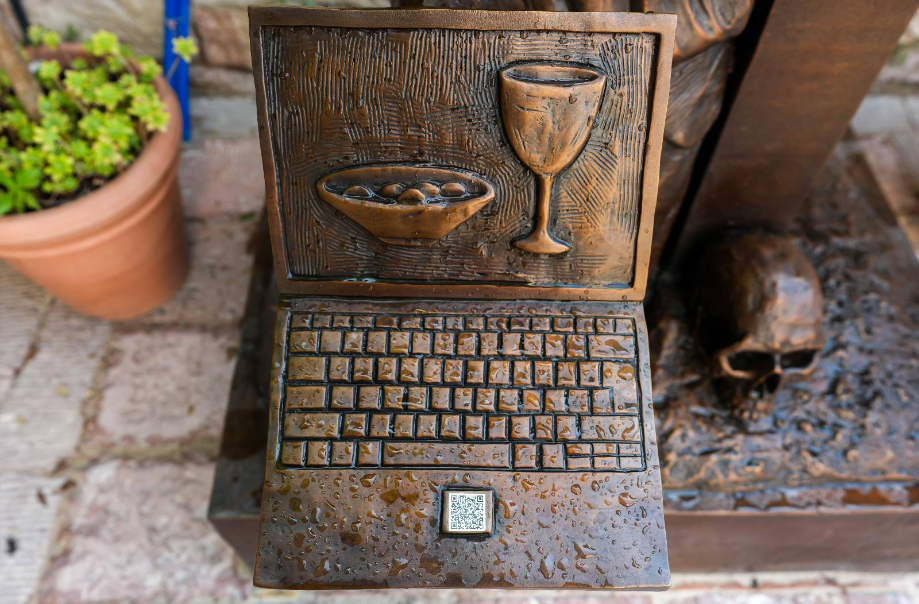
I had the privilege of visiting Assisi, Italy, in June 2025, where I found the tomb of Blessed Carlo Acutis, and I was not prepared for the immediate and profound impact it would have on my prayer life. Carlo reminds us that holiness is found in using the tools of our time, the digital ones, to lead others to heaven.

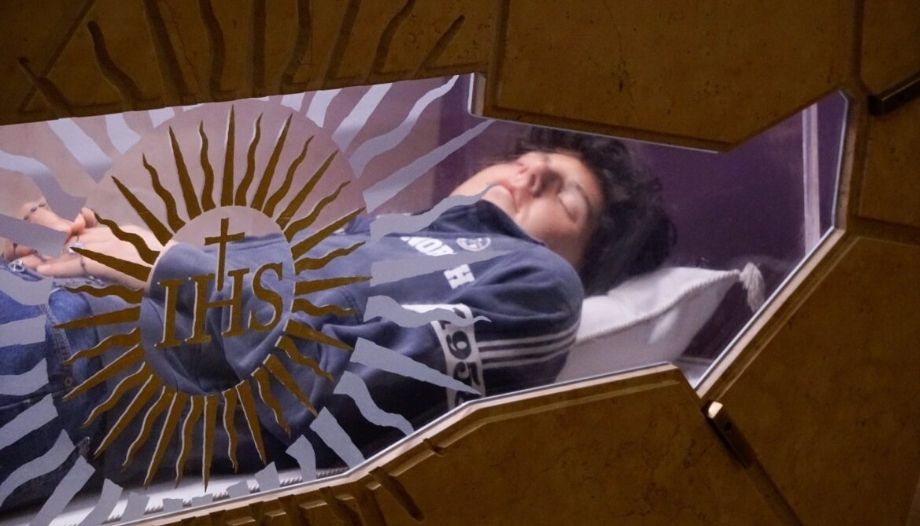
As I entered the Basilica of Santa Maria Maggiore, where Carlo's body currently rests, I remember thinking, "I can't wait to see his iconic Nike sneakers!". As I waited in line to venerate his body, I admit I was distracted by the summer heat and the religious brother repeating over and over, "No photos!" But then I saw him.

Carlo's testimony

Right there, in the city I loved so much as a child, I met a young man who gave everything for God. And I began to cry.

Carlo died young. He is on his way to becoming a saint (he already is), not because he did something great, but because he simply did what he loved and did it with authenticity. He thought it would be great to share the truth of the Eucharistic miracles on the Internet, and so he did. And because he said yes to something that fascinated him as a child of God, the Church - and the world - have been transformed by his witness.

That day, I felt as if Carlo had gently grabbed me by the shoulders. I felt that he was seeking a heavenly friendship with me. And he was offering me his intercession not only for my heart, but also for the work I do in digital evangelization.

I work as the digital marketing director for FOCUS, alongside my amazing teammates. Together, we orchestrate the social media strategy behind one mission: to process Jesus through the algorithm. 

Social networks in our lives

I often say that even the most devout Catholic can miss daily Mass, but almost everyone connects to social networks every day. Whether out of habit or addiction, scrolling through networks has become one of the most common human behaviors of our time. And so, we have the opportunity - and the responsibility - to place Jesus directly in those moments of distraction, curiosity and searching.

What strikes me most is how social networks have evolved. They are no longer just a place to keep in touch with friends. They are the place where decisions are made. We buy what we see on TikTok. We wear clothes inspired by Instagram influencers. We furnish our homes with things we discover on Facebook. We learn from strangers on YouTube. These are not just fleeting interactions; they are formative. They shape who we are becoming.

We can show people the beauty, the truth, the Jesus.

And as Catholics, we have a choice.

We can become a light, like Carlo, and offer something bigger than the trend of the week. We can show people beauty. We can show people the truth. We can show people Jesus.

Carlo Acutis reminds us that holiness is not beyond our reach. It is found in doing ordinary things with extraordinary love and in using the tools of our time to lead others to heaven. May we follow his example and may our "yes" echo his.

--------

Courtney Roach is director of digital marketing for FOCUS. University of Wisconsin-Madison.

This article was originally published in OSV News, two days before his canonization on Sunday the 7th. You can consult it here.

--------

The authorOSV / Omnes

Read more
Initiatives

On Our Lady's birthday, Mary's Meals announces new record number of children fed

Mary's Meals NGO surpasses 3 million children fed in schools, an achievement it celebrates on the birthday of the Virgin Mary

Teresa Aguado Peña-September 8, 2025-Reading time: 2 minutes

More than three million children around the world now receive a daily meal at a school thanks to Mary's Meals. The charity, founded by Magnus MacFarlane-Barrow in 2002, has reached this historic milestone after expanding its feeding programs in nine countries over the past 18 months, including Malawi, Haiti, Zambia, Zimbabwe, South Sudan and Ethiopia.

The achievement coincides with the back-to-school season in the northern hemisphere and reflects the NGO's core belief: the link between education and nutrition is key to breaking the cycle of poverty. Mary's Meals demonstrates, once again, that a simple gesture, such as a daily meal, transforms entire communities.

According to the organization's data, 71 million school-age children do not attend school in the world. However, school meals have been shown to act as a powerful incentive to reverse school dropout.

This is corroborated by Luciano Ngikiri, headmaster of Namingwere Primary School in Malawi: "Because of hunger, many children are sent on errands and other jobs to contribute to the family. We have very low enrollment rates because of hunger and poverty. Those who come hungry do not participate in class. But now, with Mary's Meals, those children who stayed home will attend school in large numbers, and they will be able to be active in class. I feel like I'm floating with joy.

Unprecedented expansion

Growth has been especially significant in countries marked by conflict and climate emergencies. In Ethiopia's war-torn Tigray region, Mary's Meals has increased its outreach sevenfold, from 30,000 (at the beginning of 2024) to more than 245,000 children served today.

In Malawi and Zambia, where the organization has been working for two decades, beneficiaries now exceed one million and 600,000, respectively, despite the droughts and floods affecting these communities.

Even in extremely unstable contexts, such as Haiti, Mary's Meals has managed to sustain and expand its work: more than 196,000 children now receive a daily school meal there.

A faith-driven project

For MacFarlane-Barrow, the growth of Mary's Meals is the fruit of providence and the protection of the Virgin Mary, to whom the work is dedicated: "We have chosen September 8 to celebrate the fact that we feed more than 3 million children every school day, as it is the day on which we celebrate Our Lady's birthday. So, on this day, we give all this work back to her. Mary's Meals is hers! This is our humble birthday gift."

Mary's Meals has maintained a strong Christian inspiration from its beginnings, but its work is universal: "We feel called to be present in those parts of the world where people have no voice".

A mission within everyone's reach

The Mary's Meals model is based on simplicity and the commitment of volunteers from the communities themselves. The cost is minimal: 12 euro cents per meal, about 22 euros to feed a child for an entire school year.

MacFarlane-Barrow recalls that although they produce enough food for everyone, thousands of children are still starving. Mary's Meals invites you to participate in their mission: that every child receives a daily meal at his or her place of education.

The authorTeresa Aguado Peña

Read more
The World

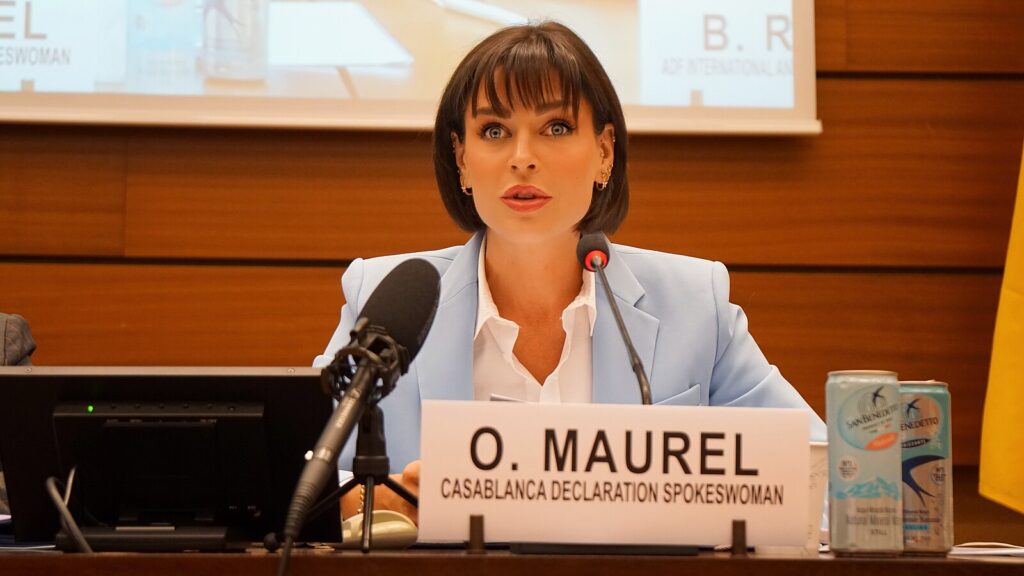
France's new sex education program denounced to the United Nations

The European Center for Law and Justice considers that the content violates the rights of parents.

Javier García Herrería-September 8, 2025-Reading time: 2 minutes

The start of the school year in France is marked by the implementation of the sex education program known as EVARS ("Educating in affective and relational life and sexuality"), mandatory in all public and private schools, from preschool to high school. According to the European Center for Law and Justice (ECLJ), this initiative violates the fundamental rights of parents as those primarily responsible for the education of their children.

The ECLJ has announced that it will bring the case before the UN Committee on Economic, Social and Cultural Rights, which monitors compliance with the international covenant that obliges states to respect "the freedom of parents [...] to ensure the religious and moral education of their children in conformity with their own convictions."

Program contents

The EVARS program, as denounced by associations such as Juristes pour l'Enfanceis not limited to an introduction to emotional and relational life, but "promotes early sexuality, encourages children to question their gender identity and makes consent and desire the only moral principles of reference". In addition, they stress that there is no possibility of exemption for families and no obligation to inform parents in advance about the content or materials used in the classes.

The new program "forces boys to talk about their intimacy, address issues of puberty and sexuality long before they are confronted with them, and teaches them all the pro-abortion feminist stereotypes against men, marriage, pregnancy, etc."

The content requires "the acquisition of concepts and is subject to evaluation. However, assessment implies right or wrong answers. Therefore, the normative character of this program is undeniable: it seeks to normalize early sexual relations in all its forms".

What is the ECLJ

The European Center for Law and Justice (ECLJ), an international non-governmental organization in special consultative status with the UN since 2007, is dedicated to the promotion and protection of human rights. Of Christian inspiration, it bases its work on "the spiritual and moral values which constitute the common heritage of the European peoples and the true source of individual liberty, political freedom and the rule of law". Its activity combines legal defense, education and litigation, with particular emphasis on the protection of religious freedom and human dignity before international courts and bodies such as the European Court of Human Rights, the Council of Europe and the European Parliament.

The French Council of State has already rejected the request to annul this program in the past, so the ECLJ and other associations consider that the international route is now the most effective. The organization plans to submit its request to the UN within a month, with the aim of getting the French education system to review its policies in this area.

Evangelization

The Nativity of the Virgin Mary

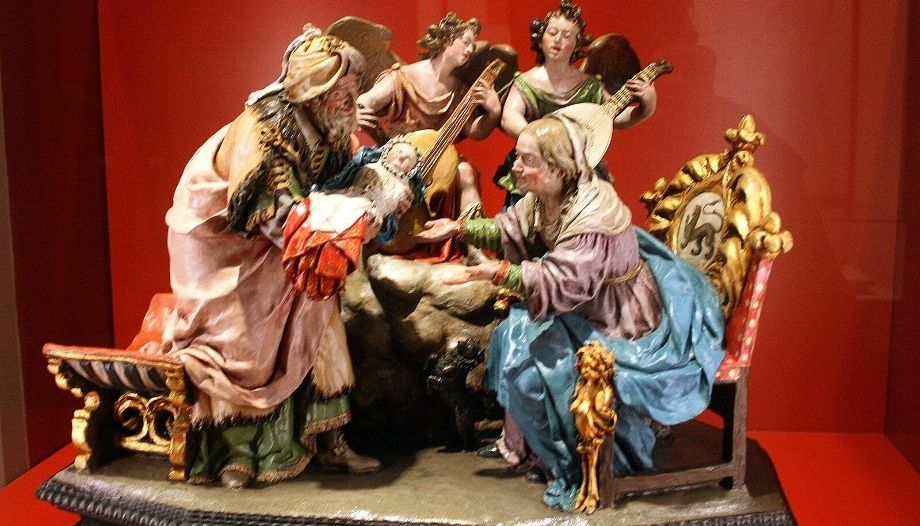
September is also a very Marian month. On September 8, the Church celebrates the birthday of the Virgin Mary, her Nativity, one of the oldest Marian feasts. Others will follow, such as the Holy Name of Mary (12th), or Our Lady of Sorrows (15th). 

Francisco Otamendi-September 8, 2025-Reading time: 2 minutes

It is believed that the origin of the feast of the Nativity of the Virgin Mary is linked to the dedication, in the fourth century, of an ancient Marian basilica in Jerusalem. On its ruins was built in the twelfth century the present church of St. Anne. Tradition has it that in this place, explains Vatican NewsThe house of Mary's parents, St. Joachim and St. Anne, was the birthplace of the Virgin, who would become the Mother of Jesus, Mother of God.

This feast of the Blessed Virgin Mary takes place nine months after the date of the Immaculate Conception, December 8, and seems to have begun to be celebrated in the Eastern Church of Byzantium (ancient Constantinople, now Istanbul).

The feast of Our Lady began to be celebrated in the eighth century in Rome, with Pope Sergius I although it has its origin in Jerusalem. It is the third feast of the "nativity" in the Roman calendar, which commemorates the Nativity of Jesus, the Son of God (December 25, Christmas). The feast of St. John the Baptist (June 24), and that of the Blessed Virgin Mary, on September 8. 

Perspective on the mysteries of salvation

The liturgy links the anniversary of the Virgin's birth with the perspective of the beginning of the mysteries of salvation, writes the franciscan directory. "The Marian celebration is the first fruits of the good things that her Son will bring us". On this same date, in immediate and following days, the Virgin is celebrated under multiple names and invocations.

On August 15, on the Solemnity of the Assumption of Mary, Pope Leo XIV said in the homily of the MassThe event was celebrated in the parish of St. Thomas of Villanova in Castel Gandolfo. "On the cross, trust won; love, which is capable of seeing what has not yet arrived, won; forgiveness won". And Mary was there; she was there, united to her Son. Today we can sense that Mary is us when we do not flee, we are us when we respond with our 'yes' to her 'yes'".

The authorFrancisco Otamendi

Books

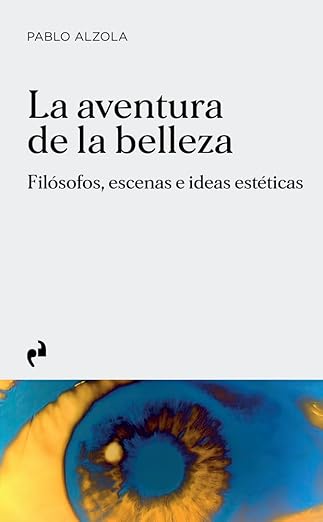
In search of lost beauty 

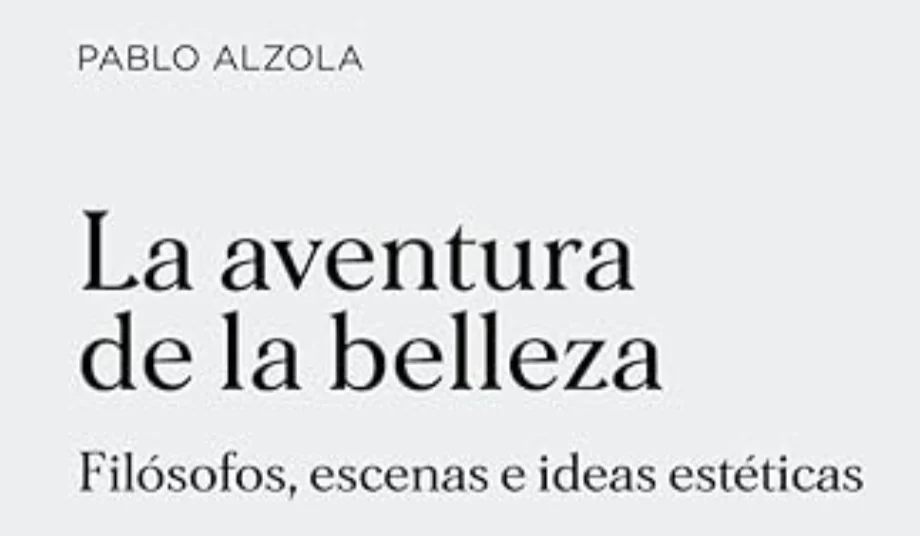
Pablo Alzola, in The adventure of beautyshows through philosophy, literature and cinema, how beauty continues to be a path of transcendence and salvation.

Juan José Muñoz García-September 8, 2025-Reading time: 4 minutes

Why are we so attracted to beauty? When one sees a work of art or a film of great beauty, one has the sensation, even if one cannot explain it, of witnessing a transfigured world, a redeemed world. There is something that catches us. However, nowadays we are suspicious of beauty, we think it has been overcome.

Years ago I was teaching film criticism at a university in Madrid, and explaining the aesthetic foundations of film analysis I talked about beauty and automatically several students replied saying that art had nothing to do with beauty. I was perplexed. In the classical training I have acquired, beauty, truth and goodness go hand in hand, they are properties of the real. Why didn't some of my students think so?

Beauty is the face of truth and goodness

Why do we choose the ugly and vulgar as authentic? Why does the consumption of pornography abound, which strips the human body of its beauty, meaning and soul? The book The adventure of beauty aims to answer these questions. Alzola says that beauty makes us more human by elevating us above ourselves. And works of art are the expression of something that transcends us. Beauty is not so much fullness as promise and, to this extent, it is synonymous with hope.

For all these reasons, beauty is by no means synonymous with naivety. Great works of art and even good films that show pain and suffering, but which are open to mystery, also leave us with the feeling of being before a promise: because in everyday life we have the impression that suffering and death have the last word, but authentic beauty speaks to us of a reality that will be transfigured, saved. That is why it has been said that beauty will save the world, that beauty which is hidden in the most beautiful of men, Jesus Christ, in his passion full of suffering and before whom our gaze turns away.

Pablo Alzola, professor of Aesthetics and Theory of the Arts at the Universidad Rey Juan Carlos in Madrid, encourages us in this essay to go through the history of thought from classical antiquity to the postmodern era, and to understand how beauty has gone from being a promise of fulfillment to become a strategy suspected of covering up dark manipulations or spurious interests. 

Cinema, philosophy and aesthetics 

Alzola invites us to begin this adventure by looking at the unbounded, mysterious aspect that beauty reflects: like that unforgettable sequence at the start of Desert Centaurswhen the door of a Texas house opens and the characters step out onto the porch to look out over the vast desert, where an enigmatic John Wayne appears on horseback. All this western speaks of search (The Searchers is its original title) and rescue. In the same way, our subjective gaze has to be open to the whole of reality, that unfathomable reality that beauty reflects.

Alzola gives an essential importance to cinema in this essay, and it is logical that this is so: cinema is the seventh art, although it took a long time for intellectuals to give it this recognition. Cinema is not only a useful anecdote to complement an idea or simply an example to embellish our thoughts, but it is philosophy in itself and therefore beauty in itself. Film art reflects that mystery of reality that amazes us so much.

That's why they parade through The adventure of beauty authors such as Plato, Homer, Augustine of Hippo, Thomas Aquinas, Shakespeare, Hume, Kant, Nietzsche, Dostoevsky, Rilke, Waugh, Tolkien or Heidegger. Films such as On the way home, Apocalypse now, Lullaby, Amadeus, The tree of life, Babette's Feast, Vertigo, Quince sun, Better than that o 2001: A Space Odyssey. With all of them we dialogue and discuss, creating a peculiar symposium of philosophy, cinema and literature.

Chapters of an adventure

In this journey to rescue beauty, the author has structured the chapters of his essay chronologically, covering the history of Western philosophy from classical Greece to the present day, all encompassed with key words that synthesize the essence of each period: 

-Unity" for Greek philosophy: unity of beauty with the good and with the divine origin of everything, which requires purifying the gaze and transcending sensible appearances in order to contemplate full beauty, the source of happiness. This purification or catharsis reminds us that happiness is possible, despite the vagaries of life, if the subject has the virtues that perfect knowledge and will. 

-Relationship" for medieval philosophy, for Christian philosophy holds that we can see beauty as a relationship between creatures and their Creator, who is a personal being. And the act of being received in the divine creation from nothing, together with the form of each thing, makes beauty something concrete and not vaporous. 

-Experience" for modern philosophy. Modernity does not admit a confident relationship with the world. Beauty ceases to be a quality of the real, because beauty is not in things but in the feeling they generate in us. The objective criteria for evaluating beauty are lost, creating a vicious circle in which beauty is where a reliable critic says it is, and the reliable critic is the one who says where beauty is. And also the unity of aesthetics and ethics begins to dislocate, and some, like Nietzsche for example, think that beauty is a mask that covers up the terrifying truth of existence, its depths of suffering and despair. The work of art becomes a question mark, Alzola concludes. 

-Work" for contemporary philosophy. Some, like Heidegger, admit that art opens us to the truth of things and of the world. Cinema reflects this very well. Beauty would be another way of calling the truth that happens as unveiling. At the same time, this work of art has lost mystery and authenticity: in the age of the selfie, it has lost its authenticity. and works of art accessed exclusively by cell phones, artistic creation loses its unique, perhaps sacred character. The old art awakens attitudes of contemplation and recollection, says Walter Benjamin. The new art seeks to distract us, to provoke us, to shock us, it is art as a shock or projectile. This phenomenon can be seen in the proliferation of violence and ugliness in certain types of cinema from the late 1960s onwards. 

Beauty and transcendence

Postmodernity has disfigured the face of truth and goodness, defaming beauty and creating a disenchanted world, full of helplessness and precariousness. But beauty resists all conspiracies, for it makes us more human by raising us above ourselves. And in this way it prepares the advent of something, of Someone, concludes Alzola. 

The adventure of beauty. Philosophers, scenes and aesthetic ideas.

AuthorPablo Alzola
Editorial: Asymmetric Editions
Year: 2025
Number of pages: 237
The authorJuan José Muñoz García

Read more
The Vatican

Pope invites not to waste life and "be saints" like Frassati and Acutis

The greatest risk in life is to waste it by not seeking to follow God's plan, Pope Leo XIV said Sunday as he proclaimed two new saints: two young lay people of the 20th and 21st centuries, Pier Giorgio Frassati and Carlo Acutis. The Pontiff noted, "all of you, all of us, are also called to be saints."

OSV / Omnes-September 7, 2025-Reading time: 6 minutes

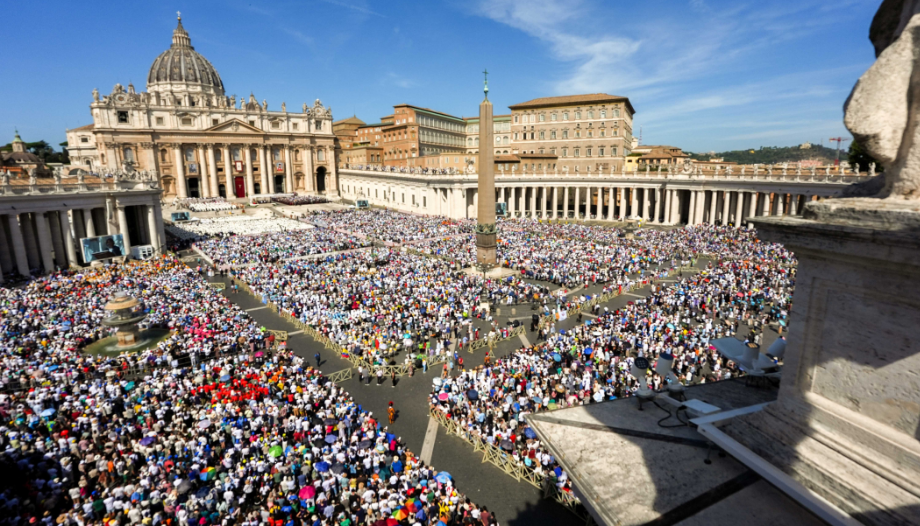
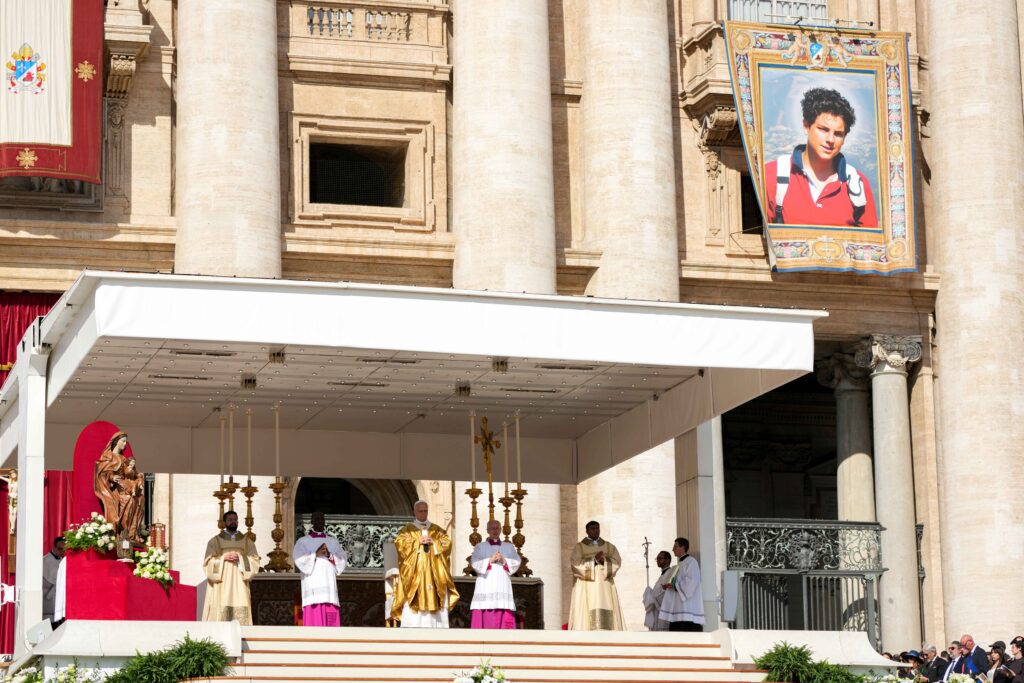
Carol Glatz (Vatican City, CNS). The greatest risk in life is to waste it by not seeking to follow God's plan, Pope Leo XIV said Sunday as he proclaimed two new saints. They are two young lay people of the 20th and 21st centuries.

"Saints Pier Giorgio Frassati and Carlo Acutis are an invitation to all of us, especially the young, not to waste our lives, but to direct them upwards. And to turn them into masterpieces."

"The simple but winning formula of their holiness," he said, is accessible to everyone at any time. "They encourage us with their words, "Not I, but God," as Carlo used to say. Pier Giorgio used to say, 'If you have God at the center of all your actions, then you will reach the end."'"

Before canonizing the first saints of his pontificate, Pope Leo greeted the more than 80,000 faithful who had gathered early in St. Peter's Square. He wanted to share his joy with them before the start of the solemn ceremony.

"It is a day of great joy," Pope Leo XIV's opening greeting.

"Brothers and sisters, today is a wonderful celebration for all of Italy, for the whole Church, for the whole world," he said before the Mass.

"Although the celebration is very solemn, it is also a day of great joy, and I especially wanted to greet the many young people who have come to this holy Mass," he said. To the families of the future saints, and to the associations and communities to which the young people had belonged.

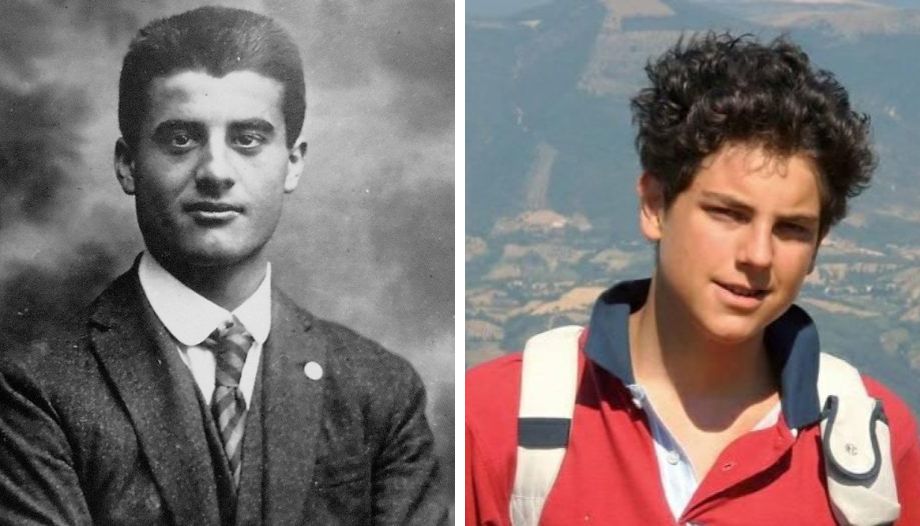
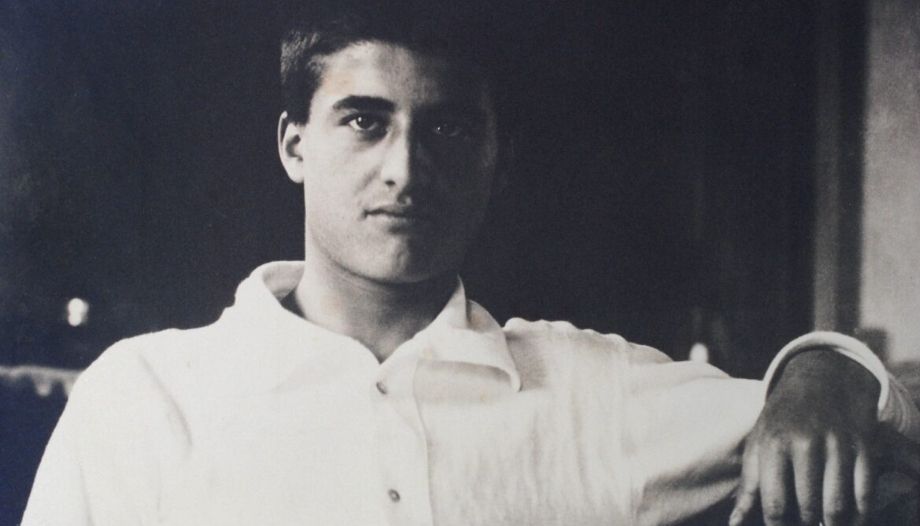
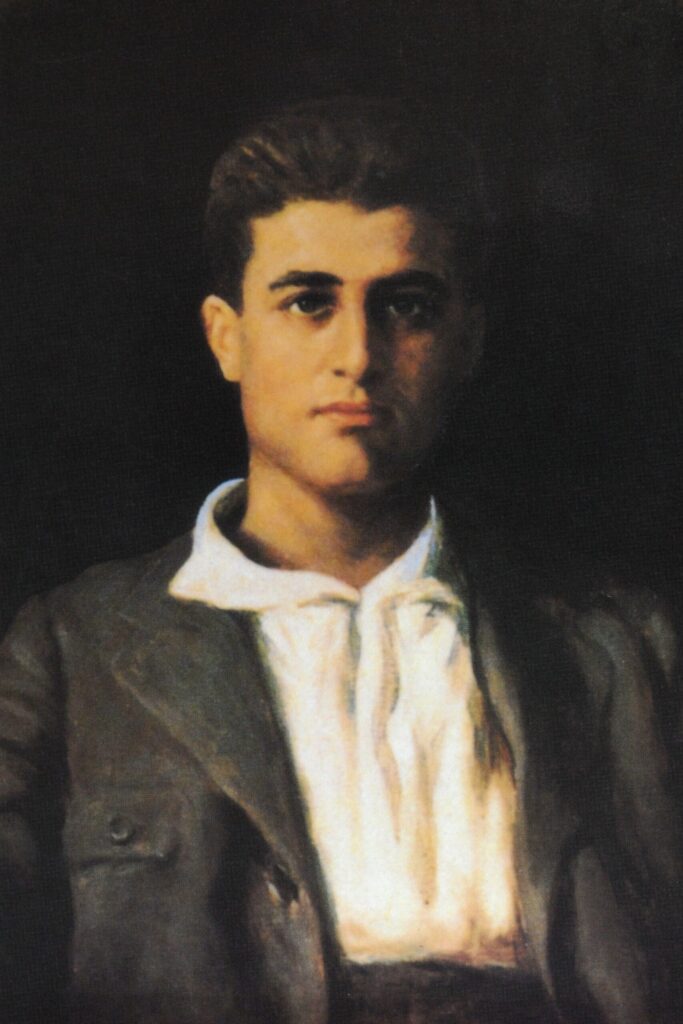
Pier Giorgio Frassati and Carlo Acutis, canonized by Pope Leo XIV (Wikimedia Commons and OSV News).

Pope Leo asked everyone to "feel in their hearts what Pier Giorgio and Carlo experienced. This love for Jesus Christ, especially in the Eucharist, but also in the poor, in our brothers and sisters."

"All of you, all of us, are also called to be saints." He said this before retiring to prepare for Mass and pay homage to a statue of Mary with the Child Jesus. Also to the reliquaries containing the relics of the two young men.

"Abandon ourselves to the adventure He offers us."

In his homily, the Pope underlined the call of Jesus in the Gospel of the day "to abandon ourselves without hesitation to the adventure that he offers us, with the intelligence and strength that his Spirit gives us.

That we can receive to the extent that we empty ourselves of the things and ideas to which we are attached, in order to listen to his word".

That is what the two new saints did and what every disciple of Christ is called to do, he said.

Many people, especially when they are young, he said, face a kind of "crossroads" in life as they ponder what to do with it.

The saints of the Church are often portrayed as "great figures". And it is forgotten that for them everything began when, while still young, they said 'yes' to God and gave themselves to him completely, reserving nothing for themselves," the Pope said.

Frassati and Acutis: "in love with Jesus".

"Today we look at St. Pier Giorgio. Frassati and St. Carlo AcutisHe said: a young man at the beginning of the 20th century and a teenager of our times, both in love with Jesus and ready to give everything for him," he said.

Pope Leo devoted much of his homily to sharing quotes from both of them and details of their lives, something Pope Francis had moved away from, preferring to focus more on the readings of the day.

Pier Giorgio: "a beacon for lay spirituality".

"The life of Pier Giorgio is a beacon for lay spirituality," Pope Leo said.

"For him, faith was not a private devotion, but was driven by the power of the Gospel and his membership in church associations," he said.

"He was also generously committed to society, contributed to political life and devoted himself ardently to the service of the poor."

Pope Leo XIV at the Mass in which he declared Blessed Carlo Acutis and Blessed Pier Giorgio Frassati saints, celebrated in St. Peter's Square at the Vatican on September 7, 2025. (CNS Photo/Lola Gomez).

Acutis "found Jesus in his family".

"Carlo, for his part, found Jesus in his family, thanks to his parents, Andrea and Antonia, who are here today with his two siblings, Francesca and Michele," he said. Meanwhile, the crowd applauded and Antonia smiled shyly at the camera.

St. Acutis also found Jesus in the Jesuit school he attended and "especially in the sacraments celebrated in the parish community," he said. "He grew up naturally integrating prayer, sports, study and charity into his days as a child and young man."

The Pope noted that the new saints "cultivated their love for God and for their brothers and sisters through simple acts, within everyone's reach. Such as daily Mass, prayer and, especially, Eucharistic adoration."

Frassati was born on April 6, 1901 in Turin and died there on July 4, 1925, at the age of 24, of polio. Acutis was born to Italian parents on May 3, 1991 in London and died in Monza, Italy, on October 12, 2006, at the age of 15, of leukemia.

The disease did not prevent them from loving

The Pope added that "even when illness struck them and shortened their young lives, even this did not stop them or prevent them from loving, offering themselves to God, blessing him and praying to him for themselves and for everyone."

Several family members and people close to the new saints attended the Mass, along with dignitaries, such as Italian President Sergio Mattarella.

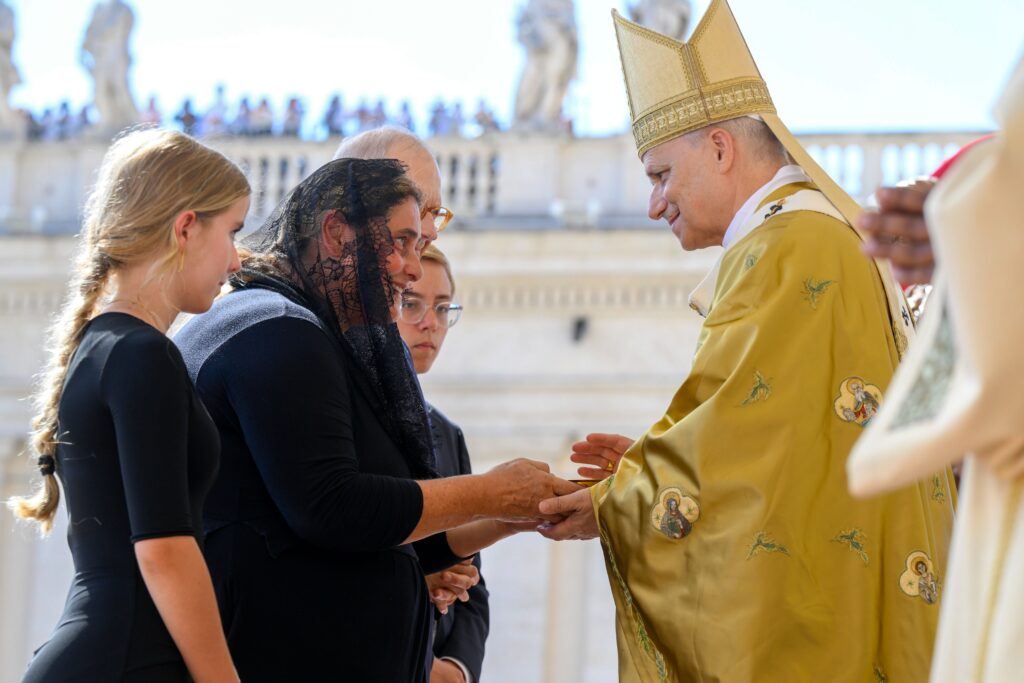
Pope Leo XIV receives the offerings of Antonia Salzano, mother of St. Carlo Acutis, and her family during the canonization Mass. In the photo, Francesca Acutis, Antonia Salzano, Andrea Acutis and Michele Acutis (Photo CNS/Vatican Media).

Acutis' family and the miracle of the young Costa Rican girl

St. Acutis' parents, Andrea and Antoniaand his twin siblings, Michele and Francesca, who were born four years after their brother's death, were present. Together they brought the offerings to the Pope. Michele also read the first reading of the Mass in English.

Valeria Valverde, who read the first prayer of the faithful, is a young Costa Rican woman who suffered a serious head injury while living in Italy. It was her inexplicable healing that provided the second miracle necessary for the canonization of St. Acutis.

Frassati, in lay movements

St. Frassati was active in Catholic Action, the Society of St. Vincent de Paul, the Italian Federation of Catholic Universities and the Dominican Third Order.

Lorenzo Zardi, vice-president of the Italian Catholic Action youth group, read the second reading at Mass. Michele Tridente, secretary general of the lay movement, also presented the offertory gifts to the Pope.

Before praying the Angelus, the Pope again thanked everyone for coming to celebrate the two new saints of the Church.

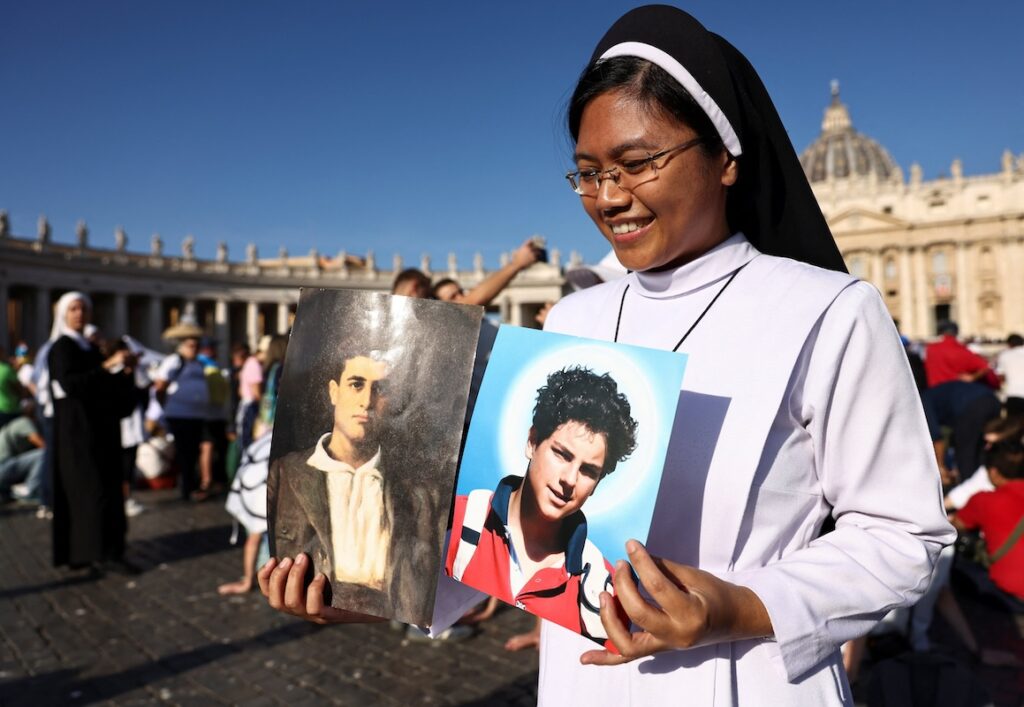
A nun holds a photo of Pier Giorgio Frassati and Carlo Acutis on the day Pope Leo XIV presides at the Mass for the canonization of Blessed Carlo Acutis (Photo by OSV News/Matteo Minnella, Reuters).

Prayer for the Holy Land and Ukraine: "God wants peace!"

However, he also asked the faithful for "unceasing prayer for peace, especially in the Holy Land, in Ukraine and in all other lands bloodied by war."

"To the rulers I repeat: listen to the voice of conscience," he said.

"Apparent victories won with weapons, sowing death and destruction, are in reality defeats and will never bring peace and security," he stated.

"God does not want war, God wants peace!" he exclaimed to applause. God gives strength to those who work to leave behind the cycle of hatred and follow the path of dialogue.

——————-

This information was originally published in OSV News. You can consult it here.

——————-

The authorOSV / Omnes

Read more
The Vatican

7 curiosities about Carlo Acutis

Carlo Acutis, called the "cyber-apostle of the Eucharist", had a short but extraordinary life, marked by a deep faith, his love for technology and his solidarity.

Teresa Aguado Peña-September 7, 2025-Reading time: 3 minutes

Carlo Acutis, the first saint millennialwill be canonized today, September 7, by Pope Leo XIV. The young man, known as "God's influencer," died at the age of 15 from fulminant leukemia. His life was marked by a deep love for the Eucharist, his passion for computers and his desire to put technology at the service of the Gospel. Despite his short life, he left a testimony of faith, simplicity and solidarity that inspired thousands of people. 

From his life we highlight seven curious aspects that define the young saint. 

Her Polish caregiver fueled her faith journey

From an early age, Carlo had a natural inclination towards the sacred. At the age of three he used to ask his mother to go into churches to greet Jesus and he used to pick flowers for the Madonna. 

At the age of seven he asked to receive the Eucharist and, requesting an exemption or dispensation, Carlo received his first communion earlier than usual. Antonia Salzanohis mother, told the newspaper Corriere della Sera: "Carlo saved me. I was illiterate in the faith". Her son discovered the faith thanks to his Polish nanny, Beata, a devotee of St. John Paul II. Even though his parents were not practicing, she instilled in him an intense spirituality. 

Served the poor in soup kitchens

Every evening she brought hot meals to the homeless. He served at the tables of the poor, those of Mother Teresa of Calcutta's sisters in Baggio and those of the Capuchins. A Hindu employee of his family converted to Catholicism after seeing how Carlo helped the disadvantaged.

He predicted his death

Carlo Acutis predicted his own death. A few days after the funeral, his mother found on his computer desk a short film he himself had shot in Assisi three months earlier: "When I weigh 70 kilos, I am destined to die."
She also predicted that her mother would have twins and sure enough, in 2010 she gave birth to Francesca and Michele.

His "whole" body in Assisi

At his exhumation in 2019, his body was found "whole, not intact", preserving all his organs. The diocese clarified that this was not miraculous incorruptibility, but remarkable preservation. 

Carlo asked his mother to bury him in Assisi. Carlo's mother told Corriere della Sera that the family had a house in Umbria. "A sign indicated that new spaces in the community cemetery were for sale. I asked Carlo what he thought. 'I would be very happy to end up here'." Now his body rests in the Sanctuary of the Spoliationwhere the faithful will be able to venerate it forever.

The heart as a living relic

Carlo's heart is preserved in a reliquary in the Papal Basilica of St. Francis of Assisi, in a beautiful paradox: they could not donate his organs because of his illness, but his heart remains preserved. 

Technology at the service of faith

He called himself a "cyber-apostle" of the Eucharist. At the age of 11, he created a website documenting more than 150 Eucharistic miracles around the world, with maps, videos, downloadable texts in multiple languages, and a "virtual exposition" that was replicated in shrines around the world. 

Courageous defender of his faith

He was not afraid to defend Catholic teachings. In school debates about abortion, he did so with moral conviction. He was also known for being a loyal friend. He used to support and protect children who were being bullied, especially a classmate with a disability. In addition, he shared with his friends messages about the value of participating in mass and going to confession, respect for the dignity of each person and the importance of chastity.
As a student, he was invited to create the website of his parish and another one to promote school volunteering; he won a national contest called "Sarai volontario" (You will be a volunteer).

The authorTeresa Aguado Peña

Evangelization

Our Lady of Guadalupe, Patroness of Extremadura and Queen of the Hispanic World

Extremadura (Spain) celebrates the solemnity of its Patron Saint, Our Lady of Guadalupe, and Queen of Hispanity on September 6. A different invocation to the Virgin of Guadalupe, patron saint of Mexico and Empress of America, whose feast day is December 12. 

Francisco Otamendi-September 6, 2025-Reading time: 2 minutes

Some ancient codices locate the origin of the image of the Virgin of Guadalupe in the first century of Christianity, and its author, St. Luke. "Although the image that today is venerated in this place is a Romanesque carving, in cedar, from the 12th century". This is explained by the Franciscan friars of the monastery and sanctuary of Guadalupe, located in Cáceres (Extremadura).

Account the legend that when St. Luke died, the image was buried next to him. It was then transferred from Asia Minor to Constantinople in the 4th century. From there, Cardinal Gregory took it to Rome (582), where he was elected Pope in 590 with the name of Gregory the Great.

This Pope became the main devotee of the image, which was moved from Rome to Seville, as the Pope gave it to the archbishop St. Leandro. And in the city of Seville it began to be venerated until the beginning of the Arab invasion (711). 

In 714, some clerics fleeing from Seville hid her by the Guadalupe River, where she was found by a shepherd, to whom the Virgin appeared. She asked him to dig in that place to find her image and then build a hermitage that would become a monastery and sanctuary. The Franciscans take up this legend, but affirmThe image that today is venerated in this place is a Romanesque carving from the 12th century". 

Meaning of Guadalupe

Say GuadalupeThe friars say, "is to permanently bring to memory snippets of the greatness and shadows of the Crown of Castile, of its pilgrim kings, of national unity. Also "of the American epic, of the visits and promises of Christopher Columbus, of the fervor of the discoverers and conquerors of the New World".

And snippets also "of the innumerable series of pilgrim saints (John of Avila, Pedro de Alcántara, Teresa of Jesus, John of God, Cristobal de Santa Catalina, John Paul II...). And "of famous and noble pilgrims (Marquis of Santillana, Cervantes, Hernán Cortés...). Of poor noble pilgrims cared for in its hospitals, in the cupboards of the porter's lodge, in the farmhouses along each of its thirteen pilgrim roads...". The enclave, the friars emphasize, has "a history of Faith and Culture of more than seven centuries".

In the programming In the celebration of the festivities, the Archbishop of Toledo, Msgr. Cerro Chaves, will preside this Saturday the Novenario, whose general theme is "In the one Christ we are one, with St. Mary of Guadalupe".

The authorFrancisco Otamendi

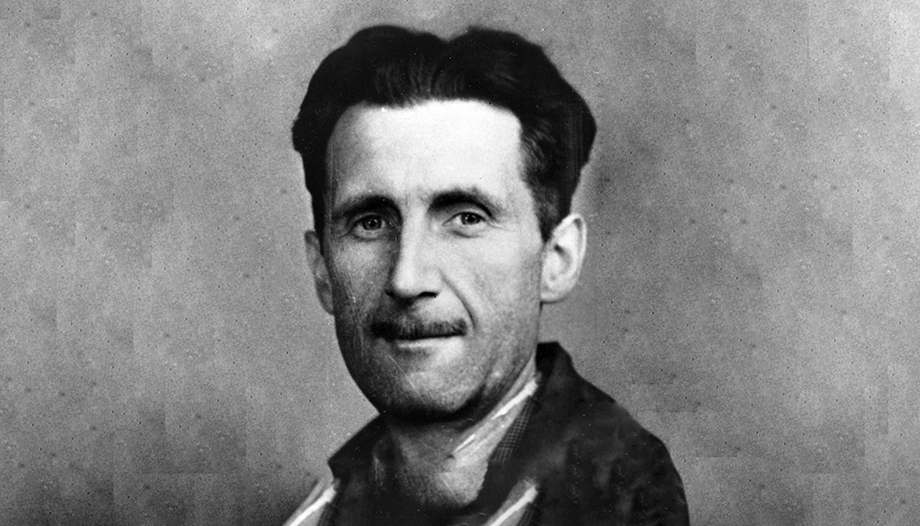
The last days of Orwell

Orwell, marked by his experience in the Spanish Civil War and his rejection of totalitarianism, maintained until his last days a firm anti-communist spirit and critical of the USSR. He died in 1950 of tuberculosis and was buried in Sutton Courtenay according to the Anglican rite.

September 6, 2025-Reading time: 4 minutes

In the excellent biography written by Yuri Felshtinsky, it is stated that Orwell, who had traveled in 1937 to the Spanish Civil War under the pretext of studying the role of the Catholic Church in the war, found in his contact with anarchism and communism in Catalonia the source of his future rejection of the roots of totalitarianism and bureaucratic collectivism. About a conversation with an Anglican vicar who visited him, he stated with his characteristic irony that he had to admit that it was true "about the burning of churches, but that he was very happy to hear that they were only Catholic churches." 

Anticommunism

In 1946, he published together with other authors in the Forward newspaper an open letter in which they asked that the Moscow trials of 1936-1938, in which the defendants (close collaborators of Lenin and Trostski) were held responsible for maintaining direct relations with the authorities of the Nazi Reich and the Gestapo; the German-Soviet friendship treaties; the murder of Polish civilians and soldiers in the Katyn forest at the hands of the Soviets, etc., be addressed in the Nuremberg trials. The letter had no repercussions because the British and American governments of the time were not interested in confronting the USSR. 

Until the last day of his life, Orwell kept jotting down in a notebook an expanding list of individuals in the West who, in his opinion, were either underground communists or agents of Soviet influence. His anti-communist sentiments grew more acute during his last months of life, eventually sending a list of 36 people to an old acquaintance who worked in the Information Research Department, whose aim was to combat communist propaganda in the British Empire.

Final disease

As D. J. Taylor wrote in an article in The GuardianEvery afternoon in January 1950, a small procession of visitors could be seen making their way, one by one, through the cheerful squares of North Bloomsbury to the University College London hospital where Eric Arthur Blair, known worldwide as George Orwell, was dying. 

The British writer had been at UCH and in the hospital for almost four months since the beginning of the previous year. Two decades of chronic lung problems had resulted in a diagnosis of tuberculosis. In a Gloucestershire sanatorium six months earlier, he had nearly died, but recovered sufficiently to be transferred to London and cared for by the distinguished chest specialist Andrew Morland. 

Fortunately, money, the absence of which had troubled Orwell for most of his adult life, was no longer an issue. 1984published the previous June, had been a great success on both sides of the Atlantic. Sixteen years younger than Orwell, with a string of previous mistresses, Sonia Brownell seemed an unlikely candidate for the role of second wife to the writer, widowed since the death of Eileen O'Shaughnessy in 1945. But the marriage was celebrated in the presence of the hospital chaplain, the Rev. WH Braine, in Orwell's room on October 13, 1949. Present were David Astor, Janetta Kee, Powell, a doctor and Malcolm Muggeridge, a left-wing writer friend of Orwell's who would eventually convert first to Christianity and almost at age 80 to Catholicism. 

In the early hours of Saturday, January 21, Orwell died of a massive pulmonary hemorrhage. The news spread throughout the weekend. "G. Orwell is dead and Mrs. Orwell, presumably, is a wealthy widow." noted Evelyn Waugh in a letter to Nancy Mitford. Muggeridge, then working at the Daily Telegraph, wrote a couple of commemorative paragraphs for the Peterborough column. "I thought of him, as of Graham [Greene], that popular writers always express in an intense way some romantic longing....".

Will

The deceased turned out to have made a will three days before his death, in the presence of Sonia and his first wife's sister, Gwen O'Shaughnessy. Materially, he was transferring his literary estate to Sonia. A substantial life insurance policy would take care of his adopted son, Richard, who was then in the care of his aunt, Orwell's sister Avril. Orwell, who during his lifetime considered himself an agnostic, although he recognized the importance of Christianity to Western civilization, arranged for him to be buried according to the rites of the Church of England and for his body to be interred (not cremated) in the nearest cemetery. The task of arranging all this fell to Powell and Muggeridge. 

Both friends attempted to engage the services of the Reverend Rose, vicar of Christ Church, Albany Street NWI. Astor's influence secured a plot in the graveyard of All Saints' Church, Sutton Courteney, Oxfordshire. Muggeridge noted in his diary the fact that Orwell died on Lenin's birthday and was buried by the Astors, "which seems to me to cover the whole range of his life."

Funeral

The funeral was set for Thursday, January 26. The evening before, Powell and his wife, visited the Muggeridge's after dinner, taking Sonia with them, "obviously in poor condition". At their last meeting, the day after Orwell's death, Sonia had been overcome with grief. Muggeridge decided that "I would always love her for her real tears....".

He left a detailed account of the next day's events: Fred Warburg greeting mourners at the door of the church, the cold atmosphere, the congregation "largely Jewish and almost entirely non-believer." who had difficulty following the Anglican liturgy. Powell chose the hymns: "All people that on earth do dwell," "Guide me, o thou great Redeemer," and "Ten thousand times ten thousand." "I do not remember why." Powell later wrote, "perhaps because Orwell himself had spoken of the hymn, or because he was, in his own way, a kind of saint, even if he was not one of shining robes."

Both Powell and Muggeridge found the occasion enormously distressing. Muggeridge, in particular, was deeply moved by Powell's chosen reading from the Book of Ecclesiastes: "Then the dust shall return to the earth as it was, and the spirit shall return to God who gave it." He returned to his home near Regent's Park to read the sheaf of obituaries written by, among others, Symons, VS Pritchett and Arthur Koestler, seeing in them already. "how the legend of a human being is created".

Family

Francesca LaRosa, a story of infertility and hope with her songs

Francesca LaRosa took home a Catholic Music Award for best new singer in Rome for her song 'My Soul Proclaims'. And she made her own unique journey through the Psalms, which brought her new life and a song in honor of Mary's words in the 'Magnificat'. He has now told OSV News his story of infertility and hope behind his songs. 

OSV / Omnes-September 5, 2025-Reading time: 4 minutes

- Lauretta Brown (OSV News)

The psalms may be a part of the Mass that many Catholics overlook. But there are times in life when the psalms are imbued with new meaning. It's when we walk with the Lord through hardship and pain, trying to maintain hope. Here is the story of Francesca LaRosa.

LaRosa always loved to sing as a child, and began singing at Mass with her father at age 9. As she became more involved in music ministry, she began adapting the responsorial psalms into her own musical arrangements. 

The first time she composed music for a psalm, as a teenager, she was encouraged by her mother. "I was able to listen and find the melodies, and I saw the Scriptures in a different way. It was like I could see the melody come off the page," she recalls.

She eventually became music director of her home parish, St. Barnabas Catholic Church in Indianapolis, before leaving the position to pursue her own music career.

Although he initially thought he would pursue contemporary Christian music, in 2020 he discovered that "God had really led me back to the Psalms."

Infertility, "a heavy cross to bear".

"I was married and suffering from infertility, and I was asking God, 'Why is this happening? Why can't we have children?' It's a very heavy cross to bear in the midst of a pandemic. I was very heartbroken," she recounts. "As I was having this conversation with God, I accidentally tripped over the nightstand as I was leaving the room, and my Bible fell on the floor. I opened it to see what page it was on, and it was in the Psalms."

I asked God if He wanted me to focus on the psalms in His music, and then "felt an overwhelming sense of peace." Consequently, he decided to embark on a "psalm journey." recording all the psalmsHe has also been selling his arrangements on his website.

Although she incorporated them into her music with the intention of helping other singers, she discovered at the same time that the psalms provided comfort in her infertility process.

Surgery for endometriosis

"The day after I finished recording my last psalm, I was operated on by a doctor from Napro and discovered that I had a chronic disease called endometriosis, which she was able to completely remove," she explained. "Right after the surgery, I was cured and blessed with a son. Two weeks later, we found out we were expecting a baby."

LaRosa's work with the psalms also ended up reaching a wide audience and generating unexpected connections. Her videos caught the attention of Catholic composer Tom Booth, who put her in touch with Catholic musician Sarah Hart, who became her mentor and friend. 

While still struggling with infertility and in the midst of recording the Psalms, LaRosa collaborated with Hart to set the 'Magnificat' to music for her song 'My Soul Proclaims'.

"A very emotional moment."

"We opened Luke 1 and it was a very emotional moment to read Luke 1 as two women, and to read the story of Mary and Elizabeth. St. Elizabeth has been a very important person in my life because of my experience with infertility," LaRosa noted. "I really wrote it from the perspective of someone who couldn't have children."

"Singing that my soul proclaims the greatness of the Lord, singing Mary's words and her saying, 'Holy, holy is his name,' brought me a lot of healing in my infertility journey writing that with Sarah in that desert season," he said.

They are expecting a child, and they release the song

She released the song just after she and her husband, David, found out they were expecting a child. She talked about the emotional moment when she heard the song the day after finding out. "That song filled the walls of my house, which had witnessed my broken history," she said. "And now, this song means something very different to me, now that I hear Mary's words while pregnant myself. I was overwhelmed with emotion."

He offered "a prayer of praise to God".

The video clip for the song, recorded shortly after discovering she was pregnant, shows her walking down the center aisle of a local church, offering her "own prayer of praise to God." She said she had real tears of gratitude for being "with my child in worship, walking toward Jesus."

LaRosa found out about the Catholic Music Awards through one of her followers and her husband submitted her music - just to see what would happen.

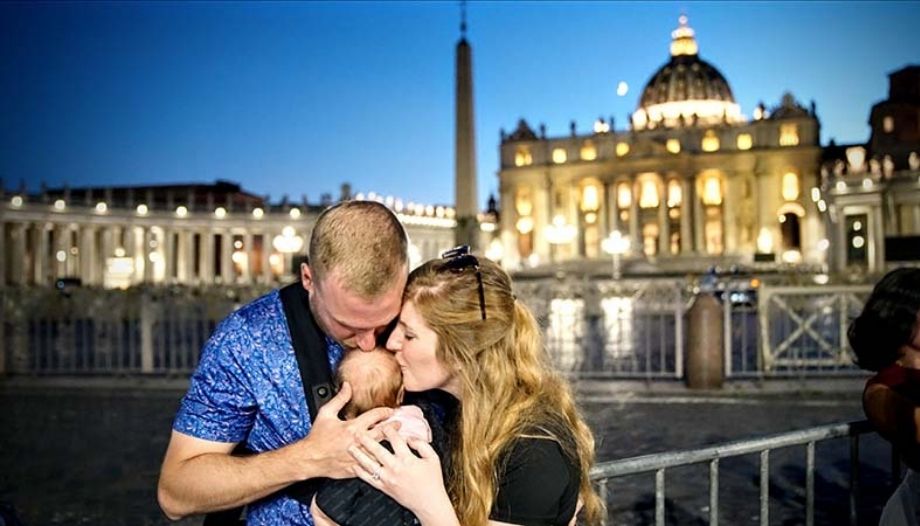
After receiving an invitation to attend the awards ceremony, she and her husband were unsure at first, as she knew she would be newly delivered at the time. But they decided they could attend in Rome when her parents and in-laws offered to accompany them and help with the baby. They formed a special family trip to Rome during the Jubilee Year of Hope.

The baby was born one month before the awards ceremony

Their daughter, Gabriella, was born just over a month before the awards ceremony and was named in honor of the angel Gabriel and the feast of the Annunciation.

The delivery and postpartum went very well and they even got Gabriella's passport and birth certificate in time for the trip, "by the grace of God," LaRosa said.

She expressed her gratitude for her personal journey by singing 'My Soul Proclaims', and then being invited to perform it in Rome.

"It came full circle."

"I had just had my daughter five weeks before I sang it in Rome," she said. "It came full circle from when I sang it in the music video while I was a week pregnant, to when I sang it in Rome five weeks after giving birth and my daughter was there with me."

"When I was announced as the best new singer, I almost fell on the floor," she said, "I feel so unworthy of it all and I'm so grateful for every moment...".

Seeing Pope Leo XIV, the first American pope, at the Angelus was also an incredible experience, she said, and little Gabriella received his blessing from afar in St. Peter's Square.

——————-

Lauretta Brown is culture editor of OSV News. Follow her on X @LaurettaBrown6.

—————–

This report was originally published in OSV News. You can consult it here

The authorOSV / Omnes

ColumnistsFernando Gutierrez

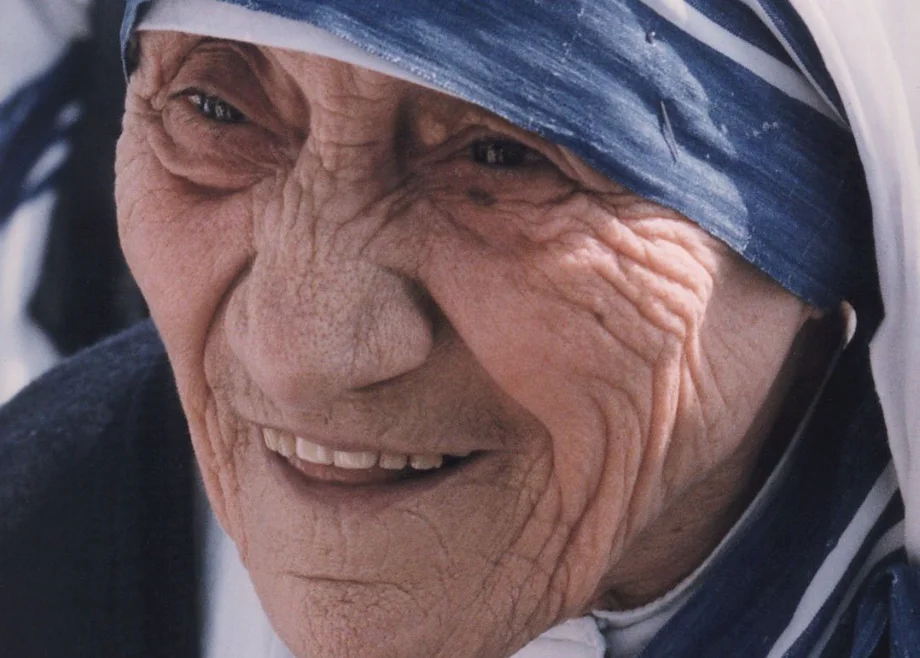
St. Teresa of Calcutta. The greatest gift

On September 5, 1997, Mother Teresa of Calcutta, whose charism the author of this text shares very closely, passed away.

September 5, 2025-Reading time: 3 minutes

Today the Catholic Church celebrates the memory of St. Teresa of Calcutta, a nun of Albanian origin who, with her yes to the Lord's plans, was able to bring the Love of God to the poorest of the poor in more than 130 countries. That is to say, to every corner of the planet. What is impossible for man is possible for God.

I remember these days that the same year that the Catholic Church, with Pope Francis at its head, canonized St. Teresa of Calcutta, a missionary of charity told me a phrase that stuck in my heart: "Our faith, compared to the faith of Mother, is very small". She was referring to Mother Teresa, whom this sister knew well during her formative years in Calcutta and whom she had seen embark on unexplored paths supported solely and exclusively by her trust in God. In her faith.

And if this nun's faith was, according to herself, small compared to Mother's, what would mine be like? I want that faith, I thought to myself immediately. At least that of the sister who might as well be the size of a mustard seed. I soon understood that having faith was not just a matter of wanting it.

My experience in Calcutta

During the fifteen months I lived in Calcutta there was one thing that caught my attention. The place where this great work of charity began, which God did through Mother Teresa in the humble neighborhood of Motijheel is still today a largely Muslim area in which there is still much poverty, both material and spiritual. And I often thought as I strolled through its streets: If I had grown up in Calcutta with a saint so close to me, I would have converted long ago and my faith would already be about the size of that mustard seed. And I would be lying if I did not say that many people in Calcutta and in other parts of the world came face to face with Jesus as a result of an encounter, fortuitous or not, with Mother or with one of her sisters. There are examples of this, I dare say, in all the places through which this hurricane of charity at the service of the King of humanity has passed.

These last few weeks in the Holy Land a similar thought has come to my prayer again. I do not intend, of course, to put Mother on the same level as Jesus, God forbid, but I can say that both Our Lord and this saint, and surely many other saints, share that mystery that perhaps one day we will be able to understand. The land where Jesus was born, the places where the very Son of God made man passed through, the mountain where he died crucified or the Holy Sepulcher from where he resurrected on the third day, are today places where his followers, the followers of Jesus Christ and his teachings, the Christians, are a minority. How is this possible?

I grew up in a Catholic family that educated me in the faith from an early age. I was baptized thirteen days after I was born, I always studied in Catholic schools and, moreover, in my home I had and still have, thanks be to God, the example of parents who, without being far from perfect, have always lived their faith with deep coherence. All this did not prevent, however, my encounter with the living God, in the Eucharist and in my brothers and sisters, especially in the most needy, from taking more than thirty years to arrive. How many baptized people live as if they were not baptized! How many Christians do not know Christ! How many! Too many.

Last Sunday, August 24, during the Angelus prayer in St. Peter's Square, the Holy Father Leo XIV addressed to us the following words that I believe we should meditate on:

"Our faith is authentic when it embraces our whole life, when it is a criterion in the decisions we make, when it makes us women and men who are committed to the good and capable of taking risks for love as Jesus did. He did not choose the easy path of success or power, but in order to save us, he loved us to the point of crossing the narrow gate of the Cross. He is the measure of our faith, He is the door we must cross to be saved, living His same love and being builders of justice and peace with our lives".

Today, as we remember throughout the world this great little saint of the end of the last century, an example of faith for the less young and also for the youngest who today continue to see how their lives are transformed by coming into contact with her Missionaries of Charity, as we raise our prayers for the poorest and for peace to St. Teresa of Calcutta, I propose to you, dear reader, two things: firstly, let us thank God for the immense gift of faith and secondly, let us pray for all our brothers and sisters, for those who want to and cannot, for those who do not see even though they can't, in Calcutta, in Palestine or in Israel, so that every day more and more people may enjoy full happiness as a result of having received, freely and undeservedly, the gift of faith, the greatest gift.

The authorFernando Gutierrez

Lay missionary and founder of Mary's Children Mission.

Initiatives

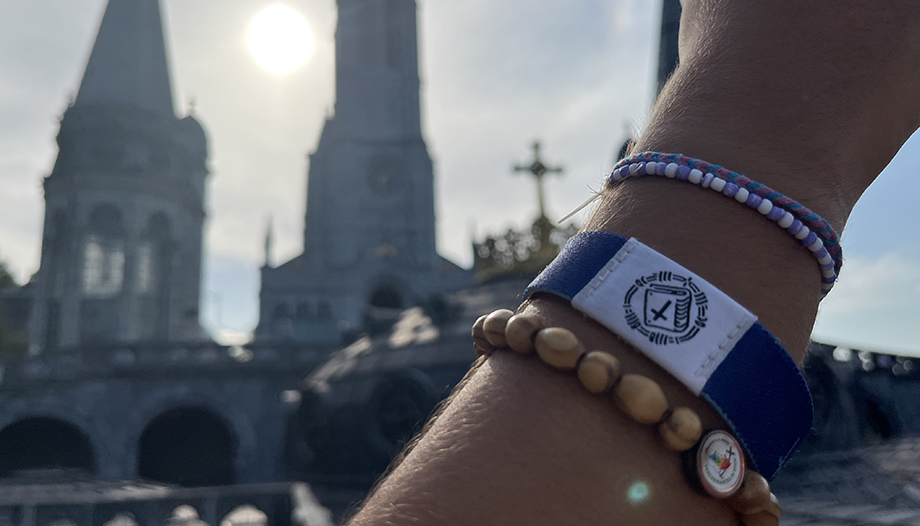
@Glorybiblebracelets What can the Bible say to you today?

With a lot of imagination, entrepreneurial spirit and a good dose of faith, two young Asturians launched, at the beginning of 2025, GloryBibleBraceletsNFC tags on wristbands and key chains give you access to different Bible verses.

Maria José Atienza-September 5, 2025-Reading time: 2 minutes

A bracelet that takes you to a Bible verse when you bring your cell phone close to it? This was the germinal idea of GloryBibleBracelets

The project was imported by Celia, one of its creators, from the United States: "I saw that there they were making a lot of bracelets of this type, with NFC tags that redirect you to the website of a store or a brand, and also to this type of religious content... I thought of making a line of this style with phrases from the Bible in Spanish and, together with a friend, we started up GloryBibleBracelets"

Not only bracelets

Since its launch, more than half a thousand bracelets and accessories have been sold in these months. Their buyers are teenagers, parish youth groups, etc. 

Although they began with a series of bracelets, through their website GloryBibleBracelets also offers key chains, fun stuffed animals of Jesus and Mini Jesus, figurines of just five centimeters. 

GloryBibleBracelets has become known, mainly, for its social networksand also by social networks have received numerous criticisms or disrespectful comments that their creators take with good humor: "We knew that in Spain it would be less well received than in the United States. There, religion is very much respected. Even if you are not a believer, people don't usually make fun of you; in Europe, and especially in Spain, this is often not the case."

Verse of the day from @Glorybiblebracelets.
Demonstration of @Glorybiblebracelets bracelets.

What makes this initiative special? 

Wristbands, key chains and soft toys are equipped with an NFC tag system, a short-range wireless communication technology that enables data exchange between devices in close proximity, usually within a few centimeters of each other, such as the one used for mobile payment. 

In this case, what this tag does is to send a link to the cell phone that, when opened, shows a Bible verse on a beautiful image. A way to "take the Word of God" with you and that can serve as an accompaniment or inspiration. 

For the young creators of GloryBibleBracelets "the purpose of the bracelets is to evangelize, but in a more modern and fun way". 

"The idea is that everyone can access the Word of God whenever they need or want it. There are those who every day, when they wake up, put on their bracelet to see a verse, or those who look for it when they are having a bad time at work....", they emphasize. A simple way to start prayer at any time of the day. 

Read more
Evangelization

Blessed Pier Giorgio Frassati: how to "be a saint in the normality of life".

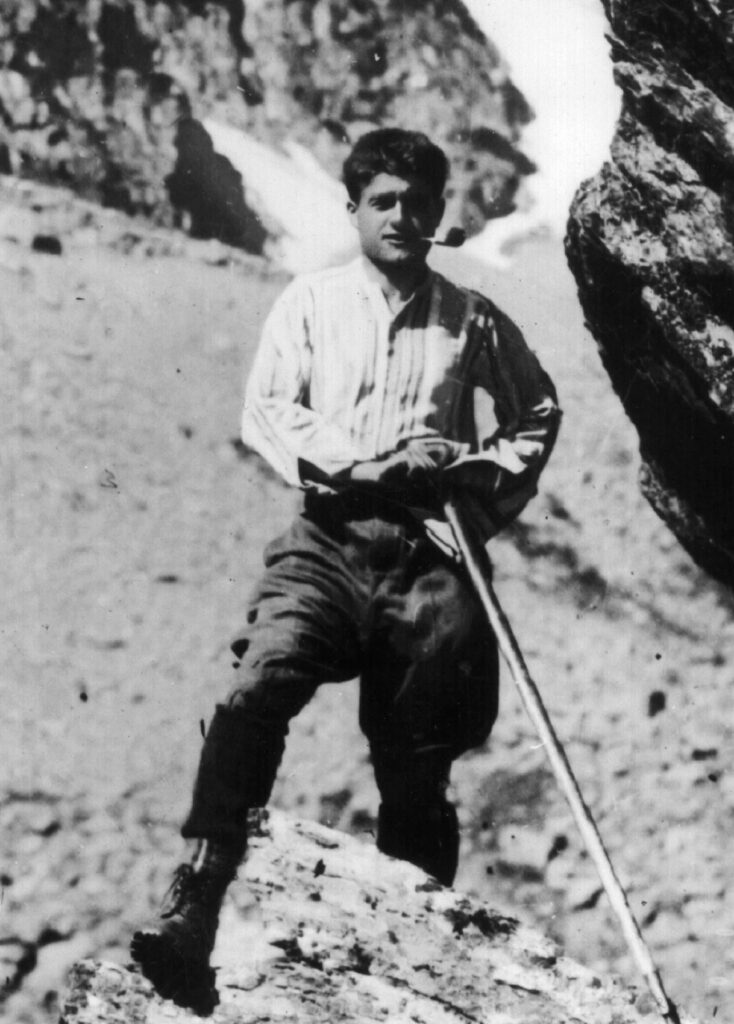
In a widely circulated photo, Blessed Pier Giorgio Frassati appears to pause during a mountain hike and leans on his cane, smoking a pipe. His posture is relaxed and confident. For many, Frassati is someone they could imagine among their friends, a future saint who somehow resembles them. Pope Leo XIV will canonize him, along with Carlo Acutis, this Sunday.

OSV / Omnes-September 4, 2025-Reading time: 6 minutes

- Maria Wiering (OSV News).

"What strikes me most about Pier Giorgio Frassati is his approachability," said Christine Wohar, executive director of FrassatiUSA. "He shows us how we can ... be saints in the normalcy of our lives."

Frassati was handsome, manly, robust, funny and athletic, he noted. He was devoted to the Eucharist and Mary, and spent time in adoration and praying the rosary. He came from a wealthy family, but was also committed to personal charity as well as broader social causes and faith-based activism.

However, according to Wohar, she also had challenges that were easy to identify with. His parents' marriage was on the verge of legal separation, he struggled to juggle his studies with other commitments. He was torn between dating a girl he liked and being misunderstood by family members. 

Will be canonized on Sunday, with Carlo Acutis 

Pope Leo XIV plans to canonize the young man from Turin, who died in 1925, along with his Italian compatriot, Blessed Carlo Acutis, on September 7. The date is a month later than the one originally indicated - though not confirmed - in November 2024 by the late Pope Francis, who had said Frassati would be canonized during the Jubilee of the Youth, July 28-Aug. 3.

Wohar had planned a group pilgrimage for that celebration, and when the date was changed, it proved too difficult to reschedule. So she and others spent late July and early August visiting Frassati-related sites in Italy before attending the Jubilee events in Rome. There they venerated Frassati's relics in the basilica of Santa Maria sopra Minerva, where his body had been temporarily transferred from Turin for the Jubilee celebration.

On that coffin was inscribed, in his handwriting, a phrase that many of his devotees have made his personal motto, loaded with spiritual meaning: "Verso l'alto" ("Towards the heights"). He wrote the phrase on another photo that had been taken of him while climbing, clinging to a rock face and looking toward the top. It would be his last climb.

Italian Blessed Pier Giorgio Frassati excelled in mountaineering. He died at the age of 24 and was beatified by St. John Paul II in 1990. This Sunday, the 7th, he will be canonized by Pope Leo XIV together with Blessed Carlo Acutis (CNS archive photo).

Pious Catholic, passionate activist for the poor

Pier Giorgio Michelangelo Frassati was born on April 6, 1901 in Turin, the son of Adelaide Ametis, a painter, and Alfredo Frassati, a journalist and politician, who was an Italian senator and ambassador to Germany. As a child, Pier Giorgio participated in Catholic groups and tried to receive daily communion. 

Strengthened by a solid prayer life rooted in Marian devotion and the Eucharist, at the age of 17 he joined the Society of St. Vincent de Paul. The goal was to care for the poor and wounded soldiers returning home from World War I. He was a member of the Society of St. Vincent de Paul. 

He was known for giving money and his possessions to poor people, and even gave up vacations at the family's summer home, saying, "If everyone leaves Turin, who will take care of the poor?"

Social Doctrine of the Church

His concern for marginalized and oppressed people would persist throughout his short life. It influenced his decision to study mining engineering at the Royal Polytechnic University of Turin, with the goal of ministering to miners. 

Although he was intelligent, his studies were affected by the time he devoted to helping the poor and to political activism. In 1919 he joined Catholic Action, which promoted the social doctrine of the Church, especially as articulated in the 1891 encyclical "Rerum Novarum," promulgated by Pope Leo XIII. 

Two years later, he helped organize the first Pax Romana conference in Ravenna, whose goal was to unify Catholic university students to work for world peace. In 1922, he joined the Lay Dominicans, also known as the Third Order of St. Dominic, choosing the name "Girolamo," in honor of the fiery 15th century Dominican preacher in Florence, Girolamo Savonarola.

Frassati, known for his cheerfulness, reverence and occasional bickering

During his youth, he was an avid lover of outdoor activities and enjoyed skiing and mountaineering, art and music, poetry and theater. He regularly gathered his friends together and was known to be a prankster, shortening his friends' sheets and waking them up with trumpet blasts, which earned him the nickname "Fracassi," as a "flop," a noisy fuss.

"He knew how to have fun," Wohar said. "He was an explosion of joy. He was the life of the party." But in church he was reverent and serene, "He would talk everything over with the Lord," he added. 

"He made religion seem fun and engaging," Wohar said. "Stories are told about how he would place bets and, if he won, his friends had to go to adoration or Mass or pray the rosary or something like that." "He believed that the apostolate of persuasion was the most beautiful and necessary thing to help his friends find the way of God."

Frassati was also involved in fist fights because of his faith-based political convictions. And on more than one occasion, in clashes with communists, fascists and law enforcement during activist demonstrations.

In the midst of his studies, social life and political activism, Frassati continued to take his spiritual life, charitable works and evangelizing efforts seriously, never missing an opportunity to invite his friends to join him in prayer, Scripture reading or Mass.

Aware of its eternal future

An often overlooked aspect of Frassati was his daily attention to death, Wohar said. He was committed to preparing each day for his own death, saying he had the "ambition" to meet God, even as his judge.

"He was aware of his eternal future, and that really determined how he lived his present," she said. "He wrote beautiful letters about it. One day he visited someone who had just passed away in the hospital and said, 'This is what's going to happen to me in a short time,' which was almost prophetic."

Symptoms of polio. Fullness of charity

In late June 1925, Frassati began to experience symptoms of polio, which he probably contracted while visiting the sick and poor of Turin. However, her grandmother was also dying at home, so she minimized her illness and focused on it, as did her family. She died on July 3.

As his suffering worsened, his mind was also on his friends and the poor. He implored his sister, Luciana, to deliver medicines and other promised items to the needy whom he visited regularly. She recounted this in her book "My Brother Pier Giorgio: His Last Days". 

Pier Giorgio Frassati died on July 4, 1925, at the age of 24, and his funeral was attended by hundreds of the poor of his city, revealing to many, especially his relatives, the fullness of his charity. He was initially buried in the family crypt in the nearby town of Pollone, but his body was transferred to the Cathedral of St. John the Baptist in Turin after his beatification in 1990.

Pier Giorgio Frassati was "immersed in the mystery of God and totally dedicated to the constant service of his neighbor: this is how we can sum up his earthly life," said St. John Paul II (OSV News photo/Catholic Press Photo).

Frassati: a "man of the beatitudes".

At Frassati's beatification, St. John Paul II described him as a "man of the beatitudes".

"In him, faith and daily events merge harmoniously, so that adherence to the Gospel translates into loving care for the poor and the needy, in a continuous crescendo until the last days of the illness that led to his death," the Pope said. 

"His love of beauty and art, his passion for sports and the mountains, his attention to the problems of society did not diminish his constant relationship with the Absolute," he continued. "Totally immersed in the mystery of God and totally dedicated to the constant service of his neighbor: this is how we can sum up his earthly life!".

A 'Saint Frassati' for our times

Although Frassati's cause for canonization was opened shortly after his death, it stalled for some time. Wohar said he believes his canonization this year, a century after his death, is part of God's plan. 

"The Lord, in his wisdom, knew that we needed a Pier Giorgio Frassati, a Saint Frassati, for a time like the one we are living in now," he said.

"If he had been canonized, for example, in the 1940s, we might never have had him on our radar," he continued. "Perhaps he would have fallen into oblivion as one of the many, many, many Italian saints. The fact that he is canonized in this Jubilee Year of Hope, when we need hope in our culture, I think presents an image of hope for young adults, for everyone, but especially for that age group."

He added, "It's God's perfect timing."

——————

Maria Wiering is editor-in-chief of OSV News.

This report was originally published in OSV News, and is available at here.

——————

The authorOSV / Omnes

The World

Catholics and Civil Society Join Forces in Lithuania’s March for Life

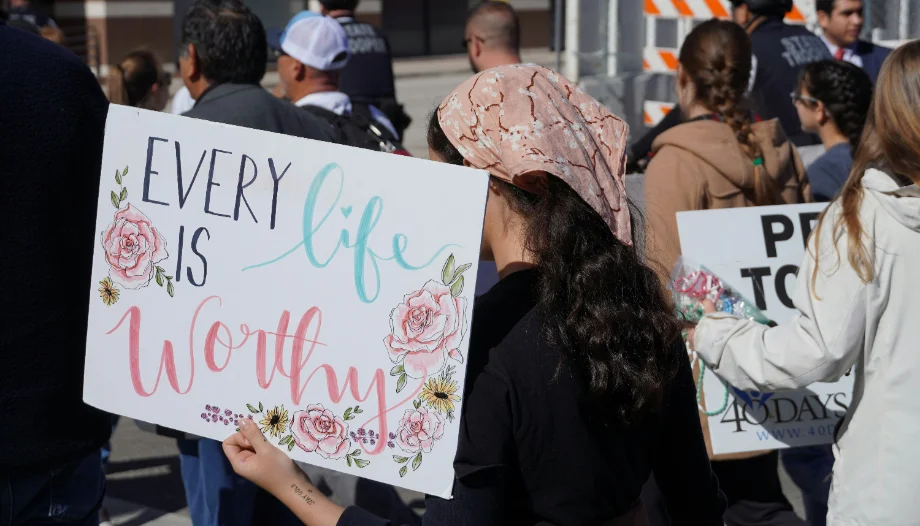
Vilnius will host Lithuania's largest March for Life in more than three decades on October 4, and organizers expect participants from across the Baltic region. This comes just before the Lithuanian Parliament debates a major law on reproductive health.

Bryan Lawrence Gonsalves-September 4, 2025-Reading time: 4 minutes

The March for Life comes as parliament continues deliberations on a reproductive health bill that would expand abortion access and public funding. The measure narrowly passed its first reading in May 2025 and will next move through committee hearings and debates before a final vote.

Lithuania is one of the few EU countries where abortion is legal but largely unregulated; under Soviet occupation and rule, the procedure was tightly controlled by the state. After independence, the country continued to rely on Soviet-era abortion regulations. The proposed Reproductive Health Law would formalise and broaden access, turning abortion from a ministerial decree into full legislation.

The proposal

Simonas Streikus, the main event organiser of Zygis už gyvybę (March for Life) in Vilnius, informed that the event was intended to highlight the enduring importance of human life. “There are values that never change. Chief among them is human life, the foundation of our humanity. To remain truly human, we must honour life with respect, with love, with responsibility, and with protection. This is why we march, so society may see and remember this truth,” he said. 

The March for Life will set off from the Martynas Mažvydas National Library at 1 pm, proceed down Gedimino Avenue, and conclude in Vilnius Cathedral Square with speeches, music, and family activities. Organisers say ending in there is intentional, pointing to its place as both the civic and spiritual heart of the capital. By finishing there, they hope to tie the defense of life to Lithuania’s broader historical identity, at the crossroads where faith, politics, and culture have long converged.

Ramūnas Aušrotas an advocate of the Vilnius March for Life, who works as a lecturer of Bioethics at the Lithuanian University of Health Sciences, had this to say “In contemporary bioethics, a troubling inconsistency is evident, for when an unborn child is desired, every medical resource is mobilised to safeguard its life. When the child is not desired, suddenly the standards shift, and termination is allowed. Some call this a social compromise; in truth, it reflects an ethical inconsistency. Human life cannot be both valued and denied”.

The new law

The proposed law would allow abortion on request up to 12 weeks of pregnancy, and up to 22 weeks in cases of rape, incest, or medical necessity. It would also expand access by making both surgical and medical abortions widely available, including through telehealth consultations, while requiring the procedures to be fully funded by taxpayers, effectively establishing abortion as a state-guaranteed service.

“I’ve seen the miracle of life at its beginning and the dignity of its natural end”, said Richard Cervin, a family doctor with more than 30 years of experience in Lithuania. “If we cannot stand for the defenceless, whose life need we defend? Protecting the life of the unborn is not political or ideological, but simply very human”. 

Sum of forces

The upcoming March for Life is being organised by a coalition of civil society groups and lay Catholic organisations, reflecting a broad base of support. While rooted partly in Catholic involvement, the march itself is secular in nature and open to participants of all faiths or none at all.

Organisers expect families, students, medical professionals, and young social activists to take part, underscoring the event’s wide appeal. “The sanctity of life transcends religious boundaries, you don’t need to believe in God to know that killing the vulnerable is wrong”, said Diana Karvelienė, the events communications director. She emphasised that the initiative is ultimately one of hope, expressing solidarity with mothers whose strength often goes unrecognised and with fathers whose support is vital for both mothers and children.

As the October 4 march approaches, it is not only seen as a peaceful public march against pending legislation, but also as an affirmation of Lithuania’s moral compass. For participants, the debate over reproductive rights is not merely a matter of policy, but a question of national identity which begs the question of what kind of society Lithuania chooses to build for future generations. 

When asked why she would be participating in the March, Lukrecija Kozlovskytė, an artist and former council member of Ateitininkai, a Lithuanian Catholic youth organisation, had this to say “I can’t stand by while innocent lives are being taken. To me, it would be like witnessing a killing in the street and doing nothing”.

Regardless of how the Lithuanian parliament votes, the Vilnius March for Life is poised to become a turning point in the country’s public conversation on human dignity, the role of the state in protecting it, and the determination of citizens to stand for their convictions. For participants, the event is an act of solidarity in standing for the unborn while also lifting mothers and fathers in the sacred task of raising a family. In the end, they hope their presence will bear witness to a single core truth, that life, in all its fragility, is always worth defending.

The authorBryan Lawrence Gonsalves

Founder of "Catholicism Coffee".

Read more
Evangelization

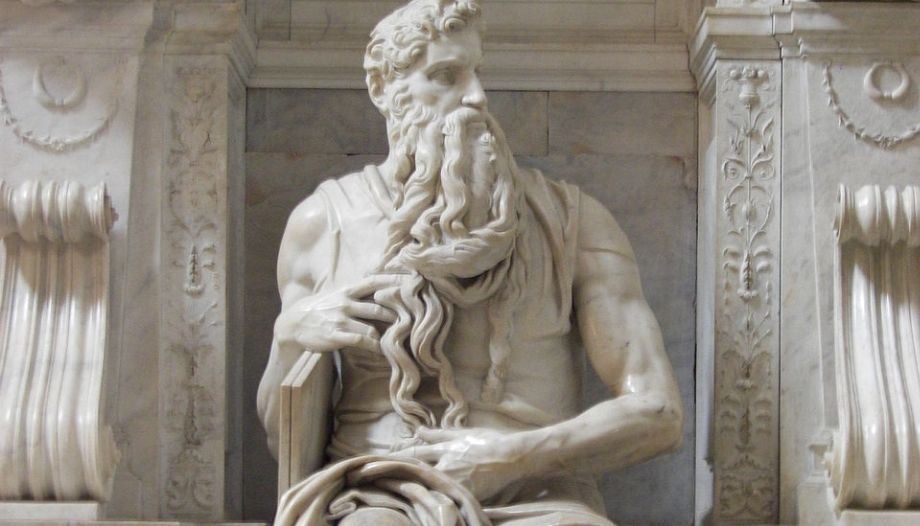
St. Moses, liberator of the Hebrew people and transmitter of the Decalogue

On September 4, the Church celebrates St. Moses, prophet and liberator of the Hebrew people from the slavery of Egypt to the Promised Land, according to the Bible. He received from God the Ten Commandments (the Decalogue) on Mount Sinai, and is a central figure in Judaism, Christianity and Islam.

Francisco Otamendi-September 4, 2025-Reading time: 2 minutes

Moses is known for leading the Hebrew people out of slavery in Egypt to the Promised Land, receiving the Ten Commandments from God on Mount Sinai and acting as a lawgiver for his people, as narrated in the Bible. He is considered a great prophet.

He led his people through the desert for forty years to reach Canaan, God's Promised Land. Moses received the Decalogue directly from God on Mount Sinai (Exodus 20). When the Son of God became incarnate, to the question of what is the greatest commandment of the law, Jesus said, "You shall love the Lord your God with all your heart and with all your soul and with all your mind," and "You shall love your neighbor as yourself."

St. Moses was the legislator who dictated the norms and precepts for the life of the Israelites, based on the Covenant with God. Jesus quotes him on numerous occasions in the Gospels. At the Transfiguration, the Lord appears gloriously to the apostles together with the prophets Moses and Elijah, who converse with him.

"I am who I am."

In the vatican saints' calendar a comprehensive synopsis of the life of Moses can be read, collected in the five books of the Pentateuch of the Bible. Numerous biblical facts can be cited from the lives of Mosessome of which have been captured on film. 

Born in Egypt and deposited in the Nile to avoid his death, he was taken from the waters by Pharaoh's daughter, who adopted him as her son. Later, the Lord appeared to him in a burning bush and said, "I am he who am" (Exodus 3).

God said to Moses, "Go to Pharaoh king of Egypt and tell him to let the children of Israel leave his land. But Moses excused himself, "If the children of Israel will not heed me, how will Pharaoh heed me, for I am dull of speech?" And God sent him with his brother Aaron to ask for the freedom of the Hebrew people.

At the gates of the Promised Land

After the plagues of Egypt, Moses led the people of Israel through the Red Sea and the desert. He died on Mount Nebo, in the land of Moab, at the gates of the Promised Land. 

Items 2052 to 2082 of the Catechism of the Catholic Church explain the Ten Commandments, the Decalogue, from the point of view of Sacred Scripture and the Tradition of the Church. 

The authorFrancisco Otamendi

Read more

On the delirious effort to make Cervantes a homosexual

Alejandro Amenábar's new film has reopened the old and hackneyed debate about whether Miguel de Cervantes could have been a homosexual.

September 4, 2025-Reading time: 3 minutes

I have spent 25 years studying Cervantes, 8 of them exclusively. I have defended and published a doctoral thesis on the Quixote. I have read dozens of books and articles about the author and his work. I have published a monograph on love in the Quixotean edition of The curious impertinent, y I have published six book chapters, seventeen articles and a prologue on aspects of Cervantes, and I have presented fourteen papers or communications at conferences. Finally, I have also given seminars and conferences on the one-armed man of Lepanto and even led guided tours. 

After these years of study, the proposal of Cervantes' homosexuality seems strange and impostured to me. Our author had a natural daughter, was married, and paid special attention to women: his work is full of strong female characters. I do not use this to prove that he was not homosexual, but I do affirm that it is neither shown nor demonstrated that he was.

It is clear that since the beginning of this third millennium a particular obsession with homosexuality has emerged. But it makes no sense to reread the past based on the prejudices of the present. I remember a magnificent doctoral course directed by a wise professor at the University of Granada. It dealt with the mysticism of St. Teresa and St. John of the Cross. A student raised the possible homosexuality of the apostle St. John, Jesus' favorite. The professor explained that not every relationship of friendship had to be sexualized, that our current prism suffered from a certain distortion in relation to these issues.

I have no special interest in denying Cervantes' homosexuality, but it is surprising the tendency to turn everyone into a homosexual. It seems as if such a prototype should displace the hero, the athlete, the wise man, the orator, the martyr, the saint, the knight, the donna angelicata, the courtier and the discreet. Because these anthropological models that I have just mentioned are so because of their actions, not because of their sexual orientation. The merit of the human being lies, as Cervantes precisely defended, in virtue, and not in blood (and I add, not in sex).

Cervantes was held captive in Algiers for five years. He tried to escape unsuccessfully on several occasions, and he never slipped up: he acknowledged the facts. Paradoxically, he did not receive the punishment that those escapes deserved. And some think that one cause of the leniency towards him could be in his homosexuality. It is a hypothesis. Cervantes carried with him some letters, one of them from Don Juan de Austria, which presented him as a brave soldier, which caused a higher ransom to be demanded for him and, probably, that he was treated with greater tolerance, besides his strong personality made him a very unique person. In any case, a hypothesis is not proof. It is a very contemporary attitude that the critical subject neutralizes or kills the object. But it is fairer for the subject to respect the object, whether texts or people.

However. We own his writings. As I said, I have published a study of love in the Quixote. The conception of love that emerges from Cervantes' great novel is wonderfully humanistic, a synthesis of Judeo-Christian and Greco-Latin thought, with the virtues of prudence, justice, fortitude and temperance being the cornerstone on which this cartography of love rests. Love emerges not only as a mere sentiment ("love in young men for the most part is not, but an appetite", we read in chapter 24 of the first part of the Quixote), but a knowledge, a will, a surrender in freedom.

As a good man of the golden century, Cervantes is captivated by beauty, particularly feminine beauty, an ecstasy that is rooted in the troubadour, stylnovist and pertarchist lyric. The quixotic epicenter is rather the friendship between Don Quixote and Sancho: a love of friendship that should not be confused with erotic love, nor with love of necessity. The Banquet Plato's De amicitia of Cicero or The four loves by C. S. Lewis, among many other works, can illustrate the marvelous and polyphonic mosaic of love in the European tradition. 

The monotonous obsession with sex is a contemporary "contribution". But the reading of Cervantes or other classics could free us from this corset, already so tiresome. 

The authorAntonio Barnés

Gospel

The cross of perseverance. 23rd Sunday in Ordinary Time (C)

Joseph Evans comments on the readings for the 23rd Sunday in Ordinary Time (C) corresponding to September 7, 2025.

Joseph Evans-September 4, 2025-Reading time: 2 minutes

In today's Gospel, Jesus is difficult to understand. He begins by talking about the need to carry the cross. We may not like it, but we understand what he is saying. We have to accept hard things in life to be his disciples: a soft and easy life will not get us to Heaven. Our Lord then says some hard things, that each one has to "postpone" a "his father and mother, his wife and children, his brothers and sisters, and even himself."in the sense of radically putting them in second place to God.

But the second part of the Gospel gets confusing. After telling us that we have to carry our cross, Jesus seems to jump to something that has nothing to do with it. He tells us the parable of a man who started to build a tower and couldn't finish it, so he was mocked. Then he tells of a king who goes to war with another king and needs to make sure he has enough men to take on his opponent. If he realizes he doesn't have them, he sends envoys to sue for peace. Jesus ends by saying that we cannot be his disciples unless we give up all our possessions. But what does not being able to finish a tower or realizing that one has a weaker army than the enemy have to do with carrying our cross?

Perhaps the answer lies in realizing that often one of the biggest crossroads we face is simply the need to persevere in what we have started. We may undertake activities or life commitments full of enthusiasm, but when the going gets tough, we start to doubt and think about giving up, and sometimes we do. People give up all kinds of projects for this reason. Or marriages break up. Or people are not faithful to their vocation. When the enthusiasm runs out, when the spark goes out, they give up. Many are good at starting, but fewer have what it takes to see what they have started through to the end. St. Paul shows this heroic perseverance in today's second reading, embracing his imprisonment for Christ and even willing to give up one of the few consolations he had, the presence of Onesimus.

Any self-respecting company goes through difficult times and we have to persevere. We have to keep building even if it is difficult and not try to get back what we once gave up. And if I really don't think I can persevere, maybe I shouldn't start, until I am ready to do so. Like that king who asks for peace. But what he should do then is take the necessary steps to build his army.

Sometimes prudence demands that we do not start something because we realize that we are too weak to do it. But then we ask God for the strength we lack and work to overcome the weakness or bad habits that hold us back.

The Vatican

Pope Leo, who sees Jesus as "beggar of love," grieves for Sudan

In Wednesday's Audience, Pope Leo XIV pointed out that the thirst of Jesus on the cross is that of a "beggar of love". Man is not fulfilled in power, but in trusting openness to others, even when they are hostile and enemies, he said. At the end, he expressed his sorrow for the tragedy of Darfur (Sudan), and prayed for children and young school children.

Francisco Otamendi-September 3, 2025-Reading time: 3 minutes

After greeting thousands of people present in St. Peter's Square in the Popemobile and blessing numerous babies, Pope Leo showed in the Audience their sorrow and prayers for the victims of the natural catastrophe in Sudan. 

He also reminded the Pope St. Gregory the Greattoday's liturgical memorial, to the next saints Pier Giorgio Frassati y Carlo Acutiswho will be canonized on Sunday. And he asked, addressing especially the Polish-speaking pilgrims, that "September be a month of prayer for the children and young people who return to school and for those who care for their education." 

Let us ask for them, he said, "through the intercession of the Blessed, soon to be saints, Pier Giorgio Frassati and Carlo Acutis, the gift of a deep faith in their journey of maturation. I bless you from my heart.

Tragedy of Darfur

Pope Leo XIV has offered his prayers for the deceased following days of heavy rains that triggered a landslide in a remote area of Sudan. And he has prayed for all those involved in the ongoing search and rescue operations.

"His Holiness Pope Leo XIV was deeply saddened to learn of the the devastation caused by the landslide in the village of Tarasin, in the central Darfur region of Sudan, and assures all those affected by this disaster of his spiritual closeness," said a telegram from Cardinal Pietro Parolin, Vatican Secretary of State, to Bishop Yunan Tombe Trille Kuku Andali of El Obeid.

Pope Leo today appealed "to those responsible and to the international community to ensure humanitarian corridors and a coordinated response" to stop the humanitarian catastrophe.

At least 1,000 dead

Late on Sept. 1, the Sudan Liberation Movement-Army, a rebel group that controls the area, reported yesterday that the entire village of Tarasin had been buried by the Aug. 31 landslide and that up to 1,000 people were dead, according to OSV. The group claimed that only one person had survived, The Associated Press reported.

The BBC later quoted the UN deputy humanitarian coordinator for Sudan as saying that at least 370 people had died in the landslide in the village, located in the remote Marrah Mountains in western Sudan.

Antoine Gérard, a UN official, told the BBC that because the area was so remote and rugged, it was difficult to know the extent of the damage or the exact number of casualties.

Crucifixion. "I thirst." 

In his catechesis, the Pope resumed the cycle of the Jubilee Year, 'Jesus Christ Our Hope', and centered his meditation on the theme 'The Crucifixion. I thirst' (Jn 19:28)".

The thirst of the crucified is not just a physiological question, it is the profound expression of a desire: "Jesus thirsts for love, relationship and communion," he said. "He is not ashamed of having assumed our fragile humanity. He who has given everything, does not hesitate to show himself in need". 

Two reflections on power

Further on, he has referred to power on at least two occasions. 

On the one hand, he reflected on the gesture of Jesus. "This gesture is an eloquent sign that man is not fulfilled by the force of power, that he is not enough to save himself, but that he is in need of others, that he must learn to open himself trustingly to others. For our love to be authentic, we must not only give it, but receive it. Jesus teaches us to give, but also to receive love".

He also added: "This is the Christian paradox: God saves not by doing, but by allowing himself to be done. Not by overcoming evil with force, but by accepting to the end the weakness of love". 

"On the cross, Jesus teaches us that man is not fulfilled in power, but in trusting openness to others, even when they are hostile and enemies. Salvation is not in autonomy, but in humbly recognizing one's own need and knowing how to express it freely".

Pilgrims from many countries 

In his words to the French-speaking pilgrims, he especially greeted those from "Senegal, accompanied by their bishop, Bishop Paul Abel Mbamba, and those from Luxembourg and France".

The Pope paid special attention to the list of pilgrims and visitors from English-speaking countries, in whole or in part, who participated in today's audience. In particular the groups from "England, Scotland, Ireland, Northern Ireland, Austria, Denmark, Malta, the Netherlands, Switzerland, Cameroon, Australia, Hong Kong, Indonesia, Japan, the Philippines, Vietnam and the United States of America".

He reminded Spanish-speaking people of "St. Gregory the Great. Let us ask the Lord that in our pilgrimage through this world, through the intercession of this holy Pope, we may be able to recognize with humility our need for God's love and that of our brothers and sisters.

"Let us not forget that only He, the Infinite One, can quench our thirst for the infinite," he reminded those who speak German. As usual, there were also words for the Chinese, Portuguese, Arabic, Polish and, of course, Italian speakers.

The authorFrancisco Otamendi

Evangelization

St. Gregory the Great, Pope and Doctor of the Church, and Apostle of England

The liturgy celebrates on September 3 St. Gregory the Great, Pope, one of the four great Latin Fathers, along with St. Augustine, St. Ambrose, and St. Jerome. He promoted liturgical chant (Gregorian chant), the reform of the Mass, the management of Church goods, and the evangelization of England. 

Francisco Otamendi-September 3, 2025-Reading time: 2 minutes

Of Christian family, St. Gregory was born in Rome around 540. As a young man he became prefect of the city. Later, he distributed his patrimony to monasteries and became a monk in the Benedictine abbey of St. Andrew, of which he later became abbot. Pope Pelagius II appointed him papal legate in Constantinople, but the pontiff died of the plague. And in the year 590 St. Gregory the Great was elected pope who was to become the apostle of England.

During his Pontificate he stood out for his zeal for the liturgy and the elaboration of the Sacramentary that constitutes the fundamental nucleus of the Roman Missal. Also for the promotion of the liturgical chant that bears his name (Gregorian) and his evangelizing impulse.

In the year 597, St. Gregory sent to saint Augustine of Canterbury and a group of forty monks to evangelize the Anglo-Saxons in England. The mission brought the Christian faith to King Ethelbert, who had married Bertha, a Christian princess of the Frankish royal family, and to thousands of Saxons, and laid the foundations for the spread of Christianity in Europe. St. Gregory the Great died on March 12, 604.

Martyrs in Japan, Korea and France

The liturgy also welcomes today the blessed Bartolomé Gutiérrez and companions martyred in Japan. Three of them were Augustinians, one a Jesuit and two Franciscans. They were imprisoned in persecutions against Christians, and wanted to make them apostatize, but they remained firm in the confession of Christ. After being tortured, they were burned in 1632 in Nagasaki. 

Saints John Pak Hu-jae and five women were lay people who were also made to suffer for their firmness in the faith, and were beheaded in Seoul (Korea) on September 3, 1839. 

The liturgy also celebrates today 72 other blessed French martyrs, mostly priests, from the diocese of Paris or from other dioceses or religious institutes. They were killed on September 3, 1792, one day laterat the Lazarist seminary of St. Fermin in Paris. 

The authorFrancisco Otamendi

Evangelization

History of the icon of Our Lady of Czestochowa: wars and scars

The famous image of Our Lady of Czestochowa, known as the 'Black Madonna', is the protagonist of a dramatic story intertwined with Polish history and faith. While legends trace the image to St. Luke and the table of the Holy Family, art historians date it to between the 6th and 14th centuries. What is certain is its enduring role as the spiritual protector of Poland.  

OSV / Omnes-September 3, 2025-Reading time: 5 minutes

- Czestochowa, Poland (OSV News). 

While the famous image of Our Lady of Częstochowa is known throughout the world, its history is full of dramatic events that are worth recognizing. 

From legends about the origin of the wood on which the "Black Madonna" was written - icons are 'written', not painted - to the reason why the image is marked. The icon reflects the historical destiny of Poland and is a spiritual refuge for Catholics from all corners of the world.

Origins of the icon of Our Lady 

The date of creation of the icon is uncertain, and art historians believe it to be a Byzantine icon from the 6th or 9th century or from the 12th-15th century. It is known to have been brought to the Jasna Góra monastery in the 14th century.

However, legend attributes it to St. Luke, who allegedly wrote the icon on the table where the Holy Family dined. "Legend has it that the Jasna Góra icon was created on a table in the home of the Holy Family," Father Michal Legan, a Pauline priest from Jasna Góra, told OSV News.

"Today we know that this is not true. But we can easily imagine that this icon has an impact on the life of Polish families and families all over the world. Because it hangs in practically every Polish home, somewhere where families gather and pray," noted Father Legan, who heads the Catholic newsroom of Polish television.

Hidden during World War II occupation of Poland

In fact, a huge library table is the piece of furniture that helped save Our Lady from the horrors of the Nazi German occupation of Poland.

The outbreak of war posed a serious threat to Jasna Góra. The German Nazis understood the deep religious and cultural significance of the icon of Our Lady of Częstochowa. There was a real danger that the painting would be seized, destroyed or sold to private collectors.

Faced with this threat, the Pauline monks took a bold step. They hid the icon in a specially prepared compartment on top of one of the tables in the Jasna Góra library. Its monumental size and unpretentious appearance ensured that the priceless treasure would go unnoticed.

The former library of the Marian shrine of Jasna Góra in Czestochowa, Poland, houses two unique tables handmade in the 1730s. During World War II, for fear of the Nazis, the icon was hidden in one of the tables (Photo by OSV News/courtesy of the Jasna Góra shrine).

In the old Library, two masterpieces 

The Old Library in Jasna Góra houses two unique tables crafted in the 1730s by Brother Grzegorz Woźniakowicz. They are masterpieces of wood carving and marquetry, richly decorated with scenes of saints and made of a variety of woods with Baroque-level craftsmanship.

Their design was not only decorative, but also practical. The tables were built as individual, non-detachable units, so heavy and monumental that it was physically impossible to remove them from the library. This feature proved crucial in protecting the icon of the Black Madonna during the war.

At one point, the Nazi occupiers of Poland planned to transport the tables to Dresden in Germany as valuable works of art. As the threat intensified, the icon was moved again, this time walled up in a monastery cell. It survived the darkest years of the war, although subsequent moves caused some damage that required restoration later.

A "symbolic ark", such as an heirloom, a shield

Although the icon did not spend the entire war inside the table, its role remains significant. It was the first hiding place, a symbolic "ark" intended to protect the spiritual treasure of the nation. Today, the table is treated as a historical relic. Almost as valuable as the rare books and manuscripts that surround it in the library.

"There is a beautiful symbolism in the fact that the icon, which according to legend was painted on the table of the Holy Family, was hidden during World War II from the Germans. Precisely on one of the most beautiful tables that can be found in Poland and Europe," said Father Legan.

A Pauline priest who showed the table to OSV News described it as "not just a piece of furniture," but rather as "a shield, a refuge and protection." And he noted that "without the brothers' decision" to hide it, "who knows what would have happened to the painting?"

Scars of the 15th century

However, the image did not escape damage over the centuries, with scars dating back to the 15th century that make the "Black Madonna" one of the most famous Marian images in the world. 

In 1430, thieves attacked the monastery at Easter, cutting and breaking the image in the Chapel of Our Lady. King Władysław Jagiełłło ordered its restoration. And painters reassembled and repainted the panel, although conservation methods were poor. The scars are still visible, either because attempts to cover them failed or, as tradition holds, they were deliberately left as a reminder of the attack. 

It is also Our Lady's appearance that makes her unique, Father Legan told OSV News. "According to St. John Chrysostom, an icon is not meant to be looked at and admired, but rather for the person depicted in the icon to be able to look at you," he said. "It is about God's gaze, which is full of goodness and does not judge, and the gaze of the Blessed Mother, which also allows us to discover our dignity."

Bishops pray before the image of Our Lady of Czestochowa at the Marian shrine in Jasna Góra on May 2, 2025 (Photo by OSV News/courtesy of the Polish bishops' conference).

Queen of Poland, venerated by faithful from many countries

While Our Lady of Częstochowa is primarily the "Queen of Poland," her importance extends beyond the country. The icon has been venerated for centuries by faithful from other nations. In 2024 alone, more than 4 million pilgrims visited the Jasna Góra shrine, a place of beloved spiritual refuge for many Polish saints, including St. John Paul II. 

A special shrine in Doylestown, Pennsylvania, nicknamed "American Częstochowa," has been run by the Pauline Fathers since the 1950s. It has become a place of pilgrimage for Polish diaspora communities and others seeking spiritual guidance, a reflection of Jasna Góra across the Atlantic.

The authorOSV / Omnes

Spain

University of Navarra launches online course on Bible and archaeology

The program is aimed at anyone interested in delving deeper into the Bible and Middle Eastern culture.

Editorial Staff Omnes-September 2, 2025-Reading time: 2 minutes

What was the Holy Land like in the time of Jesus? What is the relationship between the archaeological remains and the biblical accounts? These are some of the questions that will be addressed by the new course promoted by the School of Theology of the University of Navarra, which seeks to bring participants closer to the origins of Christianity through history, geography and archeology.

The program is offered in collaboration with Cretio Foundation (USA) and Saxum Visitor Center (Israel). It will be taught entirely online, in Spanish or English, starting on September 29th. With a duration of ten weeks and a course load of 2 ECTS, it will allow each student to progress at his or her own pace and with full flexibility.

Why learn about archaeology

Diego Pérez Gondar, professor of the Faculty of Theology and academic director of the course, stresses the importance of this training: "If you don't know who you are and where you come from, you are doomed to repeat the same mistakes over and over again. If only to understand the problems of today's world, I think it is essential to have a minimum knowledge of the origin of civilization and the contributions of Judeo-Christian monotheism, Greek thought and Roman law"..

The course will also highlight the role of biblical archaeology as a key to reading ancient texts. According to Pérez Gondar, "Faith is not pure fideism or fundamentalism; faith needs a logic. A good part of that history has left its remains, which are studied by archaeology, and which help to understand how to read the texts that arose in that ancient context.". He adds that these questions are of interest to both believers and non-believers, because "what human beings really need is to resolve the meaning of existence"..

Conceived as a "academic pilgrimage" In the Holy Land, the course will cover its geography, its history and the main biblical texts, with special attention to the New Testament. "We would like it to be the first of other similar courses, as there is a lot of material to pass on."The academic director points out.

Books

A new edition of The Way for the 21st Century Reader

Thanks to this work, The Way can continue to be read with profit by new generations, not only as a historical document or as a classic of spirituality, but as what it always was: a living book, written to accompany people in their dealings with God.

Javier García Herrería-September 2, 2025-Reading time: 4 minutes

"You write to me: "Father, I have... a toothache in my heart". -I don't take it as a joke, because I understand that you need a good dentist to do some extractions. If you would let yourself!..." (point 166). When a young reader in the 21st century reads a simple Camino point like this one, he may not fully understand its meaning, since the word "chacota" is completely foreign to today's reader.

You might also be surprised to find expressions such as "holy intransigence", "holy coercion", "holy shamelessness", "holy ambition", "holy irreverence" or the call to "blindly obeying the superior". These phrases from The Way can be understood in a benign light, as emphatic rhetorical devices, if one assumes a good concept of the author or contrasts these ideas with other passages in the work or in other books of St. Josemaría. However, an isolated and decontextualized reading of these terms could be misleading.

Why a new annotated edition?

Although there was already a critical edition of reference -that of Pedro Rodríguez, published in 2002, focused on the literary and historical genesis of the text-, a version was needed to help the reader of the XXI century to understand expressions, turns of phrase and cultural references that have become outdated or have been loaded with unforeseen nuances with the passage of time.

Expressions such as "a five-dollar coin" are meaningless for those who have never known that currency. The same happens with metaphors, sayings or comparisons that refer to a world that is unknown to many. Some words are not understood at all, such as "vayas" (in the sense of mocking, cf. point 69).

The challenge facing the contemporary reader of Camino is not only linguistic, it is also semantic. Some words have acquired new connotations. "Caudillo", for example, has acquired very different nuances from the one the author intended.

And many examples could be given. The word proselytizing Today, it is often misunderstood or interpreted in a negative sense, whereas in its original context it was understood in an appropriate and positive way.

The same challenge as Shakespeare

What happens to the current reader of The Way is very similar to what an English reader experiences when confronted with Shakespeare: the language becomes increasingly archaic, many expressions sound strange or incomprehensible to him, and he needs explanatory notes to grasp the meaning. The same thing happens to a Spanish speaker when reading Cervantes.

This is not the case with translations of The WayThe translation into other languages allows the editors to update the vocabulary and make the message understandable to the modern reader. The same is true for readers who read Shakespeare in a language other than the original. The Spanish text of The Way, on the other hand, has remained unchanged, so that today it sometimes sounds like "old" Spanish, even to Spaniards themselves.

Historical and cultural references

In addition, there are very specific historical references to the history of Spain that can be disconcerting, especially to readers from other countries. St. Josemaría refers, for example, to Lepanto or to the Navas de TolosaThe first battle is better known, the second much less so, and both require a cultural context that is no longer taken for granted.

There are also concepts from the traditional Christian heritage that are obscure to the average reader today: expressions such as mortification, individual examination or Latin locutions, which were familiar in the first half of the 20th century, are now barely understood.

The value of this edition

In short, The Way is a book written almost one hundred years ago, in a context marked by the Spanish Civil War, by a strong religious component and by a cultural climate very different from that of contemporary sensibility, marked by political correctness and sensitivity. woke. This time lag means that certain phrases can sound very different from what they sounded like at the time, and even run the risk of being misinterpreted.

Fidel Sebastián's annotated edition does not change a single word of the original text: it keeps intact the work of St. Josemaría. The author has had the good sense to maintain the original language of the points in Spanish, and what he provides are numerous footnotes that occupy more than half of the volume, explaining vocabulary, sayings, metaphors, historical references and theological concepts. It is, in a way, a bridge between the language and mentality of 1939 and the reader of 2025.

Camino News

With more than five million copies sold, translated into dozens of languages and with more than five hundred editions in circulation, The Way is undoubtedly the best-known book by St. Josemaría Escrivá, founder of Opus Dei. First published in 1939, it has become a classic of contemporary Christian spirituality and the fourth most translated Spanish-language book in history. Its influence is still alive: this same year, the Catholic app Hallow, very popular in the United States, recommended it for Lent, and for several weeks it was among the best-selling religious books in the country. A clear sign that the work remains spiritually relevant.

This is the backdrop for the publication of the 100th issue of The WayThis is not only a numerical milestone, but a publishing commitment to update the understanding of a text that is almost a century old. The novelty is that it is an annotated edition by philologist Fidel Sebastián Mediavilla, an expert in the literature of the Spanish Golden Age.

The Way

AuthorSt. Josemaría Escrivá of Balaguer
EditorialRialp : Rialp
Year: 2025
Number of pages: 506
Evangelization

Blessed martyrs of Paris in the French Revolution

The liturgy of the Church welcomes on September 2 many blessed martyrs in Paris during the massacres of 1792. There were 191 blessed, 96 locked up in the Carmelite convent of Paris, and other groups. The reason for their death was their refusal to swear the 'Civil Constitution of the clergy', considering it contrary to the faith. A text that had been condemned by Pope Pius VI in 1790. 

Francisco Otamendi-September 2, 2025-Reading time: 2 minutes

On this day, the Church honors the Blessed, most of them priests, victims in the French capital of the revolutionary government, which wanted to impose the Civil Constitution of the Clergy. It was a law of 1790, in the midst of the French Revolution, which sought to submit the Catholic Church in France to the authority of the State, and to transform the clergy into civil servants. Their aim was to replace the authority of the Pope with that of the State. 

The law required the clergy to swear allegiance to the nation and the law, and there were "sworn" priests. But many clergy were persecuted and/or executed for not swearing. Pope Pius VI had condemned the law, which generated a serious diplomatic conflict between the Holy See and France. 

Today we commemorate 191 martyrs French who opposed this law. 96 were imprisoned and executed in the Carmelite convent in Paris on September 2, 1792. There were martyrs from the secular clergy, the Franciscan family and other religious institutions. 

Beatified in 1905 and 1926

Blessed Peter James Mary Vitalis and 20 companions martyrs - one a deacon and the others secular priests - were executed on the same day. The event took place in the abbey of Saint Germain des Prés in Paris. Pope Pius XI beatified on October 17, 1926, together with other martyrs of the French Revolution

The Martyrs of Compiègne are commemorated on July 17. They are 16 Discalced Carmelite nuns executed in Paris on that date in 1794, during the same Revolution. St. Pius X beatified them in 1905, and Pope Francis canonized them in 2024.

Liturgy also welcomes todayAmong others, St. Zeno, martyr of Nicomedia (present-day Turkey), St. Antolin of Amiens, patron of Palencia, and Blessed Brocardo, of Carmel. Also the Swedish woman Blessed Ingrid Elofsdotter, who at the end of her life professed as a Dominican nun in Skänninge (Sweden).

The authorFrancisco Otamendi

Pope's teachings

Allowing oneself to be healed by Jesus

Within the cycle of catechesis corresponding to the Jubilee 2025, Leo XIV culminated the itinerary of the public life of Jesus (encounters, parables and healings), dedicating four Wednesdays to healings: Bartimaeus; the paralytic at the pool; the hemorrhagic woman and the daughter of Jairus; and the deaf-mute.

Ramiro Pellitero-September 2, 2025-Reading time: 7 minutes

Why do we need to let ourselves heal and contribute to healing others? Because we are vulnerable. Only those who lack experience or knowledge of themselves and others can be unaware of this need. Pope Leo XIV's catecheses this summer have focused on some miracles of different healings of Jesus in the Gospel.

Bartimaeus: rising up before Jesus who passes by and knocks

On his way to Jerusalem, Jesus met Bartimaeus, a blind man and beggar (cf. General Audience, "The Lord's Prayer")., 11-VI-2025). His name means son of Timaeus, but also son of honor or admiration, which suggests to us that "Bartimaeus - because of his dramatic situation, his loneliness and his immobile attitude, as St. Augustine observes - fails to live what he is called to be.".

Sitting by the side of the road, Bartimaeus needs someone to pick him up and help him out of his situation and keep walking. And he does what he knows how to do: ask and cry out. It is a lesson for us. "If you really want something -The Pope proposes, do everything you can to get it, even when others berate you, humiliate you and tell you to quit. If you really want it, keep shouting!!"

In fact, the cry of Bartimaeus, "Son of David, Jesus, have mercy on me!" (Mk 10:47)-has become a well-known prayer in the Eastern tradition, which we too can use: "Lord Jesus Christ, Son of God, have mercy on me, a sinner.".

Bartimaeus is blind, but, paradoxically, he sees better than the others and recognizes who Jesus is. At his cry, Jesus stops and calls out to him, "Jesus!because -The successor of Peter remarked. there is no cry that God does not hear, even when we are not conscious of turning to Him.".

Throwing the mantle

Curiously, Jesus does not approach him immediately, but, in order to revive Bartimaeus' life, "...".pushes him to get up, he trusts in his possibility to walk. This man can stand up, he can rise from his deadly situations.". He is able to do it, but he must first throw off his mantle..  

This means, the Pope points out, that Bartimaeus must leave his security, his home, his defensive garment (which even the law recognized, cf. Ex 22:25), and come before Jesus in all his vulnerability."Often what blocks us are precisely our apparent securities, what we have put on to defend ourselves and that, instead, prevents us from walking.". 

It is noteworthy that Jesus asks him what might seem obvious: "What do you want me to do for you?". Because sometimes we don't want to be cured of our illnesses: we prefer to stay still so as not to take responsibility.

"Bartimaeus not only wants to see again, he also wants to regain his dignity! To look up, you have to raise your head. Sometimes people are blocked because life has humiliated them and they only want to regain their self-worth.".

In any case, "what saves Bartimaeus, and each one of us, is faith.". In healing Bartimaeus, Jesus gives him back his freedom of movement, without asking him to follow him. But Bartimaeus freely chooses to follow Jesus, who is the Way.

The paralytic in the swimming pool: starring the real life 

On another occasion Jesus meets, near the door of the temple, a man who had been paralyzed for a long time (thirty-eight years), waiting to be healed by the waters of a pool called Betzata ("house of mercy"), considered thaumaturgic (cfr. General Audience, 18-VI-2025).

Pope Leo notes that this pool "could be an image of the Church, where the sick and the poor gather and where the Lord comes to heal and give hope.".

That man is already resigned, because he does not succeed in diving into the pool when the water is agitated (cfr v. 7) and others go ahead of him and are healed. "Indeed, what often paralyzes us is precisely disillusionment. We feel discouraged and run the risk of slacking off.".

Our life is in our hands

Jesus also addresses this paralytic with a question that may seem superficial: "Do you want to be cured?". A necessary question because the will to heal could be lacking. This also applies to us: "Sometimes we prefer to remain in a sick condition, forcing others to take care of us. Sometimes it is also a pretext for not deciding what to do with our lives.". 

Jesus helps him to discover that his life is also in his hands. He invites him to get up, to rise from his chronic situation, and to pick up his pallet. That pallet represents his past illness, his history, which has led him to lie like a dead man. "Now -Pope Leo observes. You can carry that stretcher and take it wherever you want: you can decide what to do with your story! It's all about walking, taking responsibility for choosing which path to take.". And this thanks to Jesus!

The hemorrhagic woman and the daughter of Jairus: Replacing fear with faith

In introducing his catechesis on the hemorrhoid and the daughter of Jairus, Leo XIV pointed out that in Christ "...the Lord Jesus Christ is the only one who is in Christ.there is a force that we too can experience when we enter into relationship with His Person" (General Audience, 25-VI-2025). 

He began by noting the weariness of living that can threaten us in our complex reality, and that can lead us to become numb, numb and even feel blocked by the judgment of those who seek to label others.

Something like this appears in the Gospel passage where the stories of Jairus' daughter (a twelve-year-old girl about to die) and a woman with blood loss who seeks Jesus for healing are intertwined (cf. Mk 5:21-43).

The Pope looks at "the girl's father: he does not stay at home lamenting over his daughter's illness, but goes out and asks for help.". Although he is the ruler of the synagogue, he does not impose himself, he does not lose patience and waits; and when they come to tell him that his daughter has died and it is useless to bother the Master, he continues to have faith and continues to wait.

His colloquy with Jesus is interrupted by the woman suffering from a flow of blood, who manages to approach Jesus and touch his cloak (v. 27). "With great courage -considers Leo XIV- this woman has made the decision that changes her life: everyone kept telling her to stay at a distance, not to let herself be seen. She had been condemned to stay hidden and isolated.". This can happen to us: "Sometimes we can also be victims of the judgment of others., that pretend to put us in a dress that is not ours. And then we are wrong and we can't get out of it.".

Deciding to seek Jesus

But that woman had in herself the strength to seek Jesus, at least to touch his clothes. Although there was a crowd of people crowding around the Master, she alone was healed, because of her faith, as St. Augustine observes: "Crowd squeezes, faith touches.".

So it is with our faith, the Pope maintains: "Every time we make an act of faith directed to Jesus, a contact with Him is established and immediately His grace flows out of Him. Sometimes we do not realize it, but in a secret and real way, grace reaches us and slowly transforms our life from within.".

When the girl's father receives the news that she had died, Jesus tells him: "Fear not, it is enough that you believe!". Arriving at the house, in the midst of the weeping and shouting people, Jesus affirms: "The child is not dead, but sleeping." (v. 39). He enters where the girl is, takes her hand and says to her: Talitá kum, "Girl, get up!". The girl gets up and starts walking.

In the face of this great miracle, Leo XIV points out: "That gesture of Jesus shows us that He not only heals every sickness, but also awakens from death. For God, who is eternal Life, the death of the body is like a dream. The true death is that of the soul: of this we must be afraid!!".

Finally, the Pope notes that Jesus tells the girl's parents to give her something to eat: "a concrete sign of Jesus' closeness to our humanity". This is why we too must give spiritual nourishment to so many young people who are in crisis. But for this it is necessary that we nourish ourselves with the Gospel..

Healing of the deaf-mute: allowing oneself to be "opened" by Jesus and communicating with others

The Pope introduces a fourth sermon (cf. General Audience 30-VII-2025) on the healings of Jesus by looking at our world, which is permeated by a climate of violence and hatred that is opposed to human dignity. The "bulimia" of hyperconnection and the bombardment of images, sometimes false or distorted, overwhelms us and can subject us to a storm of contradictory emotions.

In this scenario, we may have the desire to turn off all contact and shut ourselves up in silence: "I am not a person, but I am a person who has a desire to be silent.the temptation to shut ourselves up in silence, in a lack of communication in which, no matter how close we are, we are no longer able to tell each other the simplest and deepest things."

The Gospel of Mark presents a man who does not speak nioye (cf. Mk 7:31-37). And Leo XIV turns to us once again: "Precisely as it could happen to us today, this man may have decided not to speak anymore because he did not feel understood, and to turn off his voice because he felt disappointed and hurt by what he had heard.".

Continued the Pope: "In fact, it is not he who comes to Jesus to be healed, but he is brought to him by other people.One might think that those who lead him to the Master are the ones who are concerned about his isolation.". And he adds that the Christian community has also seen in these people "the image of the Church, which accompanies every human being to Jesus so that he may listen to his word". He further notes that the episode takes place in pagan territory, suggesting a context in which other voices tend to cover the voice of God.

As on other occasions, Jesus' behavior may seem strange at first, for he takes this person with him and takes him aside, thus seeming to accentuate his isolation. "But, -The Pope remarked. Looking at it closely, this gesture helps us to understand what is hidden behind the silence and closedness of this man, as if he (Jesus) had understood his need for intimacy and closeness.".

Approaching the isolated

The teacher offers him first of all a silent proximity, through gestures that speak of a profound encounter: he touches his ears and tongue; he does not use many words, but says only: "...".Open up!" (in Aramaic, efatà).

Leo XIV observes: "It is as if Jesus is saying to you: 'Open yourself to this world that scares you! Open yourself to the relationships that have disappointed you! Open yourself to the life you have given up facing!'", because closing in on oneself is never the solution.

One final detail: after the encounter with Jesus, that person not only speaks again, but does it "normally". This may suggest, the Pope says, something about the reasons for his silence: perhaps he felt inadequate, misunderstood or misunderstood. 

Thus we:"We all experience being misunderstood and misunderstood. We all need to ask the Lord to heal our way of communicating, not only to be more effective, but also to avoid hurting others with our words.".

Moreover, Jesus forbids him to tell what has happened to him, as if to indicate that in order to bear witness to Him, he must still go a certain way."To truly know Jesus we have to travel a road, we have to be with him and go through his Passion. When we have seen him humiliated and suffering, when we experience the saving power of his Cross, then we can say that we have truly known him. There are no shortcuts to becoming a disciple of Jesus.".

Cinema

Tolkien’s Subtle Christianity: Biblical Symbolism in "The Lord of the Rings"

J.R.R. Tolkien's deep Catholic faith is inseparable from the plot of "The Lord of the Rings." Although Tolkien did not explicitly intend to create a religious story, his deep Catholic upbringing and knowledge of Scripture flowed naturally into his narrative.

Bryan Lawrence Gonsalves-September 2, 2025-Reading time: 5 minutes

The past few years have seen a renewed surge of interest in Tolkien's “The Lord of the Rings”, with recent releases including Amazon’s prequel series "The Rings of Power", the action anime film "The War of the Rohirrim", and the video game "Return to Moria", with various upcoming projects still in the works.

As the stories of Middle-earth continue to find new audiences, readers and viewers alike often inevitably find themselves drawn to the deeper religious themes woven into Tolkien’s work, an influence that stems from his profoundly Catholic upbringing.

However, Tolkien himself was clear about his intentions. While his faith inevitably shaped his imagination, he resisted the idea of his stories being seen as direct allegories. “I cordially dislike allegory in all its manifestations, and always have done so since I grew old and wary enough to detect its presence”, he once wrote.

Instead, Tolkien preferred the idea of "applicability," believing that readers should find their own meanings in his stories rather than be led by the author’s hand. For him, true storytelling offered freedom, not instruction.

Despite this disclaimer, many have noted the undeniable presence of biblical symbolism in Tolkien's The Lord of the Rings, particularly in the characters of Frodo, Gandalf, and Aragorn.

Frodo: The Christ-like burden bearer

Perhaps the most obvious Christian parallel is between Frodo and Christ. Although Christ was without sin, he took on the sins of the world, ultimately sacrificing himself for humanity. Similarly, Frodo, innocent himself, accepts the burden of the One Ring and journeys toward its destruction at Mount Doom. The Ring’s increasing weight mirrors Christ’s struggle bearing the cross, a burden that grows heavier the closer he gets to Calvary.

Tolkien’s imagery is striking: Sam discovers the Ring’s crushing weight after briefly carrying it himself, his head bowed "as if a great stone had been strung on him" (The Two Towers, p. 434). Similarly, Christ collapses under the cross’s weight, requiring help from Simon of Cyrene (Luke 23:26). In a subtle linguistic echo, Frodo too is helped by Sam, whose name notably resembles "Simon".

Temptation further ties Frodo’s journey to Christ’s. Just as Christ was tempted by Satan in the wilderness (Matthew 4:1–11), Frodo faces the seduction of the Ring multiple times. Early in The Fellowship of the Ring (p. 112), Frodo is overwhelmed by a sudden urge to slip on the Ring when a Black Rider approaches.

Later, at Weathertop, he gives in to temptation and wears it, nearly revealing himself to his enemies (Fellowship of the Ring, p. 262). Although Christ resists temptation, both figures face intense inner battles where giving in would mean catastrophic failure.

Finally, Frodo, like Christ, is permanently scarred by his experience. Even after the Ring's destruction, Frodo continues to suffer from his wounds. On anniversaries like October 6, the date he was stabbed by a Morgul blade, Frodo is visibly ill and confesses, “I am wounded; it will never really heal” (The Return of the King, p. 377–78). Similarly, Christ retains the marks of crucifixion, as seen when he shows his wounds to Thomas (John 20:24–29).

Gandalf: Death, Resurrection, and the White Rider

Gandalf serves as a second Christ figure. After battling the Balrog in Moria and falling to his apparent death, Gandalf is resurrected and returns to Middle-earth transformed, from Gandalf the Grey to Gandalf the White. This transformation earns him the title of the White Rider, a possible allusion to Revelation 19:11: “I saw heaven standing open and there before me was a white horse, whose rider is called Faithful and True”.

Tolkien captures Gandalf’s dramatic arrival at Helm’s Deep: “There suddenly upon a ridge appeared a rider, clad in white, shining in the rising sun... ‘Behold the White Rider!’ cried Aragorn. ‘Gandalf is come again!’” (The Two Towers, p. 186).

The most striking parallel between Gandalf and Christ is their shared experience of death and resurrection. After His resurrection in John 20:17, Christ tells Mary Magdalene, “Do not hold on to me, for I have not yet returned to my Father”, hinting at His imminent return to Heaven. Similarly, Gandalf, after his deadly struggle with the Balrog, tells the Fellowship, “Naked I was sent back for a brief time, until my task is done” (The Two Towers, p. 135). This suggests that Gandalf, too, passes into another realm, perhaps a heavenly one, before returning to Middle-earth transformed as Gandalf the White.

Moreover, both figures’ deaths carry profound symbolic weight. Christ’s crucifixion conquers Satan and redeems humanity from sin. In parallel, Gandalf’s sacrifice defeats the Balrog, an embodiment of ancient evil, and frees his companions from Moria’s oppressive darkness. In both stories, death becomes not an end, but a triumphant act of liberation.

Aragorn: The Hidden King and Healer

Aragorn, the rightful heir to the throne of Gondor, emerges as another Christ-like figure. Although destined to rule, Aragorn must first wait and prove himself before claiming his kingdom. Tolkien hints at Aragorn’s true identity throughout the story, though most characters remain unaware of his significance, a reflection of how Christ’s divine kingship was both hidden and future-oriented during His time on earth.

This theme of hidden greatness mirrors the skepticism Christ faced. In John 1:46, upon hearing of Jesus, Nathanael famously asks, “Nazareth! Can anything good come from there?” Similarly, Aragorn, introduced to readers and characters as the weather-beaten Ranger “Strider,” is met with suspicion. When Frodo decides to trust him, the innkeeper of Bree, Barliman Butterbur, warns, “Well, you know your own business, maybe, but if I was in your plight, I wouldn’t take up with a Ranger” (The Fellowship of the Ring, p. 229).

Aragorn’s role as a healer further strengthens his parallels to Christ. Known for his ability to heal grievous wounds, Aragorn fulfills an ancient prophecy from Gondor: “The hands of the king are the hands of a healer, and so shall the rightful king be known” (The Return of the King, p. 169). Throughout the saga, Aragorn heals Merry after the Black Riders’ attack, tends to Frodo following his Morgul blade wound, aids his companions after battles, and later revives Sam and Frodo after the ordeal on the Pelennor Fields. Christ's ministry was similarly marked by miraculous healings and even the raising of the dead, intertwining kingship with compassion.

In weaving these traits into Aragorn’s character, Tolkien crafts a portrait of a hidden king whose authority is rooted not just in power, but in service and restoration, a distinctly Christ-like image embedded deep within the epic’s mythic framework.

Tolkien’s Faith at the Heart of Middle-earth

The profound Catholic faith of J.R.R. Tolkien is inseparable from the fabric of The Lord of the Rings. In a letter to his friend Father Robert Murray, Tolkien himself acknowledged this influence, writing, “The Lord of the Rings is of course a fundamentally religious and Catholic work; unconsciously so at first, but consciously in the revision. That is why I have not put in, or have cut out, practically all references to anything like ‘religion’, to cults or practices, in the imaginary world. For the religious element is absorbed into the story and the symbolism.”

Though Tolkien did not explicitly aim to create a religious narrative, his deep Catholic upbringing and scriptural knowledge naturally flowed into his storytelling. The result is a richly symbolic epic that resonates with biblical themes of sacrifice, resurrection, kingship, and redemption, woven subtly but powerfully into the mythic world of Middle-earth.

The authorBryan Lawrence Gonsalves

Founder of "Catholicism Coffee".

Read more
Evangelization

Saints Joshua, Egidius and martyrs of the religious persecution in the 20th Century

The liturgy includes on September 1 the feast of St. Joshua, successor of Moses in leading the people of Israel to the Promised Land. The saints' calendar also celebrates the abbot St. Egidius (or St. Giles) and, among others, blessed martyrs of the religious persecution of the 20th century.

Francisco Otamendi-September 1, 2025-Reading time: 2 minutes

The Roman Martyrology welcomes on the first of September the "Commemoration of St. Joshua, son of Nun, servant of the Lord, who upon receiving the laying on of hands by Moses, was filled with the spirit of wisdom, and upon the death of Moses introduced the people of Israel in a wonderful way, crossing the Jordan, in the land of promise (Jos, 1, 1)".

Joshua was one of the most distinguished characters of the Old Testament. His birth name, according to the book of Numbers, was Hosea, but it was changed by his predecessor Moses. 

He lived around the 12th century BC. Collaborated with Moisés and, at his death, he led the people of Israel. Miraculous deeds are attributed to him: the walls of Jericho collapsed, the sun stood still until Israel achieved victory. Joshua firmly believed that only in fidelity to the Covenant did they have a guarantee of God's protection. He is revered by Judaism, Christianity and Islam.

St. Egidio and martyrs of the 20th century

San Gil, or St. Egidioenjoyed a cult following in much of Europe. He founded an abbey in the region of Nimes (France), of which he was abbot and where he died in the VI/VII century. In that place the city of Saint-Gilles later arose. This day also celebrates French bishops, Saints Vincent, of Dax, and Victorius, of Le Mans.

The Church has also established this day to commemorate martyrs of the religious persecution of the 20th century in Spain. Among them are the Blessed José Samso i Elías, priest, who heartily forgave those who shot him, as they all did, or Ángel Amado Fierro, Buenaventura Pío Ruiz de la Torre and Claudio José Mateo, Brothers of the Christian Schools (La Salle). 

The Valencian parish priest Alfonso Sebastiá Viñals, Benito Clemente España Ortiz from Burgos, Cristino (Miguel) Roca Huguet and eleven companions martyred, religious of the Hospitaller Order of St. John of God. And Hugo Bernabé and Leoncio Joaquín, martyrs, Brothers of the Christian Schools, or José Prats and Tomás Cubells, diocesan workers, are other blessed of the day.

The authorFrancisco Otamendi

The Vatican

Pope denounces "pandemic" of gun violence

During the Angelus prayer, Pope Leo XIV denounced the "pandemic" of armed violence in the world, and called for the voice of arms to be silenced in the war in Ukraine, urging an immediate cease-fire. He prayed for the victims in Minnesota and for the migrants killed near Mauritania, and for the care of Creation, whose day is this Monday.

CNS / Omnes-September 1, 2025-Reading time: 4 minutes

- Cindy Wooden, Vatican City, Catholic News Service (CNS)

Pope Leo XIV, praying publicly for the victims of the Minneapolis school shooting, also prayed for an end to the "pandemic" of gun violence.

After reciting the prayer of the Àngelus with visitors and pilgrims in St. Peter's Square on Aug. 31, Pope Leo switched from Italian to English as he led prayers for the Annunciation Catholic School community in Minneapolis, where two children were killed during Mass on Aug. 27 and 18 others were injured.

Remembering "the victims of the tragic shooting during a school Mass in the U.S. state of Minnesota," the Pope said, "We include in our prayers the countless children killed and wounded every day throughout the world."

For an end to Russia's war against Ukraine

"We beseech God to stop the pandemic of weapons, large and small, that infects our world," he said. "May our Mother, Mary, Queen of Peace, help us to fulfill the prophecy of Isaiah: 'They shall beat their swords into plowshares and their spears into pruning hooks.'"

Pope Leo also asked again the end of the war Russia against Ukraine, condemning new attacks on several Ukrainian cities, including Kiev.

"Sadly, the war in Ukraine continues to sow death and destruction," the Pope told thousands gathered for midday prayer.

"I renew my closeness to the Ukrainian people and all the wounded families," he said, and called on everyone "not to give in to indifference, but to reach out (to the Ukrainian people) through prayer and concrete acts of charity."

Ceasefire and commitment to dialogue

"I strongly reiterate my urgent call for an immediate ceasefire and a serious commitment to dialogue," he said. "It is time for leaders to abandon the logic of arms and embark on the path of negotiation and peace, with the support of the international community. The voice of arms must be silenced, while the voice of fraternity and justice must be raised."

Tragedy of drowned African migrants

Pope Leo also prayed for the African migrants who drowned on August 26 when their boat was shipwrecked off the coast of Mauritania while trying to reach the Canary Islands in Spain.

"Our hearts are also wounded for the more than 50 people who died and the nearly 100 who are still missing in the shipwreck of a boat" off Mauritania. The boat "was carrying migrants attempting to travel the 1100 kilometers (about 680 miles) to the Canary Islands, and capsized off the Atlantic coast of Mauritania," the Pope said.

"This deadly tragedy is repeated every day throughout the world," Pope Leo said. "Let us pray that the Lord will teach us, as individuals and as a society, to put his word fully into practice: 'I was a stranger and you welcomed me.'"

Speaking in English and Italian, the Pope commended all the 'wounded, missing and dead everywhere to the loving embrace of our Savior."

Prayer for the Care of Creation 

September 1st is the World Day of Prayer for the Creation CarePope Leo recalled. Ten years ago, Pope Francis, in harmony with Ecumenical Patriarch Bartholomew I, instituted this Day for the Catholic Church.

This celebration "is more important and urgent than ever, and this year's theme is 'Seeds of Peace and Hope. United with all Christians, we celebrate it and prolong it in the "Time of Creation" until October 4, the feast of St. Francis of Assisi. In the spirit of the Canticle of Brother Sun, composed by him 800 years ago, we praise God and renew our commitment not to spoil his gift, but to take care of our common home".

May the Church be a "workshop of humility".

In his address before the Angelus prayer, Pope Leo XIV encouraged us to learn to serve like Christ and to look beyond ourselves. Leaning out of the window of the Apostolic Palace, the Pontiff reflected on the Gospel of the day, taken from the Evangelist Luke. Jesus is having lunch at the house of one of the chief Pharisees and observes "that there is a race to occupy the first places". And "by means of a parable, he describes what he sees and invites those who observe him to think". 

The Holy Father addressed the Church in particular: "Let us pray today that the Church may be for everyone. a workshop on humilityThat is to say, that house in which we are always welcome, where places are not conquered, where Jesus can still take the Word and educate us in his humility and freedom.

Dignity of those who feel they are sons or daughters of God

"Those who exalt themselves, in general, seem to have found nothing more interesting than themselves and, deep down, have little self-confidence," the Holy Father continued.

"But those who have understood that they are very valuable in the eyes of God, those who feel that they are profoundly sons or daughters of God, have greater things to boast about and possess a dignity that shines by itself. That one is placed in the foreground, occupies the first place without effort and without strategies, when instead of serving situations, we learn to serve," he stressed.

The authorCNS / Omnes

The Whatsapp Decalogue

The new ways of communicating involve new sins, new ways of failing in charity, so I have been encouraged to put down in writing some Whatsapp commandments.

September 1, 2025-Reading time: 4 minutes

A notification sounds and, on the other side of the Whatsapp, a terse "Hello" indicates the start of a conversation of unknown content yet. Seconds pass, even minutes, and the interlocutor does not seem to be encouraged to continue. One does not know what to do in the meantime, because if he was at that moment battering croquettes and has washed his hands to avoid dirtying the phone, the polite thing to do out of deference to the person who initiated the conversation is to wait until he finishes addressing you to answer as soon as possible. Finally, after several "typing" alerts from the application, and when you were about to impatiently put your hands back in the breadcrumbs, finally, the following message: "How are you? 

I don't have to count to the end for all of us to recognize ourselves in a similar story in which we have been made to waste our time in an unjustified and maddening way. Maybe the problem is mine for wanting to answer everything in the shortest possible time. The truth is that I admire those who are able to take hours and even days to answer a Whatsapp message and do it after a while without batting an eyelid, as if you had just sent it to them. They must have a lot of patience! (oops, sorry, I said that out loud).

I recognize that the same haste that moves me to speak and respond quickly so as not to waste people's time, sometimes leads me to the other extreme, that of skipping the most basic rules of civility. More than once a friend has practiced fraternal correction with me by responding with an elegant and discreet initial "Good morning" to the cold message without greeting that I sent him first thing in the morning. 

As we see, the new ways of communicating involve new sins, new ways of failing in charity, so I have been encouraged to leave in writing some commandments of Whatsapp that perhaps can also serve you by completing it with your own purposes: 

1. Treat the other as a person. Our interlocutor is not a robot, he or she is a son or daughter of God who has dignity. Understanding the informal context of the application by its own idiosyncrasy, let us respect the forms, the manners. Let us be courteous and kind, let us make the other feel at ease in the conversation, let us practice mercy.

2. Respect other people's time. Include the vocative or greeting in the same message avoiding short spaced wasps. Let's use voice messages sparingly. Let's not put our laziness to write on the shoulders of others. In large groups, let's not abuse the interventions or monopolize the chat. 

3. You will not invade privacy. Let's not include anyone who has not asked for it in groups or lists without justification. To share something that catches our attention, let's use statuses or open an account on a social network. This way, only those who have the time and feel like it will see it, without harassing those who may not be interested at the time.  

4. You will chat with truth. Whatsapp chains reach us through someone we know, but their origin is usually obscure and they seek to manipulate public opinion by appealing to our emotions, not reason. We should not forward news that is not backed up by serious media. It is possible to sin against the eighth commandment without having lied, only by forwarding a lie. Gossip and hoaxes, out.

5. You will show your face. Unless we have a problem that demands privacy, our profile picture should correspond to our identity. The one we took at that wedding in '97 or the one of our grandchildren are for show, sure, but they do not represent us and make it difficult for those who talk to us to recognize us among their contacts.

6. Promote communion. We Christians are called to be, as in the prayer of St. Francis, "instruments of your peace". Faced with the typical misunderstandings of written language or a heated discussion in a group, it is up to us to act as a bridge for understanding. In a climate of social tension such as the present one, the calls to communion are a living Gospel.

7. You will wait patiently for your interlocutor's response.. We live in a fast-paced world and Whatsapp is a child of this circumstance. When they take a long time to answer us, we must think that the other person has to rest, be with his family, attend to his obligations or simply does not feel like being online. Let's be patient.

8. You will rest from your cell phone. It is the first-person version of the previous commandment. Digital disconnection is health for the body and for the soul. The virtue of temperance will help us to leave space for what is important. It is urgent to leave the cell phone in the drawer to enjoy our family or devote more time to prayer or to do nothing.

9. You will practice digital solidarity. Whatsapp can be an excellent tool to practice charity. Using it to encourage someone who is going through a bad time, to take an interest in the sick, to say hello from time to time to someone we know is lonely, to promote solidarity initiatives or to listen with affection to someone who needs to let off steam are new works of digital mercy.

10. You will share the faith. If the Gospel is the cause of our joy, it is logical that we want to transmit it. Let us do so with wisdom and prudence, without proselytizing, knowing that more than with words, we evangelize with a way of being and acting. That is why this last commandment is the summary of all the others: may our Whatsapp always be good news!

The authorAntonio Moreno

Journalist. Graduate in Communication Sciences and Bachelor in Religious Sciences. He works in the Diocesan Delegation of Media in Malaga. His numerous "threads" on Twitter about faith and daily life have a great popularity.

A word for everyone. 60th anniversary of Palabra-Omnes

60 years ago Wordtoday OmnesThe magazine continues to accompany its readers with reflection, responsible freedom and fidelity to the Magisterium of the Church, connecting past and present in the socio-religious panorama.

September 1, 2025-Reading time: 2 minutes

In September 1965, the first issue of the then magazine Wordof which Omnes is heir and continuator.

Already at that time, the first editorial pointed out that this publication sought to "to promote among its readers truly free doctrinal and practical choices, that is to say, responsible personal decisions, which stem from reflection on the word of God and on ecclesial events". A call to freedom and personal responsibility in the formative task that, six decades later, continues to be not only fully valid, but absolutely necessary in today's social, cultural and religious context.

In these sixty years, through the pages of Word-Omnes great figures of Catholic philosophy and theology such as Cardinal Wojtyla, the future Saint John Paul II, Cardinal Joseph Ratzinger -later Benedict XVI-, Saint Josemaría Escrivá, Josef Pieper, Gustave Thibon and many others who, along the way, have carved out a path for which we could not be more grateful.

More than half a century of life in which the media, languages, sensibilities and even, in our case, the masthead, have undergone important changes. What began as a magazine for priests in Spanish is today a global medium, read in seven languages throughout the world and whose readership includes men and women of the most varied ages and personal situations. Today, more than ever, the word reaches everyone (Omnes) through the web in a direct and simple way.

The forms have changed, but Omnes maintains the essence and the spirit that gave it life in 1965, being, at present, one of the means of reference in the current socio-religious panorama. It is characterized by its fidelity to the Magisterium of the Church, its unity to the figure of the Holy Father and its analysis of the main issues that concern and occupy Catholics today, lay, priests or religious. Since its birth, and under the direction of Pedro Rodríguez, José Miguel Pero-Sanz, Alfonso Riobó and, now, María José AtienzaIn this medium, the most thorny issues have not been avoided: the reception of the Second Vatican Council, moral and ethical dilemmas associated with the conception of the human being or its natural death, certain decisions of the ecclesiastical hierarchy, etc..., etc. 

Over the next few months, Omnes will recover some of the jewels that have marked our history: interviews, articles, collaborations, that marked a milestone at the time and that are especially interesting in the current context.

Finally, a medium does not exist without its readers, collaborators and friends. Some of our readers, collaborators and friends have been with us from the beginning and therefore, it is always fair to acknowledge and thank them for their support and trust in these 60 years, with the hope that others will take their baton in the coming decades. May they be, for all of us, the first sixty.

Evangelization

Interview with Cardinal Wojtyla on the priesthood

In October 1972, the magazine Palabra (no. 86) published an exclusive interview by Joaquín Alonso Pacheco with the then Cardinal Karol Wojtyła, Archbishop of Krakow. The conversation took place on the occasion of the first anniversary of the III Synod of Bishops, dedicated to the ministerial priesthood, in which the Polish cardinal had had a prominent participation.

Joaquín Alonso Pacheco-September 1, 2025-Reading time: 13 minutes

On the first anniversary of the Third Synod of Bishops, for PALABRA we bring to its pages the statements of Cardinal Wojtyła, whose outstanding performance in it, as representative of the Polish episcopate, is well known.  

The Cardinal Archbishop of Krakow, Monsignor Karol Wojtyła, has kindly responded to the interview given to him by the director of "CRIS", Joaquín Alonso Pacheco.  

The Cardinal, in addition to alluding to the topics discussed at the Synod, speaks of the situation of the Church in Poland, where, despite various difficulties, priests are giving admirable signs of their priestly conscience.

-Poland is one of the countries that in recent years has registered the greatest increase in vocations to the priesthood. In this phenomenon plays an undoubtedly important role the image of the priest that Polish citizens want for their Church. Could you explain, Your Eminence, what expectations the Church has in Poland in this sense?

-First of all, I must say that we owe it to the last Synod of Bishops, which intensified and systematized reflection on the theme of the ministerial priesthood, that this reflection has reached the whole Church, from the Episcopal Conferences to the local Churches and all the faithful. So we have touched on one of the fundamental points of the conscience of the Church. On this conscience of the Church revived by the Synod, the problem of the expectations of Catholics with regard to the figure of the priest also arises, as far as Poland is concerned.  

It is true that the enforced lack of Catholic organizations in our country has often prevented us from consulting all sectors of the laity in the preparatory phase of the Synod; however, other events have allowed us to take direct note of their feelings on the problem of the priesthood. The celebration, in 1970, of the fiftieth anniversary of the priestly ordination of Paul VI, which was lived with particular intimacy in Poland; the 25th anniversary of the liberation of 250 priests from the concentration camps of Dachau and, last year, the preparation for the beatification of Maximilian Kolbe - the Catholic priest who gave his life in Auschwitz in exchange for that of a father of a family - have meant for our faithful a kind of spiritual introduction to the Synod and, for us, an occasion to note that the figure of the priest is at the center of the conscience of the Church in Poland.  

The answers given by our priests last spring to the questions posed by the Secretariat of the Synod during the preparatory phase prove this very point. Their answers are in keeping with this awareness, that is, they define the figure of the priest in accordance with their own convictions and, at the same time, in accordance with the concrete demands of the entire People of God. In Poland, it is a consoling fact that there is a close relationship between the concrete priestly existence - the way the priest sees himself - and the demands of the living faith of the Church - the sensus fidei of the People of God for whom he has been called to the ministry.  

From these answers it can be deduced that for Polish Catholics the problem of the priest arises mainly around the very moment of the priestly vocation. It is rightly conceived as a very special personal call of Christ, the supernatural prolongation of the call addressed by Jesus to the Apostles. All the faithful, in the various forms of Christian life, try to conduct their lives in accordance with the special intention of God contained in Baptism, but the priestly vocation is rightly understood in all its peculiarity. To this new "come and follow me" The imperative pronounced by Christ responds, in the sensibility of our faithful, to the certainty that the personal character of such a call must be followed by a total commitment of the person. In short, the expression with which the Epistle to the Hebrews describes the priest is literally lived out: ex hominibus assumptus (Heb 5:1). 

This is what explains how, in spite of the objective difficulties, the seminaries are the object of particular attention on the part of everyone and are maintained thanks exclusively to the donations of the faithful, and also explains the extraordinary participation with which - especially in the provincial communities, but also in the large cities - priestly ordinations and the celebrations of the first Masses are followed.

We can continue to use the model of the Pauline text to illustrate a second important aspect of this awareness of the Polish faithful concerning the priesthood: pro hominibus constituitur. The faithful see in the priest the substitute and follower of Christ, who knows how to willingly face any personal sacrifice for the salvation of the souls entrusted to him. They are sure of him and appreciate, above all, his concrete apostolic zeal and his untiring spirit of sacrifice for his neighbor, carried out in the spirit of Christ. And it is precisely by insisting on these dimensions of priestly existence that I believe any "identity crisis" can be overcome. The priest is useful to society if he succeeds in using all his physical and spiritual capacities in the performance of his pastoral ministry. The faithful do not need Church officials, or efficient administrative leaders, but spiritual guides, educators (among my people it is a common conviction that Christianity possesses irreplaceable moral principles and educational possibilities).

Returning to the synodal document, in order to see the Polish situation reflected in it, it would be necessary to make a new correction: rather than insisting on the identity crisisit would be necessary to emphasize the identification per vitam et ministerium which is precisely the most relevant fact about the way in which our faithful consider the Priesthood, in the light of all that has already been underlined by some conciliar documents such as the Lumen gentium and the Presbyterorum ordinis. This does not mean that Polish priests do not look with gratitude on the work done by the Synod.

It is God who gives the priesthood.

-In many Western countries, where industrialization has led to the spread of a mentality that is increasingly typical of a secularized society, there is talk of priesthood. part-time How does Your Eminence consider this problem in relation to the problem of the shortage of clergy?

-The final document of the Synod answers this question in essential terms. In the part dedicated to doctrinal principles we read: "The permanence of this reality which marks a mark for life - a doctrine of faith known in the tradition of the Church by the name of priestly character - demonstrates that Christ has irrevocably associated the Church to himself for the salvation of the world, and that the Church herself is definitively consigned to Christ for the fulfillment of his work. The minister, whose life bears the seal of the gift received by the Holy Spirit, is a permanent sign of Christ's fidelity to his Church.".

In accordance with the whole tradition, the Synod affirmed that the ministerial priesthood, as the fruit of the particular vocation of Christ, is a gift of God in the Church and for the Church; and it is precisely this gift, once accepted by man in the Church, is irrevocable. In fact, the Synod reaffirmed that "this peculiar participation in the priesthood of Christ does not disappear in any way, even if the priest is dispensed or removed from the circle of ministry for ecclesial or personal reasons.".

In practice it is the Church that, through the bishop, calls certain individuals to the priesthood and transmits it to them in a sacramental way, but this should not make us forget that the author of the gift, the one who instituted the priesthood, is God himself. "By the laying on of hands the imperishable gift of the Holy Spirit is communicated (cf. 2 Tim. 1:6). This reality configures and consecrates the ordained minister to Christ the Priest (cf. PO 2) and makes him a sharer in Christ's mission in its twofold aspect, namely, authority and service. This authority is not proper to the minister: it is a manifestation of his authority. "exasiae" (i.e., of the power) of the Lord, by reason of which the priest fulfills a mission of envoy in the essential work of reconciliation (cf. 2 Cor. 5:18-20).".

What to say, therefore, about the priesthood part-time? Here again, the answer is given in the final document of the Synod. "Full time must be devoted to the priestly ministry, as an ordinary rule. Therefore, participation in the secular activities of men can in no way be set as a principal end, nor can it suffice to reflect all the specific responsibility of presbyters.". It is therefore a question of providing an adequate answer to the question "What is a priest?", in this context the Synod takes up the words of the Presbyterorum ordinis: "Priests without being of the world and without having the world as their end, must nevertheless live in the world (cf. OP 3; 17; 10; 17, 14-16). as witnesses and dispensers of another life different from this earthly life (cfr. PO 3)".

Only on the basis of these premises can a realistic and faith-conforming solution emerge. The Synod has not forgotten that even in past eras of the Church's history there have been priests who have dedicated themselves to extra-priestly activities, but always exercising them in close connection with their specific pastoral mission. "in order to determine in concrete circumstances the conformity between profane activities and the priestly ministry, it is necessary to ask whether and in what way such functions and activities serve not only the mission of the Church, but also men, even those not evangelized, and finally the Christian community, in the judgment of the local bishop with his presbyterate, consulting if necessary the Episcopal Conference.".

The decision of the bishop or the episcopal conference should therefore take these premises into account. Finally, with regard to the performance of extra-priestly activities, the Synod consents to it, but with some important clarifications: "When these activities, which ordinarily fall to the laity, are in some way required by the evangelizing mission of the priest himself, they are required to be in accord with other ministerial activities, since in such circumstances they can be considered as necessary modalities of true ministry. (cfr. OP 3)".

The Synod has therefore assumed the responsibility of protecting the Church from the risk of devaluing the divine gift of the priesthood. In keeping with this same sense of responsibility, I maintain that the problem of the shortage of clergy must be framed in its proper dimensions; one cannot think of resolving the difficulties arising from quantity by renouncing quality. It is a question of improving the use of priests in the Church, but without forgetting that only "the Lord of the harvest" This gift can be multiplied, and it is up to men to accept it with the dispositions required by its nature.

Identity crisis?

From your words we can draw the conclusion that the crisis that has reached the Priest can be traced back, above all, to difficulties of faith and the lack of a genuine priestly spirituality in the Church today. Do you think, however, that, above and beyond this crisis, a macroscopically de-Christianized culture is also at work? The Synod, to which you referred, also touched on this aspect; what is your opinion on the matter?

-During the work of the Synod, there was much talk about the identity crisis of the priest, framing it against the background of a more fundamental identity crisis of the Church herself. Certain expressions, however, seem to me to be blurred: it is clear that rather than an objective crisis, these expressions allude to a subjective awareness of crisis. Having clarified this, I will go on to answer your question directly. The final document on the priest, in spite of avoiding the expression "identity crisis" - used, instead, in the preparatory document -, precisely in the points dedicated to illustrate such a crisis, evokes this idea. Here is an example: "Faced with this reality, some people have these disturbing questions: Is there or is there not a specific reason for the priestly ministry? Is this ministry necessary or not? Is the priesthood permanent? What does it mean to be a priest today? Would it not be sufficient for the service of the communities to have some presidents appointed to serve the common good, without the need to receive priestly ordination, and who would exercise their office temporarily?"

It can certainly be argued that questions such as these have historically arisen in the theological sphere, appealing to theoretical presuppositions systematically elaborated by certain theologians as a response to traditional theological methodology. But once formulated and launched into ecclesial public opinion, they express an attitude of deeper existential contestation. The text is concerned precisely with reconstructing the genesis of this second type of contestation, and in this environment it continues to refer to the total scope of contemporary culture: "The problems indicated so far, in part new and in part already known in the past, but today posed in new forms, cannot be understood apart from the total context of modern culture, which seriously questions their own meaning and value. The new resources of technology give rise to a hope based too much on enthusiasm and at the same time to a profound uneasiness. One can rightly ask whether man will be able to master his own work and direct it towards progress.".

"Some young people above all have lost hope in the meaning of this world, and seek salvation in purely meditative systems, in artificial and marginal paradises, shunning the common effort of humanity."

"Others animated by utopian hopes without any relation to God, so that in the attainment of a state of total impression, they transfer from the present to the future the meaning of their whole personal life." 

"With this, action and contemplation, instruction and recreation, culture and religion, the immanent and transcendent poles of human life, are completely disconnected".

The problem is this: is this diagnosis fair? Or better: does it really explain everything? That is, is it really due to the context of contemporary culture? Members of the Polish Episcopate who are in contact with post-war difficulties are inclined to maintain that the document generalizes a set of symptoms characteristic of the Western world with great technological development; the situation of the Church in other countries presents quite different aspects.

Life of faith.

The Synod certainly did not ignore this reality: "We know that there are various parts of the world where this profound change in culture has not been felt until now, and that the questions highlighted above are not raised everywhere, nor by all priests, nor under the same point of view."

However, in Poland, perhaps because of the influence of a different political and socio-political regime, the cultural transformation is not only less noticeable, but also in a quite different way. Recent polls among Polish priests show that we can speak neither of an identity crisis of the priesthood nor of an identity crisis of the Church. In the clash with Marxist ideology and its programmed and propagandistically spread atheism, the Church has not lost its own identity. Crises, when they exist, are individual; and here we return to the problem of faith and spirituality. Faith is a supernatural grace that develops in the most varied and contradictory circumstances. At this time, since the increase of material progress brings with it strong tensions in the spiritual life, I think it should be emphasized that its radical resolution depends on a proportional increase in the life of faith. And this, beyond diagnoses, was also the fundamental response of the Synod.

Public opinion in the Church.

-Parallel to the mission of stimulating and guaranteeing the faith (Magisterium) is the function of guiding believers, faithfully transmitting to them the magisterial indications. In this sense, could you explain the allusion you recently made to theology?

-It is not only a question of theology, but, in general, of the formation of public opinion in the Church. In this area, a decisive role is played by the massmediaThe latter, of course, cannot act to the detriment of their fidelity to the message. These, of course, cannot act to the detriment of their fidelity to the message.

The problem is so real that the Synod itself echoed it in the document on justice with these words: "the conscience of our time demands truth in social communication systems, which also includes the right to the objective image disseminated by the same media and the possibility of correcting its manipulation"..

The Church has dealt with the problem of communication in an increasingly positive and trusting manner (one need only think of the conciliar decree Inter mirifica and in the instruction Communio et progressio), but at the same time the objective existence of the objective existence of the danger that the evils of communication may harm the right to truth and become one of the main centers of injustice in the contemporary world cannot be concealed. For this reason, by assigning to the massmedia its rightful purpose, the synodal text explicitly states: "This type of education, since it makes all men more fully human, will help them not to remain in the future the object of manipulation, neither by the media nor by political forces, but, on the contrary, will make them capable of forging their own destiny and of building truly human communities.".

These texts are the focus of our theme, even though to some extent they go beyond the context: they help to dispel the misunderstandings that arise when we move from the level of the Church's life - where pastors and theologians make their specific contribution, in fidelity to their pastoral and priestly ministry - to the level of communication and the creation of public opinion. I therefore consider the concerns of the Synod Fathers to be justified in preventing the distortion of elements that are essential to the life of the Church in the course of social communications. It is a matter of setting in motion a movement of sensitization that will promote in those responsible for communications a greater awareness of their responsibility in building up the Church according to the will of Christ, realistically detecting those factors which, because of partisan interests and a widespread spirit of divinism, have a negative influence.

Ask yourself about Christian values.

-Among the warnings given to priests by the recent ecclesiastical Magisterium, the warning against the temptation to adapt the proclamation of the Word and the criteria for pastoral action to the worldly mentality stands out for its frequency. If this mentality shows itself to be increasingly steeped in permissive ideology and one already speaks openly of "permissive theology," should such a warning be extended to theologians as well?

-Permissivism and its manifestations in the theological sphere are typical phenomena of Western society which, in countries such as Poland, have, for the time being, a rather relative influence. As an outside observer, therefore, I can only limit myself to general considerations.

First of all, it is clear that at the root of permissivism there is an exclusively horizontal - and therefore somewhat reduced - conception of freedom. Freedom is the constitutive element of the dignity of the person uninterruptedly proclaimed and defended by Christian thought. But it should also be borne in mind that Christian freedom is never an end in itself, but rather is necessarily finalized: it is the means to the attainment of the true good. The error of perspective of permissivism consists in turning the point of view upside down: the end becomes the pursuit of individual freedom, without any reference to the kind of good to which freedom is committed. The practical consequence is that, outside the completion of the good, freedom is transformed into abuse and, instead of providing the person with the ground for his own self-realization, it determines his emptiness and frustration. All that remains of freedom is the slogan.

Undoubtedly, such an approach must be considered as absolutely contrary to the criteria that should guide an upright theology and effective pastoral action. In such a situation, theologians and pastors must constantly ask themselves about true Christian values. Man carries the norm of his freedom-according to the Pauline expression-in a "earthenware vessel" (II Cor. 4, 7). The temptations are many, but the possibilities for recovery are many. With regard to the problems of a permissive society, many confusions can be avoided by remembering that it is the Christian message-its root in the natural conscience-and not permissiveness that must dictate the laws of the struggle for authentic freedom, which is also always one of the indispensable components of the Church's mission.

-What, in your opinion, Eminence, is the lesson that priests today, and in particular Polish priests, can draw from a figure like Maximilian Kolbe?

-The fact that Maximilian Maria Kolbe was identified during the work of the Synod attributes to his figure - as Cardinal Duvial, the current president of the Synodal Assembly, emphasized - a significance that transcends national boundaries and makes him an example for all priests: the sign of a time marked by inhuman cruelties, but also by consoling episodes of holiness. Then, for us Poles, his beatification obviously has a very special character: for the oldest among us priests it reminds us of the torments suffered with the rest of the population in the extermination camps where pain and solidarity prepared the Church in Poland for new trials. For the younger ones, Father Kolbe represents an indication of how much the priest must demand of himself in the service of others.

Other aspects of his personality can also be considered paradigmatic (it is enough to think of his devotion to Our Lady and his apostolic action in the press); the whole of his figure, so intimately marked by the cross, is a pressing call to the apostolic purpose of the Christian vocation and to the total renunciation of self, which constitutes a constant dimension of priestly existence.

The authorJoaquín Alonso Pacheco

The World

Tallinn prepares for beatification of Eduard Profittlich, an example in the face of persecution

On September 6, Archbishop Eduard Profittlich, a martyr of the faith and a point of reference for the local Catholic Church, will be beatified.

Javier García Herrería-August 31, 2025-Reading time: 2 minutes

The capital of Estonia is getting ready for a historic event: the beatification of Archbishop Eduard Gottlieb Profittlich, SJ (1890-1942), a martyr for the faith and the first figure of the Catholic Church in the country, will take place on September 6. The ceremony will be held in Freedom Square and will be presided over on behalf of the Pope by Cardinal Christoph Schönborn, Archbishop of Vienna. The faithful from all over Estonia are expected to attend.

Profittlich, a German Jesuit who dedicated his life to the mission in Estonia, arrived in the country in 1930 and quickly became a point of reference for the local Catholic community. Appointed apostolic administrator in 1931 and archbishop in 1936, he obtained Estonian citizenship and worked with dedication to consolidate the Church.

Philippe Jourdan, Bishop of Tallinn and promoter of the cause for his beatification, points out that "there is much to learn from Archbishop Eduard Profittlich. He was an open person with a great capacity for communication. He always had time for everyone and communicated with many families, regardless of their religious affiliation. With his dignified attitude, he won the favor of Estonians in Estonian society. The Catholic Church in Estonia does not forget Eduard Profittlich, who shared the fate of our people and the Church during the most difficult time in the country's history."

Faithful in times of persecution

The archbishop's fate was sealed after the Soviet occupation in 1940. Despite an invitation to return to Germany, Profittlich decided to remain with his faithful. He was arrested in June 1941 and transferred to Kirov prison, 800 kilometers from Moscow. After months of nightly interrogations, he was sentenced to death for alleged anti-revolutionary activities, although he died in prison on February 22, 1942, before the sentence was carried out.

For decades, the whereabouts and circumstances of his death remained hidden. Only after Estonian independence did the details of his martyrdom become known, which opened the way for his cause of beatification. Bishop Jourdan explains that "during the Soviet occupation, the life of the Church in Estonia was poor and, to be honest, it was even very difficult to practice the faith here, in occupied territory, for more than 50 years. People were completely unaware of Profittlich's fate. All the information about his death spread when Estonia gained independence and recovered some documents of deported and arrested people, among them Profittlich's interrogation protocols from Kirov prison in 1941. Immediately, the debate about his beatification began in the Catholic Church".

Hope for Estonian Catholics

Pope Francis approved the decree of beatification in December 2024, recognizing Profittlich's martyrdom "in odium fidei". His episcopal motto, Fides et Pax ("Faith and Peace"), symbolizes his dedication and will be a focus of inspiration during the ceremony. For Estonian Catholics, the beatification represents a witness of fidelity in the midst of persecution; for the universal Church, an example of unwavering faith in the face of hostility and violence.

On September 6, Estonia will celebrate not only a pastor and martyr, but a new intercessor who connects the memory of a painful past with the hope of a future of faith and freedom. The expectation in Tallinn is at its highest, and the Catholic community is preparing to live a historic moment of prayer, reflection and recognition.

Evangelization

While some question confession, others duplicate seminarians with audacious campaigns

Harvard documents the steep decline of confession in the United States as several dioceses, such as New York and Denver, try innovative campaigns to promote priestly vocations.

Javier García Herrería-August 30, 2025-Reading time: 2 minutes

Harvard University Press has published this year the book Because I have sinned: The rise and fall of the Catholic confession in the U.S.by historian James O'Toole. The book describes how, until the 1960s, it was common for Catholic parishes to offer five to six hours of confessions each Saturday, with priests hearing hundreds of confessions a week.

The author explains that the practice of the sacrament has declined dramatically in recent decades and that many Catholics seem to consider that it is no longer indispensable for receiving communion or for leading what they understand as "a full Catholic life." The book invites reflection on how the faithful can continue to express and understand their ideals in a changing Church, and even suggests that new forms of Christian life could emerge in the 21st century if the sacrament of penance no longer meets the spiritual needs of the community.

New York's bold proposal

In contrast to this trend that seeks to bring Christian sacramental practices in line with the times, the Archdiocese of New York has launched a unique initiative to foster priestly vocations. Through the website New York PriestCatholics are invited to send the data of young men they consider to have a possible vocation to the priesthood. Subsequently, the diocese contacts the nominees personally to encourage them to begin a period of discernment.

The campaign also addresses the common objections that parents express when a son considers entering the seminary. These include ideas such as "he is too young", "he will be alone", "celibacy is impossible", "I will not have grandchildren", "I will lose my son" or "he will not be happy". The website responds to these ideas, described as "myths", with a proactive approach aimed at offering peace of mind to families.

Does such a campaign work?

The New York model has been replicated in the Diocese of Denver, in collaboration with the Catholic media group Vianney Vocations. Since its launch last May, parishes have submitted more than 900 names of young men considered potential candidates for priestly ministry.

Each of the nominees receives a personal letter from the Archbishop of Denver, congratulating them on the recognition and encouraging them to be open to God's call. Jason Wallace, who sends weekly discernment messages and organizes small spiritual accompaniment groups with priests and deacons.

The response has been remarkable: more than 70 young people have already confirmed their participation in these meetings and, as a result, 23 new seminarians have been admitted this year, almost twice as many as the previous year. According to the diocese, the increase reflects the importance of prayer, the support of families and the involvement of parishes and schools in vocation ministry.

Read more
Evangelization

St. Margaret Ward, Blessed Cardinal Ildefonso Schuster and Blessed Maria Rafols

The liturgy celebrates many saints and blessed on August 30. Among them, the English martyr Margarita Ward, the Catalan Maria Rafols, founder of the congregation of the Sisters of Charity of St. Anne in the 19th century, and the Cardinal of Milan, the Roman Benedictine Ildefonso Schuster, who defended the Church and the freedom of education.

Francisco Otamendi-August 30, 2025-Reading time: < 1 minute

The Church celebrates this day in English Margaret Wardwho refused to reveal the hiding places of priests in 16th century London during the Elizabethan period. He was arrested and hanged together with the blessed Richard Leigh, priest, and the laymen Edward Shelley and Richard Marti, John Roche, Irish, and Richard Lloyd, from Wales.

Today the liturgy also commemorates the Catalan Blessed Maria Rafols. Born in Barcelona in 1781, she continued her apostolate in Zaragoza at the Nuestra Señora de Gracia hospital with the sick, abandoned children and disabled people. 

During the sieges of Saragossa in the War of Independence, the Mother Rafols helped many people with a group of young people. He also went to the French and Spanish authorities to intercede for the sick, wounded and prisoners. 

Defender of freedom, denounced persecutions

Blessed Cardinal Schuster was born in Rome in 1880 and began his novitiate in the Benedictine monastery of St. Paul Outside the Walls in Rome. He was ordained a priest in 1904 and cultivated the study of liturgy, sacred art, Christian archaeology and history and the Benedictine monastic tradition. In 1918 he was elected abbot of his monastery. 

Pius XI appointed him Archbishop of Milan in 1929, and created him a cardinal. He demanded that the States renounce totalitarian pretensions over youth and education, and denounced the religious persecutions and racist legislations of his time. In World War II he helped the victims and led an austere and penitent life. He died in the seminary of Venegono on August 30, 1954. He was beatified by St. John Paul II in 1996.

The authorFrancisco Otamendi

The Vatican

Eight cardinals for the Dicastery of the Clergy and new Syro-Malabar provinces

Pope Leo XIV has appointed eight cardinals and fourteen bishops as members of the Dicastery for the Clergy, whose Prefect is South Korean Cardinal Lazarus You Heung-sik. He has also appointed 11 consultors of the same Dicastery, two of them religious. In addition, four Syro-Malabar ecclesiastical provinces have been erected in India. 

CNS / Omnes-August 29, 2025-Reading time: 2 minutes

The dicastery's religious consultants are American Trappist Mother Martha Driscoll, superior of the women's community at the Tre Fontane monastery in Rome. And Romanian Iuliana Sarosi, a member of the Congregation of the Mother of God and professor of psychology at the Pontifical Gregorian University in Rome.

The dicastery provides guidance and assistance to bishops in all matters related to the selection, formation and continuing education of diocesan priests and permanent deacons.

Purpurates with South Korea's Lazarus You Heung-sik

The cardinal members of the dicastery are Luis Antonio G. Tagle, Pro-Prefect of the Dicastery for Evangelization, Section for First Evangelization and the New Particular Churches, and Jean-Marc Aveline, Marseille (France). Virgilio do Carmo da Silva, S.D.B. Díli (East Timor) and Stephen Brislin, Johannesburg (South Africa). Frank Leo, Toronto (Canada) and José Tolentino de Mendonça, Prefect of the Dicastery for Culture and Education. Mario Grech, Secretary General of the General Secretariat of the Synod, and Arthur Roche, Prefect of the Dicastery for Divine Worship and the Discipline of the Sacraments.

Archbishops and bishops

Archbishops and bishops include Salvatore Fisichella, Pro-Prefect of the Dicastery for Evangelization, Section for Fundamental Questions of Evangelization in the World. Alejandro Arellano Cedillo, Dean of the Tribunal of the Roman Rota. Alfonso Vincenzo Amarante, C.SS.R., Rector Magnificent of the Pontifical Lateran University. Jesús Vidal Chamorro, Bishop of Segovia (Spain) and Erik Varden, O.C.S.O., Prelate Bishop of Trondheim (Norway).

In addition, Bishop Luis Manuel Alí Herrera, secretary of the Pontifical Commission for the Protection of Minors, has been appointed. And Bishops James F. Checchio, of Metuchen, New Jersey, and Edward M. Lohse, of Kalamazoo, Michigan.

4 new Syro-Malabar ecclesiastical provinces in India

The Holy See has also informed of some appointments and new ecclesiastical circumscriptions siro-malabares in India.

First of all, the Synod of Bishops of the Major Syro-Malabarese Archbishopric Church has elected the Most Reverend Father Joseph Thachaparambath, C.M.I., Bishop of the Eparchy of Adilabad, as Bishop of the Eparchy of Adilabad.

Next, also included in the framework of the Eastern Churches, the Vatican reported the creation of the Syro-Malabar ecclesiastical provinces of Faridabad, Kalyan, Shamshabad and Ujjain in India. 

The decision has been made in all cases by His Beatitude Mar Raphael Thattil, Major Archbishop of Ernakulam-Angamal and of the Syro-Malabar. There has been consent of the Synod of Bishops and prior consultation with the Apostolic See. 

At the same time, His Beatitude Mar Raphael Thattil has appointed the first metropolitan archbishops, having accepted the resignation of the eparchial bishop of Kalyan. Likewise, His Beatitude Mar Raphael Thattil, with the consent of the Synod of Bishops and after consultation with the Apostolic See, has assigned the Eparchy of Hosur as suffragan of the Metropolitan Archdiocese of Trichur.

The authorCNS / Omnes

Read more
The Vatican

Live and act according to faith; avoid split personality, Pope tells politicians

Pope Leo XIV reminded a group of French politicians that being a Christian implies living the faith in all dimensions of public and private life, without separating the political vocation from Christian identity.

OSV / Omnes-August 29, 2025-Reading time: 2 minutes

By Cindy Wooden, OSV.

Even in countries with the strictest separation between Church and State, being a Christian means living and acting as a Christian, Pope Leo XIV told a group of French politicians and civic leaders.

"Christianity cannot be reduced to a mere private devotion, for it implies a way of living in society marked by love of God and neighbor, who in Christ is no longer an enemy but a brother," the pope told members of the group from the diocese of Créteil, who were on pilgrimage with their bishop, Msgr. Dominique Blanchet, on August 28.

Pope Leo began the audience by telling the delegation that, although he assumed that many of them spoke English, "I will try to speak French, counting on your benevolence".

Faith in all areas of Christianity

Faith in Jesus has implications for "all dimensions of human life, such as culture, economy and work, family and marriage, respect for human dignity and life, health care, along with communication, education and politics," the Pope said.

"Unite yourselves more and more to Jesus; live in him and bear witness to him," Pope Leo told the group. There should not be "a division in the personality of a public figure; there is not the politician on one side and the Christian on the other. Rather, there is the politician who, under the gaze of God and guided by his conscience, lives his commitments and responsibilities as a Christian."

Pope encouraged politicians and civic leaders to grow in their faith and study doctrine catholic The Pope is committed to "apply the social teachings of the Church in the exercise of his functions and in the drafting of laws".

Mention of Natural Law

"Its foundations are in deep harmony with human nature and the natural law that everyone can recognize, including non-Christians and non-believers," he said. "So do not be afraid to propose it and defend it with conviction: it is a doctrine of salvation that seeks the good of every human being and the building of peaceful, harmonious, prosperous and reconciled societies."

Pope Leo prayed that the Jubilee Year pilgrimage would help pilgrims "return to their daily commitments strengthened in hope, more firmly rooted to work for the building of a more just, more humane, more fraternal world, which can only be a world more deeply imbued with the Gospel."

The authorOSV / Omnes

Read more
Evangelization

10 times Pope Leo has quoted St. Augustine in his speeches

On the occasion of the Feast of St. Augustine, here are 10 public speeches in which Pope Leo made reference to the thought of St. Augustine, or quoted him directly. The first was on May 8 itself.  

OSV / Omnes-August 29, 2025-Reading time: 5 minutes

- Maria Wiering (OSV News)

Pope Leo XIV's description of himself as he stood on the balcony of Peter's Basilica on May 8, the day of his election, underscored his vocation in the Augustinian order. "I am an Augustinian, a son of St. Augustine, who once said, 'With you I am a Christian, and for you I am a bishop.'" 

In these past months, Pope Leo has constantly directed the eyes of his audience to St. Augustinethe fifth-century bishop who continues to serve as a philosophical and theological heavyweight in Catholic thought.

Here are 10 times that Pope Leo has referred to the thought of St. Augustine or quoted him directly.

We are the times

Let us live well and times will be good.. We are the times". (Speech80.8) - Speech to the media, May 12, 2025. 
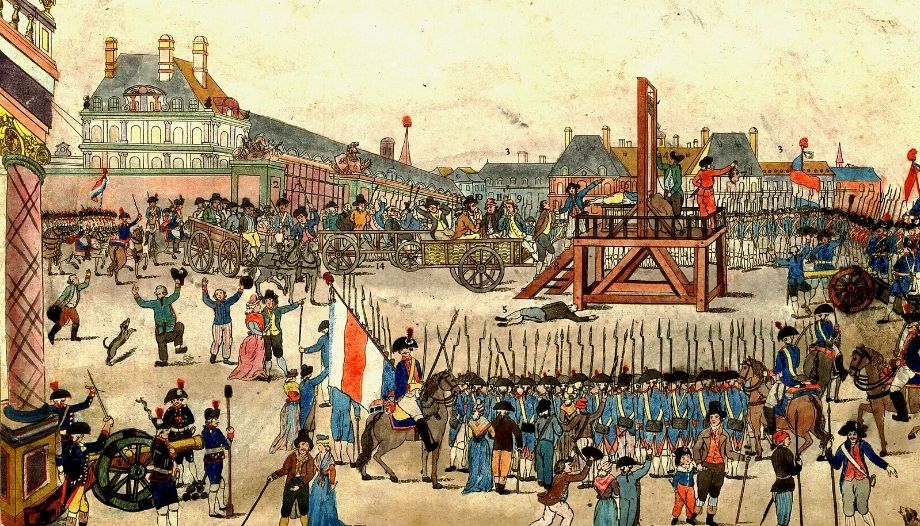
Days after his election to the papacy, Pope Leo shared a quote from St. Augustine, when he spoke to members of the media about their service to truth and their role in facilitating conversation about social issues.

2. "The church is made up of all those who are in harmony with their brothers and sisters and that love your neighbor".(Sermon 359, 9) - - -Homily at the Mass of Initiation of the Petrine Ministry, May 18, 2025.

Pope Leo pointed out his great desire for a united church, to become "a leaven for a reconciled world," in his homily for the Mass inaugurating his papacy. There he presented this quote from St. Augustine.

Unity: "In the One, who is Christ, we are one".

In fact, unity has always been a constant concern of mine, as evidenced by the motto I chose for my episcopal ministry: 'In Illo uno unum'. This expression of St. Augustine of Hippo reminds us how we too, though we are many, 'In the One, who is Christ, we are one.'" (Expositions on the Psalms, 127, 3). - -Audience a representatives of other churches and ecclesiastical communities and other religions, May 19, 2025.

The day after his inaugural Mass, Pope Leo met with leaders of other churches, ecclesial communities and other religions to discuss universal brotherhood and interreligious dialogue.

The prayer of the Son of God, which gives us hope in our journey.It also reminds us that one day we will all be one unum (cf. St. Augustine, Sermo super Ps. 127): one in the one Savior, embraced by the eternal love of God". - Jubilee of Families, Children, Grandparents and Elders, June 1, 2025.

Pope Leo concluded his homily for the Jubilee of Families, Children, Grandparents and the Elderly with this quote from St. Augustine. There he pointed to the love and unity of the family in Christ, both today and among those who have gone before us.

'St. Augustine's heartfelt appeal'.

5. "May we be accompanied by the heartfelt appeal of St. Augustine, who said: Love this Church, be in this holy Church, be this Church; love the Good Shepherd, to the Spouse so fairwho deceives no one, who wishes no one to perish. Pray also for the scattered sheepThat they too may come, that they too may recognize him, that they too may love him; that there may be one flock and one shepherd". (Sermon 138, 10) -Discourse Address to the clergy of the Diocese of RomeJune 12, 2025.

Pope Leo's address to the clergy of his diocese on priestly communion, being a living example in his mission field and addressing the challenges of our time, culminated in this appointment.

Belief in God, with the positive values that derive from it, is an immense source of goodness and truth. for the life of individuals and communities. St. Augustine spoke of the need to move from 'amor sui' - selfish, short-sighted and destructive self-love - to 'amor Dei' - a free and generous love, rooted in God and leading to the gift of self." (cf. The City of God, XIV, 28) - Address to the members of the International Inter-Parliamentary Union, June 21, 2025.

In an address to members of the International Inter-Parliamentary Union, a global organization of parliaments with an emphasis on democracy and diplomacy, Pope Leo referred to St. Augustine's understanding of love. And to its application in building the city of God on a fundamental law of charity.

Journey to the heavenly homeland

7. "Every time the Church yields to the temptation of 'sedentarization and ceases to be 'civitas peregrina' - the people of God on pilgrimage to the heavenly homeland - (cf. Augustine, The City of God, Books XIV-XVI), ceases to be "in the world" and becomes "of the world".(cf. Jn 15:19). -Message for World Migrants and Refugees Day 2025July 25, 2025

In this message, Pope Leo noted that migrants and refugees remind the church of their pilgrimage journey to heaven, and that they can be missionaries of the virtue of hope in the countries that welcome them. 

8. "In his commentary on this point of the text, St. Augustine says, in the name of Jesus, 'The crowd presses in, faith touches' (Sermon 243, 2, 2). So it is: every time we perform an act of faith addressed to Jesus, contact is established with Him, and immediately His grace flows out of Him. Sometimes we are not aware of it, but in a secret and real way, grace reaches us and gradually transforms our life from within." - General AudienceJune 25, 2025.

The Pope's Wednesday General Audience catechesis on the healing of the bleeding woman and the resurrection of Jairus' daughter in Mark 5 reflected on the transforming power of the virtue of faith.

'Pathways of the mind to God'.

9. Catholic universities are called to become "pathways of the mind to God", following the apt expression of St. Bonaventure, so that the timely exhortation of St. Augustine may become a reality in us. 

"Behold, brethren, what is in the human soul. It has no light of its own, it has no powers of its own: but all that is good in the soul is virtue and wisdom: but it is not wise of itself, nor strong of itself, nor is it light to itself... There is a certain origin and source of virtue, there is a certain root of wisdom, there is a certain, as it were, yes, it must also be said, region of immutable truth: from it the soul turns away and is darkened, it draws near and is enlightened" (Exposition on Psalm 58, I, 18). - Message to the participants in the 28th General Assembly of the International Federation of Catholic Universities, July 28, 2025.

Pope Leo's message to institutions of Catholic higher education pointed out their role in the formation of intellects in the search for truth and the danger of novel, popular or safe "siren songs" that distract from their mission.

The City of God

10. "In order to find our balance in the current circumstances, especially you as a Catholic legislators and political leaders, I suggest that we can look to the past, to that towering figure of St. Augustine of Hippo. As a leading voice of the Church at the end of the Roman era, witnessed immense upheaval and social disintegration. 

In response, he wrote 'The City of God', a work that offers a vision of hope, a vision of meaning that can still speak to us today". - Address to the International Network of Catholic Legislators, August 23, 2025. 

Pope Leo recommended St. Augustine's book to an international group of Catholic legislators, noting the saint's comparison of the "City of Man" and the "City of God," and what the mentality of each means for the flourishing of society.

—————

Maria Wiering is a senior writer for OSV News.

————–

This article was originally published in OSV News, and can be consulted at here

The authorOSV / Omnes

Evangelization

Martyrdom of St. John the Baptist, heroic witness of the truth

The liturgical memory of the martyrdom of St. John the Baptist, which the Church celebrates on August 29, completes the solemnity of his nativity on June 24. The Baptist dies as a martyr for the truth.

Francisco Otamendi-August 29, 2025-Reading time: 2 minutes

John is a cousin of Jesus, conceived by Elizabeth from her husband Zechariah. His birth takes place about six months before that of Christ, according to the Gospel episode of the Visitation of the Virgin Mary to St. Elizabeth. The date of his death is placed between the year 31 and 32 AD. The general Christian consideration is that the Baptist dies as a martyr of the truth.

"He is not a martyr for the faith - because he is not asked to deny it - but a martyr for the truth. He is a 'just and holy' man condemned to death for his freedom of speech and for being faithful to his command." stated Pope Francis.

"As a true prophet, John bore witness to the truth without compromise." noted Pope Benedict XVI. "He denounced the transgressions of God's commandments, even when the protagonists were the powerful. Thus, when he accused Herod and Herodias of adultery, he paid with his life, crowning with martyrdom his service to Christ, who is truth in person."

The facts

The gospel narrative is well known. Herod had John imprisoned because of Herodias, his brother's wife, whom he had married. "For John said to Herod, 'It is not lawful for you to have your brother's wife'" (Mk 6:18-19). On the occasion of Herod's birthday, Herodias' daughter Salome danced in honor of the king. She pleased Herod and his guests so much that the monarch swore to give her anything she asked for, even half his kingdom. She, after consulting with her mother, asked for the head of John, who was beheaded.

According to the Vatican agency, today's memoir has ancient originsThe relic: dates back to the dedication of a crypt in Sebaste (Samaria), where the head of the Baptist was venerated as early as the middle of the 4th century. In the 12th century, Pope Innocent II had the relic transferred to the church of San Silvestro in Capite in Rome. The celebration of the martyrdom of St. John was already present in France in the 5th century, and in Rome in the following century.

Courageous testimony

Among the considerations that the figure and life of St. John the Baptist can suggest, "we can look especially at his courageous and heroic witness to the truth, which led him to martyrdom", has written on August 26 the Prelate of Opus Dei, Fernando Ocáriz. "I am reminded of the words of St. Josemaría: 'Do not be afraid of the truth, even if the truth brings you death' (The Way, no. 34). 

"Without going to the extreme of martyrdom, love for the truth can bring with it, in some circumstances, inconveniences of various kinds and, at times, very notable ones," the prelate continues. "At the same time, love for the truth about the reality of the world and of oneself sets us free (cf. Jn 8:32); and, radically, the Truth that is Christ sets us free (cf. Jn 14:6). Without freedom we could not love, and without love nothing would be worthwhile".

The Franciscan Directory He underlines: "His disciples picked up the body, buried it and went to tell Jesus about it. In this way, the forerunner of the Lord, as a burning and shining lamp, both in death and in life bore witness to the truth".

The authorFrancisco Otamendi

Evangelization

St. Augustine and the search for God: reality of modern man.

St. Augustine teaches that the human heart, marked by the desire for truth and love, finds rest only in God. His thought offers modern man a guide to order desire, to open himself to interiority and to reach fulfillment in the encounter with the Creator.

Reynaldo Jesús-August 28, 2025-Reading time: 7 minutes

Throughout the history of the Church, it is common for some of the phrases uttered or written by the saints to constitute a high when it comes to approaching his work, and in this case, St. Augustine is no exception. Nevertheless, the same phrase is a synopsis of his whole life, of the incessant search for a "Something" that surpassed him and that he did not understand; of the very particular race of his life to find the Truth, of a turn in the activity that had impassioned him throughout his existence to stop, to let himself be taken over by the One from whom he had wanted to escape, to recognize Him, to contemplate Him, to love Him and to rest in Him.

A vital career that discovers an encounter of the one who loves with the one who allows himself to be loved and summarizes this experience by quoting: "You made us, Lord, for you, and our heart is restless until it rests in you". This phrase condenses the core of Augustinian anthropology: the human being is a seeker of God, and in a world marked by interior fragmentation, existential uncertainty and haste, the thought of the Bishop of Hippo offers keys to understand the human condition and its openness to mystery.

It is interesting that we recognize how important it is in the work of St. Augustine the deep desire of the human heart and its particular vocation to truth and love; in Christian terms, we speak of nothing other than the vocation to the life of Grace, to the life of and with God, with his only Son Jesus Christ who has presented himself as Truth (cf. Jn 14:6) and St. John has recognized in him Love (cf. 1 Jn 4:8).

The personal experience of the Bishop of Hippo is the starting point; he does not limit himself to analyzing the search for meaning, but to assuming it in his testimony of life; we could almost say that the work is dramatized in the fleshIn this way, like him, many people today continue, sometimes without knowing it, to search for meaning in their own lives. To reread St. Augustine is then, a way to enter in contact with someone who has known how to dialogue with classical philosophy, Christian revelation and existential experience, someone who has searched with sincerity. Let us not see his thought as a kind of "Christian archaeology".but as a spiritual pedagogy for today.

The Restless Heart: Augustinian Anthropology

Based on the revelation, the human being has been created by God. in his image and likeness (cf. Gen 1:26), an image that has been wounded by sin and has caused man to enter into a kind of permanent tension in which, although he is called to communion with God, at the same time he experiences his fragility and his trend to seek himself, leaving God aside, and sets out on a path in which it seems that the only objective is to walk alone, without the one who has called him into existence.

– Supernatural concern of the human heart is not simply anxiety or emptiness, but the expression of a radical openness since it is structurally oriented towards a "beyond" itself. For Augustine, the heart symbolizes the center of the person: his intelligence, his will, his memory and his affectivity. This inner unity, however, is disordered if it is not centered on God (cf. Confessions X, 29, 40).

This inner tension is described by St. Augustine as a struggle between two loves: on the one hand, he identifies the self-esteem closed to the Creator or "amor sui usque ad contemptum Dei".and at the other extreme, he discovers the love of God that orders and elevates all things, or "amor Dei usque ad contemptum sui". (cf. St. Augustine, De civitate DeiXIV, 28).

This dialectic is what makes personal life take shape, but also, with it, history and culture. Augustinian anthropology is expanded and a note is discovered that is not eminently philosophical, but existential. To link man's attitude to the Creator by wanting to move away from or to draw near to Him, whether he closes himself to His action or identifies Him as the foundation of everything through love, is to offer an anthropology in a theological key. Man is a pilgrim, not a nomad; he has an origin and a destination; and the restlessness that inhabits him is not resolved by possessions or knowledge, but by the presence of the living God.

For Augustine, desire (desiderium), is not a defect to be suppressed, but a force to be ordered and purified; for him, desire is an imprint of the Creator in the creature, and therefore, what God has sown in man is the yearning for the infinite. Thus, every search for beauty, truth and goodness is, at bottom, a search for God, even if it is not always recognized as such. St. Augustine affirms that "everyone wants to be happy" (De beata vita, I, 4), but in this search for happiness, not a few get lost looking for it where it is not. The true drama of the human being consists in absolutizing temporal goods, which in reality replace the Supreme Good. In this sense, conversion is the redirection of desire: to stop loving oneself disorderly (love sui) and learning to love God for Himself (amor Dei).

The yearning of the heart and desire as a deep longing within man are not detached from the anthropological identity itself, they go hand in hand, they are united because desire well understood is a way to reach the truth, that force that impels the search for what fills life, the person and existence. This process, which is not limited only to the intellectual aspect, involves a transformation of the heart, a form of pedagogy of desire transversal to the gracethe prayer and the opening to the truth.

In Augustinian logic, to educate desire is to direct it to its source, not to repress it, but to broaden it since, as Pope Benedict XVI affirmed: "in the heart of every man is inscribed the desire for God" (Spe salvi27); in fact, we can affirm that today's man is no different from yesterday's man in his deepest thirst. Languages and technologies change, but not the cry of the heart: 'I want to live for something greater than myself', and that 'greater' is always God".

Interiority as a path to God

Pope Benedict XVI seems to paraphrase what St. Augustine said centuries ago when he reflected on man, insisting on a return within, to oneself, and there, in the interior of our life, we can find the essence of all reality, Truth itself. St. Augustine said: "Do not go outside, go back to yourself; within man dwells the truth" (De vera religione, 39,72). This call to interiority remains current in a culture saturated with noise, images and superficiality, where there is a risk of losing contact with oneself and, therefore, with God; a reality where selfishness, vainglory, consumerism, well-being, immorality, appearances lacking in sincerity and truth seem to be the order of the day, is, in the final analysis, a world in which there is room for everything and everyone, except for the Divinity.

Augustinian interiority is openness to a presence: God is more within me than I am myself (meo intimate interiorcf. ConfessionsIII,6,11). To find him, man needs silence, listening and truth. The Augustinian itinerary towards God invites us to assume our limits, to remember our wounds and to contemplate mercy. This vision is complemented by his teaching on memory (memory sui), which St. Augustine considers a kind of "inner chamber" where the past resides, as well as the imprint of God. Memory becomes a theological place, a space where the Creator, who has never ceased to accompany his creature, is rediscovered. From this perspective, prayer is not an empty and meaningless petition; on the contrary, prayer enters into the dynamics of relationship, since it is an existential dialogue. It is the space where the desire is purified, the will is ordered and the person is unified. As St. Thomas Aquinas would later say, following St. Augustine: oratio est interpretatio desiderii (St. Thomas Aquinas, Summa Theologiae, II-II, q. 83, a. 1, ad 2).

The challenges of modern man

Augustine's thought is still profoundly current because it does not start from abstract theories, but from the experience The experience of the human heart is constant, continuous and always new, open to the realities of each time and ready to lead those who desire it to a dynamic of encounter. In a world where many live dispersed, without a stable center or worse, a world where we do not know what is the center or the vital referent that drives our actions, without a clear horizon of meaning, in the midst of all this, the Augustinian vision offers a luminous word.

Today, as in the fourth century, man runs the risk of absolutizing the immediate, of seeking himself without transcendence. Augustinianism invites us to rediscover that the human being can only find himself by going out of himself and opening himself to God. Its message is also profoundly pastoral: it is not only a matter of "thinking of God", but of "loving Him", and letting ourselves be loved by Him and for Him, loving our neighbor, those who surround us, those who are present in our daily lives.

The pedagogy of desire proposed by St. Augustine is a way of evangelization: it does not start from the imposition of ideas, but from accompanying the desires of the human heart, helping to discover that, deep down, these desires point to God. In this sense, Christian anthropology, far from repressing freedom, frees it from its false absolutes and is thus capable of reorienting life no longer to having or possessing that which is passing away, but to strive to receive that which lasts until eternity. Consumerism is a passing act, a store of commerce that induces to spend resources -not only economic- on that which does not tend towards eternity. 

Augustinian thought can dialogue fruitfully with psychology, literature and contemporary philosophy. The search for meaning, the experience of suffering, the longing for interior unity and the thirst for truth continue to be, as in the past, places where the Gospel can be incarnated. With the above, the Augustinian proposal is not a theory of the past -I insist-, but a light for the present. Modern man, like the man of any era, is a being who desires, seeks and longs for fullness; and in the midst of so many paths, St. Augustine reminds us that only in God does that restless heart find rest.

To return to Augustine is to rediscover that the Christian faith is not a burden, but a response; a response to the truest desire of the human being and that the search for God is not at odds with freedom, but rather fulfills it, makes the heart burn in a constant search for Love, opening the experience of encounter and with it, that of holiness because it is not the absence of desire that makes us holy, but the purified desire of the Spirit; God wants us with a heart that burns, not with an extinguished heart. Augustine's passion for truth, his intellectual honesty and existential humility continue to inspire those who, in the midst of noise and confusion, listen to the restlessness of their heart and receive the strength not to flee from the world, learning from St. Augustine that the heart, in order to be at peace, must learn to beating to the rhythm of GodIn the end, this is what the search for God consists in, to be with Him, to surrender ourselves to Him, to allow ourselves to be assumed by Him, to live eternally with Him.

The authorReynaldo Jesús

Read more
Vocations

Pope not afraid to raise priestly vocation to children and adolescents

The audience with altar boys became the occasion for Leo XIV to speak about the priestly vocation and to highlight the greatness of this path.

Javier García Herrería-August 28, 2025-Reading time: 2 minutes

Pope Leo XIV received at the Vatican a pilgrimage of altar boys from France. During the meeting, the Pontiff surprised them by the clarity of his message: he encouraged them to be attentive to the possibility that God might call them to the priesthood, without fear of considering their vocation from childhood.

The gesture is significant in a context in which the secularism of certain sectors presses to remove religion from school life, even going so far as to present the transmission of the faith to children as a supposed "abuse of conscience". At the same time, for decades there has been a growing tendency among some Christians to delay baptism so that their children can make their own decisions as adults, and there are many believing parents who avoid offering their children and adolescents a demanding Christian life.

Having a prayer life from a young age

It would seem that by going to Mass on Sundays and going to confession from time to time one is already leading a great Christian life. However, the Pope invited those present to dedicate "time to speak with Jesus in the depths of your heart and to love him more and more. His only desire is to be part of your life, to enlighten it from within, to become your best and most faithful friend. Life becomes beautiful and happy with Jesus. But He waits for her answer. He knocks at the door and waits to enter: "Behold, I stand at the door and knock; if anyone hears my voice and opens the door, I will come in to his house and dine with him and he with me" ( Apocalypse 3, 20). 

The Pope's words showed great enthusiasm as he added: To be "close" to Jesus, He, the Son of God, and to enter into His friendship! What an unexpected destiny! What happiness! What consolation! What hope for the future!".

Only Jesus Christ saves

After explaining that God loves each one of us, he encouraged the young people to have contact and intimacy with him, stressing that Jesus Christ is the only one who can save us, "because only He has the power to do so - He is God Almighty - and because He loves us". The proof that God loved us is that He died on the cross for each one of us. "And the Church, from generation to generation, carefully preserves the memory of the Lord's death and resurrection, to which she bears witness, as her most precious treasure. She preserves it and passes it on by celebrating the Eucharist, which you have the joy and honor of serving. The Eucharist is the treasure of the Church, the treasure of treasures."
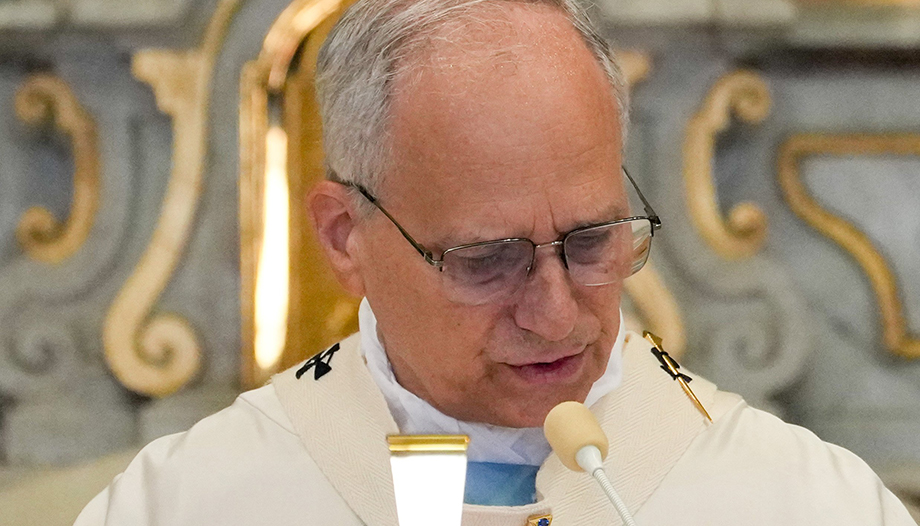
Leo XIV did not seem to be concerned about the enthusiasm of age or the lack of maturity of his listeners to ask themselves the great vocational questions: "Also I hope that you will be attentive to the call of Jesus to follow him more closely in the priesthood. I speak to your consciences of enthusiastic and generous young men, and I will tell you something that you must hear, even if it worries you a little: the lack of priests in France, in the world, is a great shame! A shame for the Church!". 
Before taking his leave, the Pope encouraged the young people to discover the greatness of the priestly vocation: "May they, little by little, Sunday after Sunday, discover the beauty, the happiness and the necessity of such a vocation. What a wonderful life is that of the priest who, at the center of each of his days, encounters Jesus in such an exceptional way and gives him to the world."
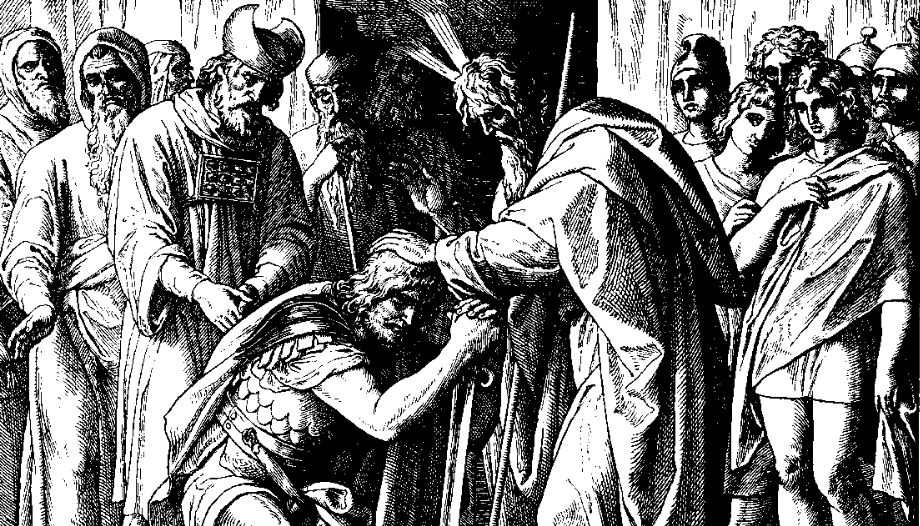
From St. Paul to Jaccob Gapp: saved in hope

The Jubilee of Hope convoked by Pope Francis reminds us that faith needs the constancy of hope to remain firm in the midst of trials.

August 28, 2025-Reading time: 4 minutes

The Jubilee of Hope, convoked by Pope Francis for the year 2025, continues its course. As we know, Jubilees have their origin in the Hebrew tradition and the Church convokes them to grant special graces, among them the possibility of obtaining a plenary indulgence. The Jubilee of the Youth, celebrated in Rome with the participation of Pope Leo XIV in the last days of July, has had a particular resonance.

It is early and, on the other hand, it is not possible to take stock of the spiritual fruits of a Jubilee, but for all Catholics the Jubilee of Hope is an invitation to deepen and live more fully this theological virtue.

Hope in St. Paul

St. Paul writes to the Christians of Rome: "being justified by faith, we have peace with God through our Lord Jesus Christ, through whom also we have access by faith into this grace, in which we stand and rejoice in hope of the glory of God" (Rom 5:1-2). Pope Benedict XVI, in the encyclical Spes salvi of November 30, 2007, teaches that "hope is a central word of biblical faith, to the point that, in many passages, the words faith and hope seem interchangeable. Thus, for example, in this same passage or in the Letter to the Hebrews where its author closely unites 'the fullness of faith' (10:22) with 'the firm confession of hope' (10:23)".

It can be said, therefore, that the virtue of hope requires and enriches the virtue of faith with the quality of constancy, fidelity and permanence. To live the virtue of hope would be, then, to remain firm in faith. Faith needs this fidelity and permanence because, in this life, it is subjected to trials and, on many occasions, to hard tests. The text of St. Paul to the Romans, quoted above, continues: "and not only so, but we also rejoice in tribulations, knowing that tribulation produces patience, and patience proves, and testing gives hope" (Rom 5:3-4).

In turn, this permanence in faith, which is hope, is ultimately sustained by the love of God: "hope," concludes the Apostle, "is not ashamed, because the love of God has been poured out through the Holy Spirit, who has been given to us" (Rom 5:5).

So, we can conclude, we are "saved in hope" (Rom 8:24), but a hope that is completely reliable, thanks to which we can face our present, even if it is tiring. Christian hope is reliable because it leads to a goal, because we can be sure of that goal and because this goal is so great and glorious that it justifies the effort of the journey.

We must live this hope, which is rooted in faith, with the certainty of a personal and profound conviction.

Jaccob Gapp

Jaccob Gapp was an Austrian Marianist priest and educator who was guillotined by the Nazi regime on August 13, 1943 and beatified by St. John Paul II on November 24, 1996. He was arrested by the Nazi authorities when he was in Austria, his superiors transferred him to France and, from there, to Spain, but in November 1942, during an excursion from Spain, he crossed the border into France and was arrested by the Gestapo. A book on his life has just been published in Spanish, entitled "The Gestapo".Everything passes, only heaven remains"The author and editor is Father Emilio Cárdenas.

Jaccob Grapp seems not to have had the "wood of a saint". His character was not very serene, passionate and impulsive, but his letters from prison are a splendid testimony of Christian hope. "Only heaven remains," he writes, or "one must live and express one's (Christian) convictions as stories and not as probabilities," or, finally, "I will not be able to speak to others of my hope until I have made it my own interiorly." Heinrich Himmler, head of the Gestapo, remarked that if the million members of the Nazi party were as committed as Father Gapp, Germany would conquer the world without difficulty.

Faith is "hypostasis".

This certainty is not rooted in a purely subjective conviction. The virtue of Christian hope is not only "every future," but that we already possess, in some way, "something" of the inheritance that awaits us. Benedict XVI comments on this in the encyclical "Spes salvi" number 7, exegeting the text of the Letter to the Hebrews 11:1: "faith is a guarantee of what is hoped for; proof of what is not seen". Faith is "hypostasis" of what is hoped for and proof of what is not seen. The Fathers and theologians of the Middle Ages translate the Greek word "hypostasis" with the Latin term "substance". With faith eternal life begins in us. The expected realities are already in germ in us.

Protestant translations, which have later influenced also some Catholic translations, have reduced this word "hypostasis/substance" to its subjective sense, leaving aside its objective sense. The word "hypostasis" is not only an expression of a pure inner aptitude, as a disposition of the subject, which is true, but does not do full justice to the term "hypostasis/substance". It is not only inner conviction, but also "proof", "proof", "proof". Just think, for example, of the Catholic doctrine on the Eucharist.

During the Jubilee Mass at Tor Vergata, Pope Leo XIV asked young people to "give voice to the hope that the living Jesus gives us, to the ends of the earth". May this request of the Pope be the fruit of the Jubilee 2025.

The authorCelso Morga

Archbishop emeritus of the Diocese of Mérida Badajoz

Read more
Gospel

Human glory and eternal glory. 22nd Sunday in Ordinary Time (C)

Joseph Evans comments on the readings for the 22nd Sunday in Ordinary Time (C) corresponding to August 31, 2025.

Joseph Evans-August 28, 2025-Reading time: 2 minutes

Today's readings have a very clear theme, humility. The key message could be summarized in these words of our Lord: "For everyone who exalts himself shall be humbled; and he who humbles himself shall be exalted.".

We begin by focusing on the behavior of the Pharisees, in whom we see various sins in action. "They spied" to Jesus to engage him. And then we learn that "they chose the first positions".

Their pride is ridiculous, even childish. They begin by trying to detect another's faults, blind to their own, and then seek their own glorification. These sins often come in pairs: proudly blind to our own shortcomings and vainly exalting ourselves, we focus on the shortcomings of others and seek to bring them down.

In reality, Jesus speaks to them on their own level, giving them a uniquely human reason for occupying the lowest seat at a banquet: because the host will see you there and take you to a higher place, for your own (earthly) glory. Whereas if you aspire to the highest place, you might find yourself displaced to the seat below, should someone more important than you arrive, to your shame. Jesus is not encouraging the pursuit of human glory. In fact, he is turning this episode into a parable to tell us about the pursuit of eternal glory.

The deeper lesson is that if we try to exalt ourselves we will sink. Pride brings us down. But by humbling ourselves, by seeking the lowest place, God will lift us up. And what is the lowest place? What is the company we should keep? Who should we invite to our party? Jesus says: "to the poor, the crippled, the lame, and the blind; and you will be blessed, for they cannot repay you; they will repay you at the resurrection of the just.".

We should not serve the poor in the mere hope of one day enjoying heavenly glory in some proud way. That would be a rather twisted way of thinking: "I will accept earthly humiliation so that one day everyone in Heaven will see how great I am.". Our service to the poor should be a necessity of our heart, a joy, a spiritual feast. We want to be with the humble of the world and share their lives. In fact, we are convinced that we deserve no better. This is true humility and humble service, and then, even if we do not seek it, God will exalt us.

The Vatican

Pope appeals for full respect of humanitarian law in the Holy Land

In a Paul VI Hall packed with pilgrims, Pope Leo XIV made a "strong appeal to the parties involved and to the international community" for peace in the Holy Land, and to fully respect humanitarian law. In addition, on the feast of St. Monica, mother of St. Augustine, he proposed "to choose every day to love and to give life freely".  

Francisco Otamendi-August 27, 2025-Reading time: 3 minutes

Pope Leo XIV has joined this morning in the Audience General to the joint statement of the Greek Orthodox and Latin Patriarchates of Jerusalem yesterday. The patriarchs called for an end to this spiral of violence of war, and to give priority to the common good of the people. In the same vein, the Holy Father made a "strong appeal" to the parties involved and to the international community for peace in the Holy Land, with "full respect for humanitarian law".

On August 22, I proposed a Day of fasting and prayer for our brothers and sisters who suffer because of wars, Pope Leo said before giving his blessing. Today "I once again make a strong appeal for an end to the conflict in the Holy Land, which has caused so much terror, destruction and death.

Release of hostages and permanent cease-fire

The Pontiff called for the release of all hostages, and for "a permanent cease-fire that facilitates the safe entry of humanitarian aid, and full respect for humanitarian law". In particular, the obligation of all parties involved to avoid the indiscriminate use of force, as well as forced population movements. 

Let us implore Mary, Queen of Peace, source of consolation and hope, for her intercession, so that she may obtain reconciliation and peace in that land so dear to all of us, he concluded at the end of the Audience.

Theme for the World Day of Peace 2026

Pope Leo's words are completely in tune, as was to be expected, with the theme of the message made public yesterday by the Vatican for the World Day of Peace 2026which will take place on January 1st of next year. In the text, he invites humanity to reject the logic of violence and war, to embrace an authentic peace, based on love and justice. 

"This peace must be unarmed, that is, not based on fear, threat or weapons; and disarming, because it is capable of resolving conflicts, opening hearts and generating trust, empathy and hope. It is not enough to invoke peace, it must be embodied in a lifestyle that rejects all forms of violence, visible or structural."

"The greeting of the Risen Christ, "Peace be with you" (cf. Jn 20:19), is an invitation addressed to all - believers, non-believers, political leaders and citizens - to build the Kingdom of God and to build together a humane and peaceful future", concludes the message made public yesterday.

To love and to give life freely

At today's Audience, the Pope has reflected on the theme "The betrayal. 'Whom seek ye?" (Jn 18:4), the moment when Jesus was arrested in the Garden of Olives.

The Gospel does not show us a fearful Jesus, who flees or hides," the Pope began. "On the contrary, it reveals to us a serene man who gives himself freely, thus manifesting the greatest love. In this gesture is embodied a hope of salvation for our humanity; it is the fact of knowing that, even in the darkest moments, we can be free to love to the end."

Precisely this freedom to love was the leitmotif of the Pope's meditation. "Jesus teaches us that Christian hope is not evasion, but commitment. This attitude is the fruit of deep prayer, in which we ask God for the strength to persevere and remain in love," he said.

He then reminded the Spanish-speaking pilgrims that "today we celebrate the liturgical feast of St. Monica and tomorrow that of her son, St. Augustine". 

"Let us ask the Lord, through the intercession of these dear saints, that we may know - following the logic of the Gospel - how to love and give life freely and gratuitously, as Christ, our hope, did. May God bless them. Thank you very much.

In the darkness of trial, God's love sustains us

In life it is not necessary to have everything under control. "It is enough to choose every day to love freely," he stressed at another time.

"This is true hope: to know that, even in the darkness of trial, God's love sustains us and makes the fruit of eternal life ripen in us."

Looking to Christ with confidence 

In his words to pilgrims of different languages, he referred to the same idea of freedom. For example, to the German-speaking pilgrims: "Let us pray to the Holy Spirit to grant us too, in situations of difficulty and suffering, the trust and inner freedom of Jesus, with which he gave himself to the good will of the Father and gave his life for us".

In closing, he addressed, as usual, "the young, the sick and the newlyweds. Look with unwavering trust to Christ, light in difficulties, support in trials and guide in every moment of human existence".

The authorFrancisco Otamendi

Read more
Education

Friends of Monkole seeks to school children from orphanages in D.R. Congo

The Friends of Monkole Foundation has launched a campaign in Spain to provide schooling this school year to 50 children from two orphanages in the municipality of Mont-Ngafula, in the D.R. of Congo, where there is an unemployment rate of 82 percent and many families live in extreme poverty. 

Editorial Staff Omnes-August 27, 2025-Reading time: 2 minutes

Thousands of children in the Democratic Republic of Congo live in a situation of severe vulnerability and have no access to education. In Kinshasa alone, the capital of the African country, more than 30,000 homeless children live in the streets. In this context, the Friends of Monkole Foundation has launched a campaign in Spain to provide schooling for 50 children from two orphanages in Mont-Ngafula. 

The armed conflict in the east of the country has forced the closure of more than 2,500 schools and learning spaces, leaving more than 1.6 million children out of school.

Enrique Barrio, president of Friends of MonkoleThe schooling of a child for one school year costs approximately 200 euros, including school supplies and uniform," he explains. We want to reach the 50 children (aged 6 to 16) living in orphanages, but we would like to double this figure next year".

Back to school in Kinshasa

In order to achieve this, the foundation has launched a campaign in Migranodearena. The goal is to raise 8,000 euros. Donations can also be made through the solidarity Bizum 03997. 

For this project, the foundation has an established local team, led by Christian Lokwa, who visits the children every month, meets with their teachers and monitors their progress.

Helping more than 150,000 people

Among the objectives are to cover tuition, materials and uniforms, accompany the children during the school year and offer them workshops on hygiene, values, creativity and academic reinforcement.

The Friends of Monkole Foundation, based in Madrid (Spain), was born in 2017 and has the "Donate with Confidence" seal of Fundación Lealtad. Since its inception, it has already helped more than 150,000 people in the Congo, mainly children and women in vulnerable situations. 

Friends of Monkole currently has 13 projects in this African country, many of them through the Monkole Mother and Child Hospital in Kinshasa.

Integral ecology

"Surrogate motherhood is violence" says UN Special Rapporteur

The Casablanca group of experts assesses as a "historic breakthrough" the report of the UN Special Rapporteur, Reem Alsalem, who considers surrogacy as "violence" against women and children. The report will be officially presented to the UN General Assembly in October 2025.

Francisco Otamendi-August 27, 2025-Reading time: 3 minutes

The report of the United Nations Special Rapporteur, Reem Alsalem, was published on August 22 of this year. It describes surrogacy as a practice characterized by exploitation and violence against women and children. 

The document stresses that this practice reinforces patriarchal norms, reduces women to their reproductive roles and exposes children to serious violations of their human rights.

4 recommendations to the States

The Special Rapporteur recommends the following to States, as noted by the so-called Casablanca group, which brings together experts and NGOs from more than 80 countries.

1. The eradication of all forms of surrogacy.

2. The adoption of a binding international treaty banning surrogacy;

3. The prohibition of advertising and surrogacy agencies;

4. Strengthening international cooperation to combat trafficking in women and children related to surrogate motherhood.

Universal abolition

The Casablanca group, in a communiqué dated August 25 in Paris, welcomed the report. It is a confirmation of its work for the universal abolition of surrogacy. It urged States to assume their responsibility by inviting them to act without delay to give concrete expression to these recommendations in their public policies.

The Special Rapporteur's report focuses on human rights violations. Specifically, those occurring in the surrogacy market, she said. Bernard Garciaexecutive director of the Casablanca Declaration.

"Where are you, Mom?" by Olivia Maurel.

"This is an unprecedented recognition at the highest international level: surrogacy is not an act of love, but a form of violence and exploitation. This landmark report shows the way to its global ban," said Olivia Maurel. 

French-American activist Olivia Maurel, a surrogate mother, is a spokesperson for the Casablanca Declaration and the author of the book "Where are you, Mom? This book will be published in Spanish in September 2025.

In an interview with Omnes, Olivia Maurelwho considers herself an atheist and is the mother of three children, said that "surrogacy is a new form of human trafficking".

Maurel also said: "I find it terrible that in a country like France, where surrogacy is forbidden, the media are so intent on promoting 'good stories'. And they never put in front of people who have undergone it or who campaign for its abolition". 

Dignity of women and children

Recently, sources from the technology sector have referred to the study of a possible prototype in China of a gestating robots of babies. The embryo would spend nine months in a machine with artificial amniotic fluid. AI expert Rafael González Aguayo commented on LinkedIn, and to Omnes. "If it is not a fake, it is a mere instrumentalization of the woman, who becomes secondary in the face of motherhood."

Bernad Garcia recalled in April of this year the words of Pope Francis in 2024: "I consider the practice of so-called surrogate motherhood to be deplorable. It gravely offends the dignity of the woman and the child, and is based on the exploitation of the mother's situation of material need. A child is always a gift and never the object of a contract. I therefore call on the international community to commit itself to a universal ban on this practice".

A few days before this speech, the Casablanca executive explained, the Pope had received a letter from Olivia Maurel in which she shared her story. And he invited the Pontiff to support the cause of the universal abolition of surrogacy, promoted by the Casablanca Declaration.

The authorFrancisco Otamendi

The World

The media paradox: the most harassed faith seems to be the most dangerous one

52 people were killed in DR Congo by the Islamist group ADF. The most persecuted faith in the world hardly has a voice in the Western media, while in the public imagination it is presented as a source of violence.

Javier García Herrería-August 26, 2025-Reading time: 2 minutes

Violence is once again hitting the east of the Democratic Republic of Congo. Between August 9 and 16, the territories of Beni and Lubero were the scene of a chain of attacks perpetrated by the Allied Democratic Forces (ADF), a local Islamist group linked to the Islamic State. At least 52 civilians were killed.

The Daesh propaganda agency, Amaq, claimed that 39 of the victims were Christians and celebrated that the militants "burned around 50 Christian houses and confiscated some belongings before fleeing."

The attacks in Congo add to an escalation of violence against Christians that has already left more than 100 people dead so far this year in the region. In July, a Catholic church in Komanda was attacked during a vigil, leaving 35 dead, mostly young people.

Last June, Nigeria was the scene of another tragedy: the massacre of more than 200 Christians in attacks attributed to extremist groups. Despite the magnitude of the horror, the news went almost unnoticed in the general Spanish press, in contrast to the attention received by other tragedies in the West with a smaller number of victims.

A UN day that goes unnoticed

August 22 marked the commemoration of the "International Day of Remembrance for Victims of Acts of Violence Based on Religion or Belief"sponsored by the UN. The day, aimed at condemning terrorist attacks against religious minorities, passed without any echo in public opinion.

On the contrary, for many people religion is a common cause of violence. Authors such as Richard Dawkins have popularized the idea that "religion is the major cause of wars". However, specialized historical studies disprove this idea. The work Encyclopedia of Wars (2004), by Charles Phillips and Alan Axelrod, records 1,763 wars in history, of which only 123 (less than 7%) were motivated by religious reasons, of which only 3% have their origin in Christianity. The famous sociologist Steven Pinker, a regular critic of religion, estimates that only 13% of the worst atrocities in history were related to religion.

Christianity, the most persecuted faith

Worldwide, Christianity is today the most harassed religion. More than 200 million believers live under persecution or severe discrimination. Every day, an average of at least 10 Christians die for their faith, in a reality that, despite its magnitude, hardly generates social alarm in the West compared to other forms of injustice.

Evangelization

Saint Teresa Jornet Ibars, patron saint of the elderly, and Friar Junípero Serra

On August 26, the Church celebrates St. Teresa Jornet Ibars, Spanish nun and founder of the congregation of the Little Sisters of the Elderly Homeless. Junipero Serra, Franciscan evangelizer of California, where he founded and presided over several missions.  

Francisco Otamendi-August 26, 2025-Reading time: 2 minutes

Teresa Jornet Ibars was born on January 9, 1843, in Aytona, Lérida (Spain). The following day she received the sacrament of baptism, and the sacrament of confirmation at the age of 6. She studied teaching and felt called to the contemplative life. In Barbastro she met the priests Pedro Llacera and Saturnino Lopez Novoa, and saw the project to which God was calling her. Surrendering her life as a religious sister to the service of the elderly in need

He received the definitive approval of the Constitutions a few days before his death in August 1897. At that time he said: "Take care of the elderly with interest and care, have great charity, and observe the Constitutions; in this lies your sanctification". She died in Liria (Valencia) on August 26, 1897. She was beatified by Pius XII on April 27, 1958 and canonized on January 27, 1974 by St. Paul VI. 

The Roman Martyrology The following is collected: "In Liria, Spain, saint Teresa de Jesús Jornet Ibars, virgin, who, to help the elderly, founded the Institute of the Little Sisters of the Elderly Forsaken (1897)".

California Evangelist

Fray Junípero Serra (1713-1784) is the only Spaniard with a statue in the Capitol in Washington. Pope Francis inscribed him in the catalog of saints in 2015, after he was beatified by St. John Paul II in 1988. Sufficient data to clear the good name of this illustrious Spanish friar against any activism or ignorance alien to the historical truth. Thus wrote Friar Antonio Arevalo Sanchez, OFM, in Omnes

Fray Junípero -under the motto 'Always forward, never back' - dedicated his intelligence and energy to instill human dignity in the natives of Querétaro and the two Californias. He did this through evangelical doctrine, civilizing progress and an exemplary life of patience, humility, poverty and enormous sacrifices, Fray Arevalo pointed out.

The authorFrancisco Otamendi

Resources

"A very human and very divine air": the secret of the rebirth of Spanish-language Christian music

Christian music in Spanish has grown exponentially thanks to its ability to connect the human and the divine, driven by artists who integrate their spirituality into songs and festivals that bring together thousands of young people in an atmosphere of faith and beauty. This global phenomenon reflects a thirst for transcendence that goes beyond genres and borders.

Luis Sierra-August 26, 2025-Reading time: 3 minutes

Spanish-speaking Christian music has experienced tremendous growth in recent years. Some of the causes are: the influence of globalization in music consumption, the thirst for God that young people manifest, and the rise of worship spirituality.

While it is true that there is a great deal of momentum in other denominations, non-liturgical Catholic music is not far behind.

Did you expect to find Rosalia singing St. John of the Cross and surpassing 22 million plays on YouTube alone? Did you expect to hear Rigoberta Bandini asking Christ to "teach her to pray" with 3 million plays on Spotify alone?

In the English-speaking world, Justin Bieber has broken new ground by naming his experience with God in his song 'HolyLike the U.S. group Imagine Dragons, which fills stadiums thanking God with Beautiful Things.

However, Íñigo Quintero didn't need to sing in English to become the most listened artist in the world with his song "El País". If you are notin which he creates music from Heaven.

New trends

This is the new trend that music platforms around the world are facing: the spiritual restlessness that artists are explicitly expressing. Their own relationship with God.

Some even dedicate themselves exclusively to non-liturgical Christian music. This is the case of Hakuna Group MusicThe group, linked to the ecclesiastical movement of the same name, has become one of the most listened to in Spain, according to statistics for the last few years. 

Luis Poveda - a priest of Opus Dei better known as Luispo- is the hidden composer behind some of his songs, as well as some of the songs most frequently heard in parishes throughout Spain: Yours are o You said yes are some of them. Also May they all be onein collaboration with Trigo 13. Luispo surpasses the figure of one hundred thousand monthly listeners only on Spotify.

Giving his music "a very human and very divine air" is the secret he reveals when composing hits that take his listeners to the top and serve them to connect with transcendence: "Every word and every chord is born from a lived, prayed experience. Living to be able to sing, with the soul in the flesh, with true lips, full of desires, hopes, battles and scars. And everything backstage, on the intimate and deep stage of the heart, where the great adventures take place, the decisive battles", he wrote.

It is the same set of motions that runs through the music of other established authors such as Jésed or Canto Católico, who have accumulated millions of reproductions of some of their songs uploaded to YouTube.

The swing of the youthful pendulum facing the industry has meant the liberation of some plots that seemed reserved for music produced on the fringes of God.

This reality became evident during the development of the World Youth Day in Lisbon 2023, which was attended by nearly two million young people. Hurricane was one of the most listened hits in Portugal in those days, consecrating the aforementioned group that was also recognized in the edition of the SPERA Awards of the Spanish Episcopal Conference in 2023.

"He who composes expresses with his heart and, when someone speaks to you from the heart, captures your attention and makes you feel that you are part of what he is telling you," said the priest Raúl Tinajero, responsible for this recognition by the Spanish bishops. Other artists who have been recognized have been: AISHA, Nico Montero, Valivan or Ixcís.

Concerts and festivals

This new air has given rise to new encounters and opportunities for many artists. For example, Christian music festivals are proliferating: Resurrection Fest, Fe Festival or the Multifestival Laudato Si stand out among many others, while presenting on their stages some of the most relevant artists of Christian music from all over the world.

They continue to be repeated with success every year and fill auditoriums as special as the amphitheater of the Rambla de Almeria or the very WiZink Center in Madrid.

There are many countries -almost all of Latin America, Africa, Oceania- that are giving great importance and strength to the new evangelization through music," said Marcelo Olima. He has promoted the Multifestival Laudato Si, together with the diocesan priest Antonio Cobo: "Music connects with the fiber of the soul, with the heart of man".

"It enhances that: to live the beauty that we are one family, which is the Church. All the charisms. Even people who are not from the Church. They see that and see a very beautiful atmosphere, with children and young people," Cobo added. Perhaps that is the secret for this music to fill the hearts of those who listen to it with "a very human and very divine air".

The one who discovered it before anyone else was Antonio J. Esteban, announcer of Radio Maria, recently deceased. We end with the memory of this record player who promoted non-liturgical Christian music when nobody was talking about it yet and created -for this purpose- the program Generation hope more than thirty years ago. He was one of the visionaries who knew how to predict the musical movement that today tops charts around the world. A movement that comes from above and continues to grow.

The authorLuis Sierra

Priest of the Diocese of Saragossa