


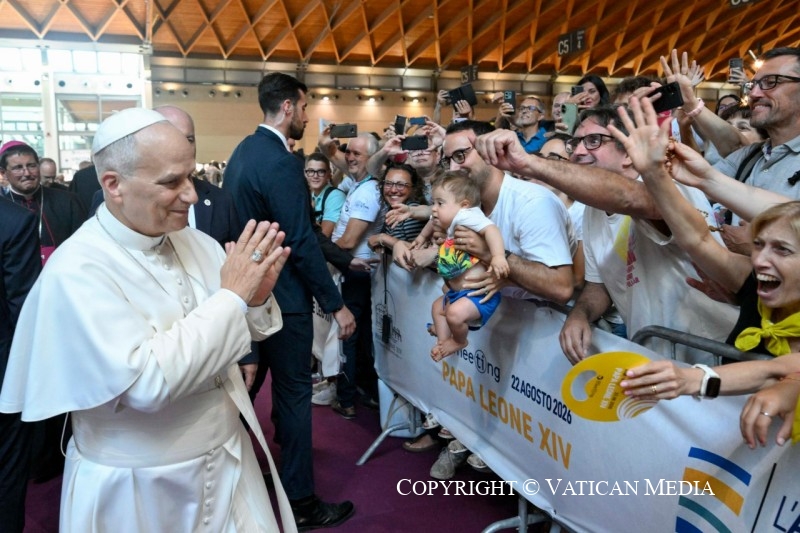
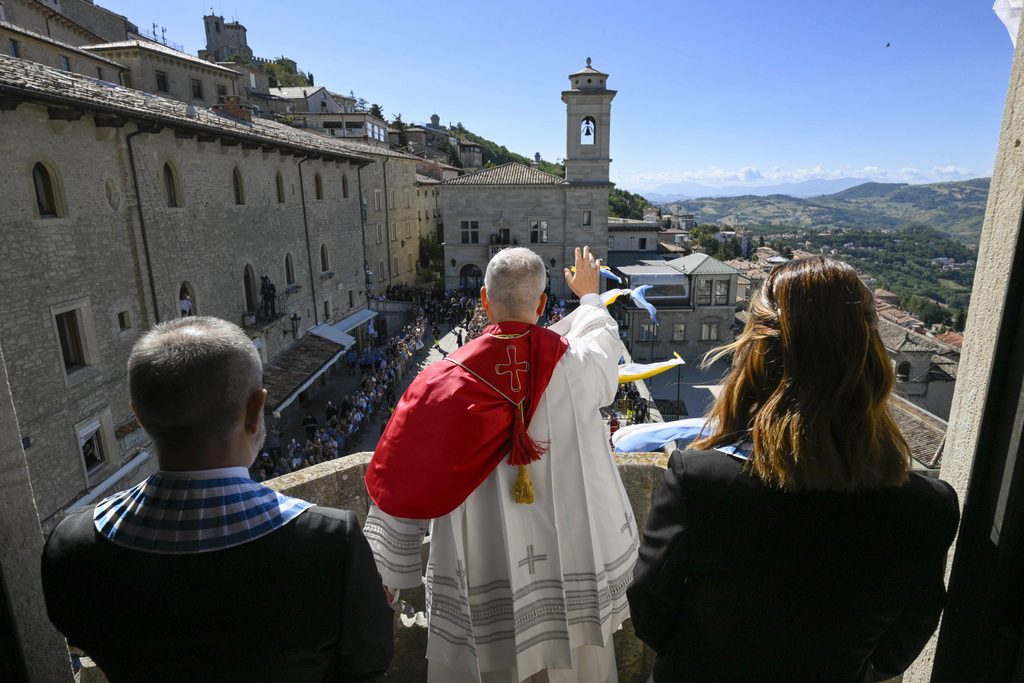
A call to young people to open “a window to infinity,” to pursue the deepest desires of their hearts, and to “embrace their mission” in the world with enthusiasm. A “strong synergy between the family and communities” for an educational covenant, and a call “for communion among parishes, between pastors and the faithful, and among the different charisms and ministries.” The search for “true freedom in Jesus Christ,” the deep connection between freedom and conscience, and the conviction that “all of you are daughters and sons of God, and God loves you,” are some of the messages Pope Leo XIV delivered from the Basilica of San Marino during his pastoral visit to the Republic yesterday, Saturday.
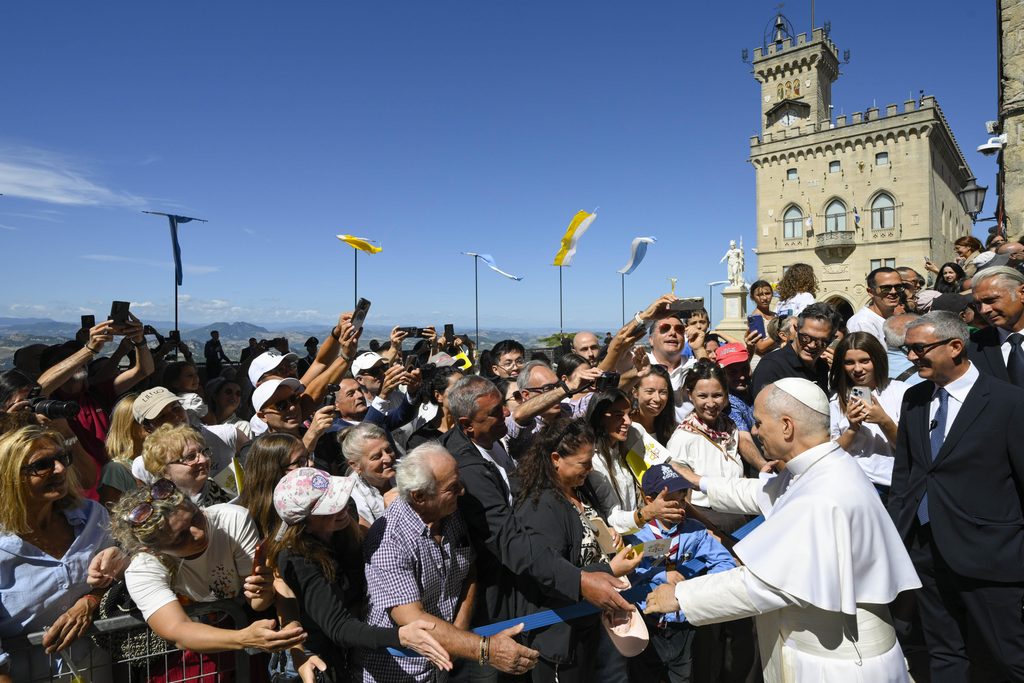
After his address to the church community on the feast of Saint Mary, Queen, the Pope went out into the atrium and greeted the young people and the other faithful gathered in the street, who were also waiting to hear his words—or at least a summary of his address in the basilica.
And that is what the Pope did, without any notes.
Remembering Benedict XVI
Inside, with Bishop Domenico Beneventi and the rector of the Basilica, Marco Mazzanti, The Holy Father had recalled in his Speech, quoting Benedict XVI during his visit to San Marino, that “the Diocese of San Marino-Montefeltro is the heir to a rich history of faith and courage: that of Saints Marino and Leone, who, eighteen centuries ago, through the Christian message, “introduced into the context of this reality […] new perspectives and values, giving rise to a culture and civilization centered on the human person, the image of God” (Benedict XVI, Homily, San Marino, June 19, 2011).
“I address myself first and foremost to young people,” added Leo XIV, drawing on what Pope Benedict XVI told them fifteen years ago: “Do not settle for partial and immediate answers […] that are easier and more comfortable in the moment, which may bring a few moments of happiness or euphoria, but which do not lead to the true joy of living” (Meeting with Young People, June 19, 2011).
Never be afraid, and be generous
Once outside in the atrium, the Pope addressed the young people first and foremost:
“Open the door to your hearts, always listen to Jesus Christ, and never be afraid of what Jesus might say to each one of you. I can say one important thing to you young people: recognize within yourselves the value of life—your life, the life of each one of you—which has been created by God, and your life is of great value to us, to the Church, to your family, and to the whole world.”.
“Believe in what God has created, because you are all daughters and sons of God, and God loves you. Live with that sense of love in your hearts; it will give you everything you need throughout your lives. Be generous, always be open to serving others, and seek to form genuine friendships; through friendship, we can build community.”.
“Don’t be afraid to make difficult decisions”
In the Basilica, Leo XIV had encouraged them in their vocational journey and in their decisions.
“Do not be afraid to make difficult decisions—such as marriage, consecration, ordained ministry, your professional life, and social and political engagement—and prepare yourselves as best you can for the responsibilities that lie ahead. Get involved in initiatives and projects related to charity and justice.”.
Libertas, True Freedom
“Here in San Marino, they have just one word: ”libertas.’ You’ve surely heard it many times,” continued the Vicar of Christ.
“We find true freedom in Jesus Christ; we find it in the truth. In Jesus, who has come to give us life, who has come to help us recognize the truth in a world that is often full of lies and harm,” he said.
“If you have Jesus Christ in your hearts, if you have the truth and the freedom to follow Jesus, do not be afraid of anything, because Jesus walks with you. And Jesus calls all of us; he invites us to walk together. Thank you to all of you; may we truly be one community, always united.”.
Then the cheers and shouts of ‘Papa Leone!’ grew louder, but the Pope had to leave to continue his busy agenda, which began at 8:00 a.m. at the Vatican heliport and ended at the same location at 9:00 p.m.
To promote freedom is to defend the realm of conscience
The Pope had spoken specifically about freedom mid-morning in his Speech to the authorities and civil society.
First, he stated, “I wish to emphasize that there is no true civil liberty without personal liberty—that is, without respect for and the promotion of the dignity of the human person, of which liberty is an essential component. This freedom is ultimately granted and guaranteed by God, whose voice resounds in the conscience of every human being.”.
In addition, Leo XIV emphasized that “promoting freedom means defending the realm of conscience.”.
His thoughts then turned “to the many men and women who, throughout history and across the globe, are martyrs for freedom because they bear witness to the primacy of conscience.”.
In Praise of St. Thomas More and Those Who Do Not Betray Their Conscience
“Firmly grounded in the search for truth, they are fully responsible for their own decisions and, therefore, free from any restriction other than that which is inherent in the creature and which unites them to God. St. Thomas More, patron saint of governments and politicians, is an example of this.”.
Even today, in many parts of the world, the Pope continued, “there is no shortage of people who remain faithful to their conscience even in times of great adversity, bearing witness to true freedom—the freedom that comes from being sons and daughters of God. With admiration, we express our solidarity with those who, at this very moment, are paying a personal price for not betraying their conscience.”.
In Rimini, after 44 years
That afternoon, by helicopter, the destination was Rimini, which had not been visited by a pope for 44 years—since August 1982, when St. John Paul II visited and also stopped at the Rimini Meeting. This is the "Meeting of Friendship Among Peoples," organized by Communion and Liberation and is now in its 47th edition.
Yesterday, Pope Leo XIV held a long-awaited meeting with the participants in the Gathering, and later went to the cathedral in Rimini for another meeting, this time with the sick, the disabled, and the poor assisted by Caritas.
Love: The Theme of This Year's Meeting 2026
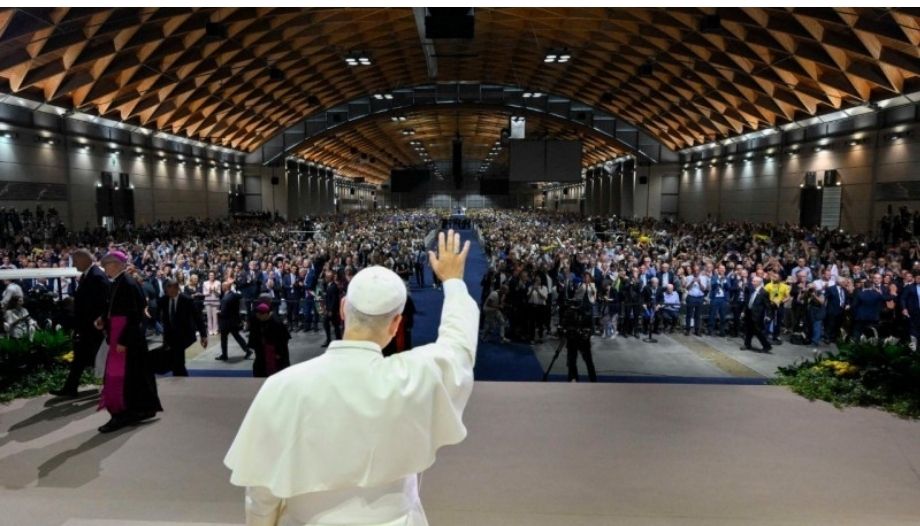
At this year’s Rimini Meeting, organized as usual by the Fraternity of Communion and Liberation (CL), some 60,000 people awaited Pope Leo XIV with great enthusiasm, as seen in the footage from Vatican News. This year’s theme is ‘The love that moves the sun and the other stars,’ the final line of the Divine Comedy—specifically, the “Paradiso”—by the Florentine Dante Alighieri.
In explaining the theme, the organizers note that “there is a force that sets the entire universe in motion, from subatomic particles to galaxies. It is not a force that crushes or dominates, but one that attracts and harmonizes, that propels without violence, that guides without imposing. It is love as the dynamic principle of the cosmos, the energy that holds all things together and propels them toward their fullness.”.
“The loudest applause should go to Jesus Christ”
After the Pope’s tour of the fairgrounds in the popemobile, during which he said informally, “Thank you, thank you! ”The loudest applause should go to Jesus Christ: we are all disciples of Jesus,” Bernhard Scholz, president of the Meeting Foundation for Friendship Among Peoples, and Davide Prosperi, president of CL, expressed to Leon XIV their “immense gratitude and joy” at his presence.
Bernhard Scholz spoke of “the passion for the destiny of every person that Don Luigi Giussani has passed on to us,” and “the trust in the love that moves all things.” Davide Prosperi, for his part, said that “thousands of young people, families, and volunteers had been waiting for this moment for weeks, because their presence here is an enormous, extraordinary gift for our journey. A gift we will never forget and that we welcome as a caress from the Lord.”.
Pope Leo XIV's speech could have been a formal one, even a brief one. However, it lasted 22 minutes and 48 seconds, including interruptions for applause on several occasions. His words were dense, so you can consult here the full text.
“A gathering of friendship!”, “Friendship among peoples!”
The Pope began by quoting St. John Paul II, who, on August 29, 1982, emphasized the special significance of the words “Encounter!”, “Encounter of friendship!”, “Friendship among peoples!”. ”Words that take on special meaning in these often dramatic times in world history” (Address at the Third Meeting on Friendship Among Peoples, Rimini, 1982).
He then praised you for “not having turned the ‘Encounter’ into a kind of enclave: on the contrary, it has become a crossroads for the Church and for society, an encounter that gives rise to many other encounters and inspires new paths.”.
”We give thanks to the Lord for this living legacy, which bestows upon you a great historical responsibility, within the communion of the Church, to serve a humanity that hungers and thirsts for justice.”.
”A Historic Responsibility: The Realism of Mercy in the Face of the False Realism That Rearms"
A task in which “today’s Catholic culture must counter the “realism of mercy”—which holds that enemies cannot exist and that everyone, even adversaries, are brothers and sisters whom we should look in the eye and welcome with sincerity—‘in the face of the false realism that rearms minds, words, and nations.’”.
Sin exists, of course, the Pope noted, “but Christ’s redeeming love is stronger.”.
Then, the words of Leo XIV rang out like a slow, measured cry at the Rimini fairgrounds. He spoke of liberation in precise terms.
“Let us, then, free our coexistence from suspicion, our culture from arrogance, our education from ideology, our work from the idolatry of profit, and our technology and finance from the business of death. Building on the organizations we have created and in which we operate, we will expose the unjust power structures that lie at the root of poverty and inequality, war, and environmental disasters. Let us dismantle technological development when it becomes pervasive and destructive. We need courageous pioneers who, beginning with a change of course in their own actions, will make the transformation we all need convincing and credible.”.
‘Take on the “educational risk” that Fr. Giussani spoke to you about’
And the Pope reached out to Don Giussani, to the young people, and to the Movement.
“Dear friends, the unadorned beauty of this Mystery (the Incarnation) demands that we take on the ‘educational risk’ that Fr. Giussani spoke to you about. He intuited that “the educational method best able to produce good is not one that flees from reality, affirming good in isolation, but one that promotes good in the world.””.
Love moves us, drives us, awakens us from lethargy, inspires new vocations, and calls us to take risks, Leo XIV continued. “Get involved! Open yourselves to true universality, extending your ties beyond any overly narrow affiliations. May the Movement, the groups, and the communities serve as a springboard from which you can immerse yourselves in the fullness of reality. Resist anything that distances you from brothers and sisters of different cultures, sensibilities, and backgrounds—especially the poorest among us. Go out and reach out to everyone!”.
“Always love the Church! Love her and preserve her unity!”
The Vicar of Christ thus made the appeal that drew the most applause from the audience: to always love the Church.
“Dear friends, always love the Church! Love and preserve unity. It is worth repeating: “Always love the Church!”‘ Dear friends, love and preserve the unity of the ’community“ through which Christ has reached you and draws you to himself. As Pope Francis told you on the centennial of your founder’s birth, ”even difficult moments can be moments of grace and renewal.’”.
The Synodal and Missionary Dimension of the Church
Finally, the Successor of Peter affirmed that “in recent years, we have rediscovered the synodal and missionary dimension of our being Church, which calls us above all to learn to listen to one another. (…) It is a path that also requires the renewal of every associative reality and ecclesial movement.”.
I invite you—both within the Communion and Liberation Movement and in the particular Churches to which each of you belongs—to walk this path together: may each of you listen, allow yourselves to be transformed by the faith of others, and, together, under the guidance of our shepherds, develop new perspectives, take new steps, and practice courageous obedience to the Holy Spirit,” the Holy Father encouraged.
“You’ll know how to do it, my dear friends”
Synodality is not the name of a process, but the very nature of a people who, through friendship and encounter with others, feel that they belong to God alone. (…) You will know how to do this, dear friends, by following in the footsteps of your founder, fostering unity among yourselves, with those called to lead the Movement, with the Apostolic See that has recognized you, and with the Successor of Peter. May the Holy Spirit guide us in the practice of communion.”.
León XIV’s eventful visit to Rimini concluded with a concelebrated Mass at the harbor, by the sea, attended by tens of thousands of people. In his homily, among other reflections, he encouraged us to seek rest within ourselves, in the depths of our souls.





 Español
  English
  Italiano
  Français
  Deutsch
  Polski